

TABLE OF CONTENTS
James Cameron’s Avatar sequels 2026 story has entered a very different phase from the one described in the older material about four planned sequels. The original article supplied for this report was written when Avatar 2 was still expected in 2021 and Avatar 3–5 were being discussed as future projects. Much of that information has since become history.
The franchise has now reached its third released feature, Avatar: Fire and Ash, which arrived in cinemas on December 19, 2025. The official Avatar site confirms the film’s release date, its 3-hour-15-minute runtime and its return to Pandora with Jake Sully, Neytiri and the Sully family.
That means the real question for Avatar sequels 2026 coverage is no longer simply when will Avatar 2 arrive? It is: what happens to the franchise after Fire and Ash, and how certain are Avatar 4 and Avatar 5?
1. From the 2009 Record-Breaker to a Global Franchise
The first Avatar changed the commercial and technological expectations surrounding blockbuster cinema.
Its combination of 3D presentation, performance capture, digital environments and large-scale world-building helped establish Pandora as one of the most recognizable fictional worlds in modern entertainment.
The original material supplied by the reader correctly captures the extraordinary commercial importance of the first film. It also shows how unusual Cameron’s development timetable was. At that stage, audiences were being asked to wait years for the next chapter.
That long production cycle ultimately became one of the defining characteristics of the franchise.
Instead of releasing sequels quickly, Cameron and his creative team spent years developing the technology, characters, environments and mythology required for Pandora.
The result was Avatar: The Way of Water, released on December 16, 2022. The official Avatar site records that the sequel became the third-highest-grossing film of all time and set another benchmark for visual effects.
This history matters because the Avatar sequels 2026 discussion cannot be separated from the franchise’s unusually long production model.
2. Avatar: The Way of Water Changed the Story
The Way of Water did more than continue Jake Sully and Neytiri’s story.
It expanded Pandora.
The first film introduced audiences primarily to the forest world of the Omatikaya. The second moved the Sully family toward the ocean-dwelling Metkayina and introduced a substantially larger family narrative.
The official Avatar material describes the film as beginning more than a decade after the events of the first movie and focusing on Jake, Neytiri and their children as they attempt to protect one another.
That expansion created the foundation for the later films.
Instead of treating Pandora as one location, Cameron’s franchise increasingly presents it as an entire ecosystem containing different cultures, environments, creatures and political tensions.
This approach is commercially important because a successful entertainment franchise becomes more valuable when it can generate multiple stories without abandoning its central identity.
That is one of the reasons Avatar sequels 2026 remain such an important entertainment-business topic.
3. Fire and Ash Took Pandora in a Darker Direction
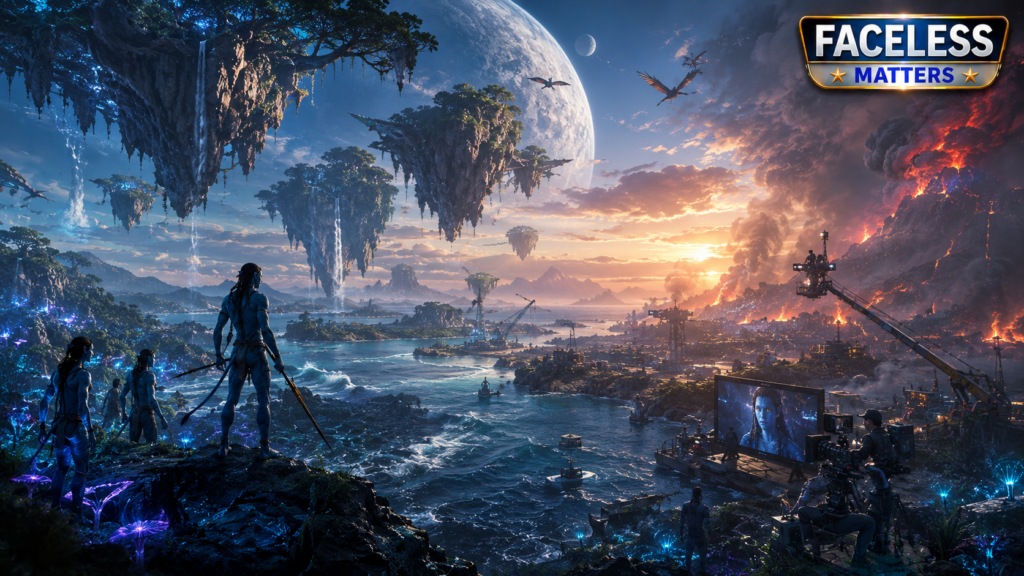
The third film, Avatar: Fire and Ash, changed the visual and thematic landscape again.
The film introduced the Mangkwan, also known as the Ash People, and their leader Varang. The official Avatar material describes the clan as having experienced devastating natural destruction that reshaped its culture and relationship with Eywa.
The film also expanded Pandora’s skies through the Wind Traders, while continuing the story of Jake, Neytiri and their family.
This is significant because Cameron is not simply repeating the visual formula of the first movie.
Each installment has attempted to reveal another side of Pandora.
Forests became oceans.
Oceans expanded into volcanic landscapes.
And future chapters are expected to continue expanding the geography and history of the fictional world.
4. Fire and Ash Has Already Proven the Franchise’s Commercial Strength
One of the biggest changes from the old article is the commercial record of the franchise.
When the original article was written, the discussion centered on the enormous success of the 2009 film and the enormous budgets planned for future installments.
Today, the evidence is much stronger.
Disney announced in January 2026 that Avatar: Fire and Ash had passed the $1 billion global box-office milestone. Disney reported a global total of approximately $1.083 billion at that stage and noted that it became the third film in the franchise to cross $1 billion.
Disney also reported that the three Avatar films had collectively exceeded $6.35 billion in worldwide box-office revenue at that point.
That performance gives the franchise significant commercial credibility.
For Avatar sequels 2026, this is one of the most important facts: the third film did not collapse commercially after the long wait between installments.
Instead, it continued the franchise’s ability to attract audiences to premium theatrical formats.
The changing release schedule makes Avatar sequels 2026 an important topic for fans following the franchise.
5. What Happened to the Original Avatar 2–5 Schedule?
This is where the old source material needs careful updating.
The original article described a plan in which Avatar 2 would arrive in December 2021, followed by annual December releases through Avatar 5 in 2027.
That timetable did not survive.
Avatar: The Way of Water eventually arrived in December 2022.
Avatar: Fire and Ash followed in December 2025.
The remaining two planned films are now associated with much later release dates.
Current release listings put Avatar 4 on December 21, 2029 and Avatar 5 on December 19, 2031, although these dates should be understood as planned dates rather than guarantees.
Therefore, anyone searching for Avatar sequels 2026 should be careful with older articles that still show 2021, 2024, 2026 or 2027 as the relevant release schedule.
Those dates belong to earlier versions of the production plan.
6. Avatar 4 Is Still a Major Long-Term Project
The next major question is Avatar 4.
Current industry listings identify December 21, 2029 as the planned U.S. theatrical date.
However, the project is still far enough away that production schedules can change.
This is especially important because Cameron has recently discussed the possibility that his future role in the franchise may evolve.
Recent reporting says Cameron is considering what portion of his remaining career should be devoted to directing Avatar films versus writing or producing other projects. No final decision means that his involvement should not be described as permanently confirmed in every future creative capacity.
This creates an unusual situation.
The Avatar universe may continue even if Cameron eventually reduces his directorial responsibilities.
That possibility would have been difficult to imagine during the early years of the franchise.
7. Avatar 5 Could Take the Story Even Further
Current listings place Avatar 5 on December 19, 2031.
Very little of the final film’s complete story has been publicly established, so claims about its plot should be treated cautiously.
That uncertainty is actually part of the franchise’s appeal.
Cameron has built a universe with enough characters, cultures and environments to support a long narrative.
The bigger question is whether audiences will still have the same appetite for a film series that began in 2009 by the time the later chapters arrive.
That is an important issue for entertainment business strategy.
A franchise must maintain cultural relevance while also protecting its creative identity.
8. Why Long Production Cycles Are Both a Strength and a Risk
The Avatar model has one enormous advantage: quality control.
Cameron can spend years developing new production techniques, environments and visual effects.
But the same model creates commercial risks.
Technology changes quickly.
Audience habits change.
Streaming platforms become more important.
Short-form entertainment competes for attention.
And production costs can rise substantially.
The entertainment industry increasingly operates around intellectual property, franchise economics, global distribution and streaming engagement.
Avatar sits directly in the middle of those trends.
The franchise is therefore not only a film story.
It is also a major case study in modern entertainment investment.
9. The Technology Behind Avatar Remains Part of the Story
One reason the Avatar franchise continues to command attention is its connection with filmmaking technology.
Cameron has repeatedly pushed performance capture, virtual production, underwater filmmaking and digital environments.
That technological ambition creates a connection between entertainment and the broader media-technology economy.
The visual effects industry, digital production pipelines, computer graphics, animation technology and high-performance computing all contribute to modern blockbuster filmmaking.
This is also where the Avatar story connects naturally with wider technology trends.
FACELESS MATTERS has recently examined the expanding relationship between AI infrastructure, data centers, electricity and digital technology in its analysis of the global AI infrastructure boom.
The underlying lesson is similar: major digital experiences increasingly depend on sophisticated physical infrastructure.
10. The Franchise Is Also a Global Business
Avatar’s commercial strength is not limited to North America.
Disney’s January 2026 report on Fire and Ash highlighted major international markets including China, France, Germany and South Korea.
That international reach is strategically important.
A modern blockbuster can no longer depend solely on domestic box-office performance.
Studios consider:
- international theatrical distribution
- premium-format cinema
- streaming rights
- digital sales
- merchandise
- theme-park opportunities
- licensing
- global marketing
- franchise longevity
Avatar has advantages across many of these areas because Pandora is a globally recognizable entertainment property.
This is why the franchise remains commercially significant even between theatrical releases.
11. What the Old Four-Sequel Article Got Right
The original supplied article was written at a very different moment, but several of its observations remain valuable.
It correctly identified Cameron’s ambition to build a much larger Avatar universe.
It also recognized the importance of returning cast members such as Sam Worthington, Zoe Saldaña, Sigourney Weaver and Stephen Lang.
Most importantly, it understood that the franchise was being designed as a long-term cinematic universe rather than a simple one-off sequel.
That central observation has aged well.
The timetable changed.
The titles changed.
The production process changed.
But the larger strategy survived.
12. What Has Changed Since That Article?
Almost everything surrounding the original schedule has changed.
The expected Avatar 2 date moved from 2021 to 2022.
The third film moved through years of development before finally arriving as Fire and Ash in 2025.
The proposed annual release pattern disappeared.
Avatar 4 and Avatar 5 are now associated with 2029 and 2031.
And Cameron’s own future directorial plans have become a subject of discussion.
Therefore, the best way to understand Avatar sequels 2026 is not to reproduce an old prediction.
It is to compare the original plan with the franchise’s actual development.
That distinction is essential for responsible entertainment reporting.
For audiences tracking Avatar sequels 2026, the difference between old projections and current plans is especially important.
13. Avatar Sequels 2026: What Fans Should Watch Next
For audiences following the franchise, several developments deserve attention.
Avatar 4 production
The next major production milestone will be progress toward the fourth film.
James Cameron’s role
Any confirmed announcement regarding whether Cameron will direct, write or produce future films will be important.
Release-date stability
The 2029 and 2031 dates remain long-term targets and can change.
Box-office performance
The commercial performance of Fire and Ash provides a strong signal, but future films will still have to justify their scale.
Audience interest
The biggest long-term test is whether audiences continue returning to Pandora.
These factors will shape the future of the franchise more than old release calendars.
14. The Entertainment Business Behind Avatar
There is another important lesson.
Avatar demonstrates how valuable intellectual property can become when a studio creates a world rather than simply a character.
A strong fictional universe can support:
films,
streaming content,
music,
books,
merchandise,
theme-park experiences,
games,
licensed products,
and global fan communities.
That makes franchise development a major part of the modern entertainment economy.
For advertisers and businesses, entertainment audiences also create opportunities in digital media, streaming services, premium advertising, consumer products and global brand partnerships.
That is why major film franchises remain commercially important even when a new movie is several years away.
15. FACELESS MATTERS Strategic Assessment
The most important conclusion is that the Avatar franchise has survived the very problem that once appeared most dangerous: time.
The original film arrived in 2009.
The second film came in 2022.
The third arrived in 2025.
Despite those long gaps, the franchise has continued to attract enormous global audiences.
Fire and Ash crossing the $1 billion mark is particularly important evidence that Pandora still has commercial power.
But the future is not guaranteed.
Avatar 4 and Avatar 5 are expensive, technically demanding projects with long production timelines.
Cameron’s evolving career plans add another variable.
The franchise therefore enters its next stage with both enormous strength and genuine uncertainty.
16. Internal Reading — Related FACELESS MATTERS Analysis
1. World News 2026: 4 Major Global Risks to Watch — World News | Recent
This recent FACELESS MATTERS analysis examines how global events, technology, energy and economic risks are becoming increasingly interconnected.
2. The AI Infrastructure Boom: Nvidia, OpenAI and the Global Race for Data Centers, Chips and Power — Business | Medium-Recent
This analysis is relevant to the technology-intensive production environment behind modern digital entertainment and visual effects.
17. Conclusion
The old story about four Avatar sequels was once a report about what James Cameron planned to do.
In 2026, it has become a story about what Cameron and the franchise have actually achieved.
Avatar: The Way of Water arrived after a 13-year wait.
Avatar: Fire and Ash followed in 2025 and passed the $1 billion global box-office milestone.
The remaining films are currently associated with 2029 and 2031 release targets, while Cameron’s future role in directing them remains an important developing question.
For audiences searching Avatar sequels 2026, the key message is therefore simple:
Pandora is not finished — but its next chapter is entering a period where timing, technology, economics and James Cameron’s creative decisions will all matter.
The future of Avatar sequels 2026 will ultimately depend on production plans, audience interest and James Cameron’s creative decisions.
EDUCATIONAL & EDITORIAL NOTE
This FACELESS MATTERS report updates an older entertainment article using current information available on 28 August 2026. Historical claims are distinguished from current developments. Future release dates and production plans can change, and developing reports concerning James Cameron’s future role should not be treated as final unless officially confirmed.
This article is for informational and educational purposes and does not represent an official announcement from Disney, 20th Century Studios, Lightstorm Entertainment or James Cameron.
[…] Avatar Sequels 2026: What Comes After Fire and Ash? […]