

6 September 2026 | Islamabad
TABLE OF CONTENTS
The milestone season premieres on September 6, 2026, with JioHotstar scheduled to stream the show at 9 p.m. Indian Standard Time and Colors TV scheduled to broadcast it at 10:30 p.m. IST. That translates to 8:30 p.m. and 10 p.m. Pakistan Standard Time, respectively, although streaming availability can vary by territory.
The launch is already generating attention beyond the basic question of who enters the house.
Promotional material has emphasized mystery and a new game structure, while reports have highlighted an unusual house design, new contestants and renewed interest around Salman Khan’s return. India Today reported that the new season’s theme is built around duality and that several contestants had been confirmed, while other names remained subject to reporting and speculation.
At the same time, Salman Khan’s pre-premiere appearances have generated their own social-media conversation. Jang reported that the actor shared new photographs after an incident involving paparazzi during the show’s production, adding another layer of attention ahead of the premiere.
But the deeper story is bigger than celebrity buzz.
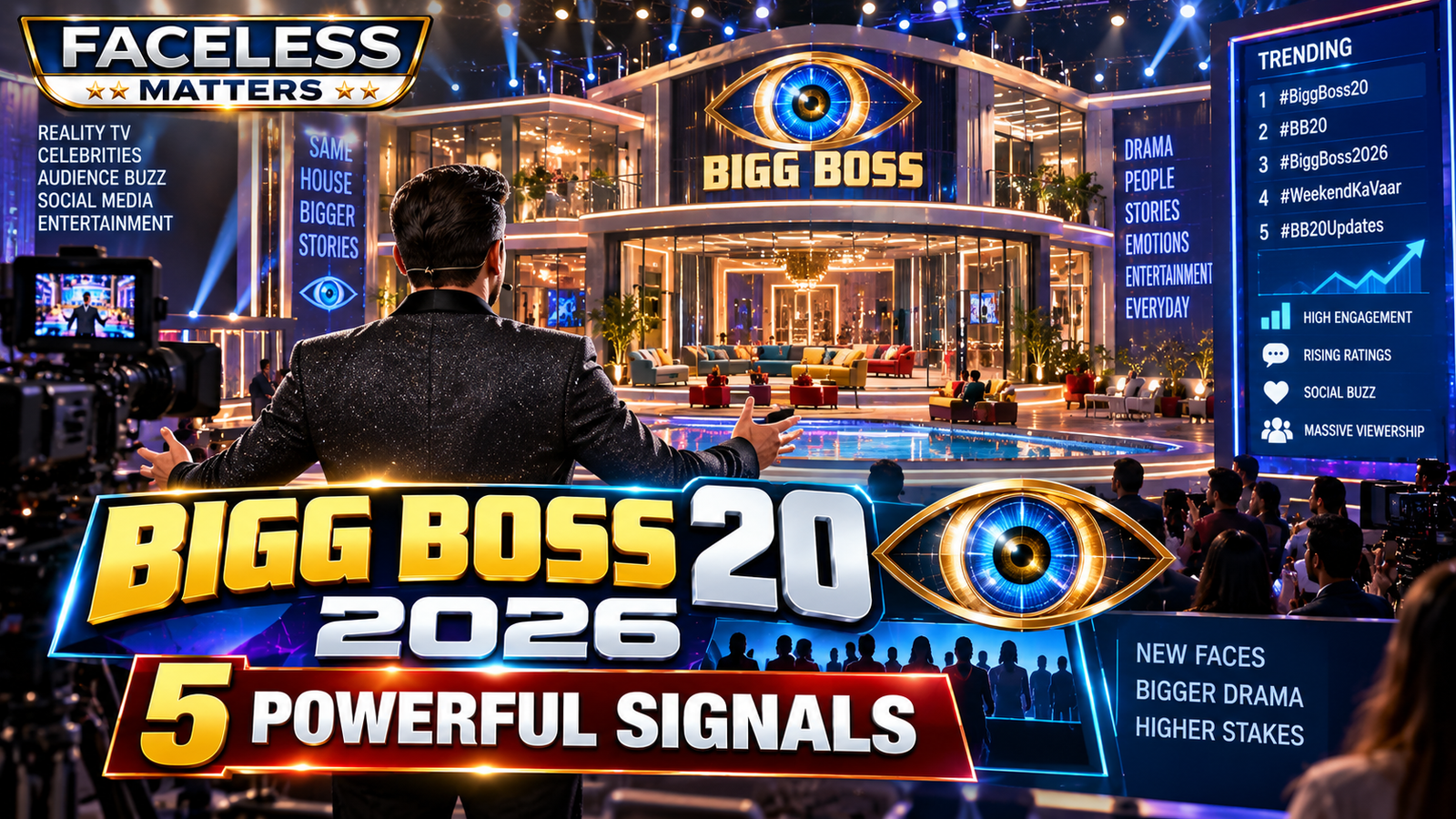
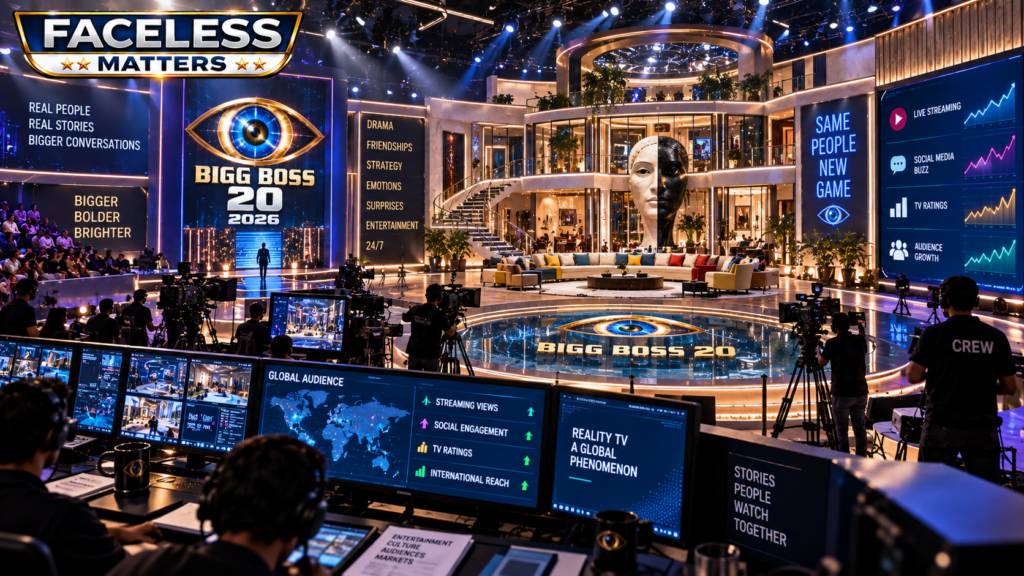
Bigg Boss 20 2026 is a useful case study in how entertainment franchises now compete across television, streaming, social media, celebrity culture and audience participation at the same time.
1. Why Bigg Boss 20 2026 Is Trending Before Premiere
A traditional television show usually has a straightforward marketing cycle.
A trailer appears.
The cast is announced.
The premiere arrives.
Reality television works differently.
The audience can become part of the marketing process before the show even starts.
Rumoured contestants generate discussion. Promotional clips create theories. Host appearances generate headlines. Social-media users debate potential participants. Media outlets publish updates. Fans begin choosing favourites before seeing a full episode.
That cycle creates an unusual advantage.
The program does not need to wait until premiere night to become part of the entertainment conversation.
Bigg Boss 20 2026 has benefited from exactly this dynamic.
The season’s promotional campaign has used mystery as a central theme. India Today reported that the teaser presented a clue-based concept and encouraged viewers to decode what the new season might contain.
This approach transforms promotion into participation.
Instead of simply telling viewers what is coming, the campaign encourages them to speculate about it.
That is valuable in an entertainment market where audience attention is increasingly fragmented.
Signal 1: The Host Remains Part of the Product
Salman Khan’s return is one of the biggest recognizable elements surrounding the new season.
The host is not simply an announcer.
For a long-running reality franchise, the host can become part of the identity of the program itself.
The tone of the weekend episodes, the interaction with contestants, the reactions to major developments and the host’s relationship with viewers can all contribute to the show’s recognizable personality.
That is particularly important for a long-running franchise.
A new cast can change every season.
The house can change.
The rules can change.
The challenges can change.
But a familiar host can provide continuity.
Why continuity matters
Entertainment audiences often respond strongly to familiar formats.
A recognizable host reduces uncertainty.
Viewers know what kind of interaction to expect.
Advertisers understand the audience profile.
Broadcasters know the franchise has established awareness.
Streaming platforms can market the show using an already recognized entertainment property.
This gives the franchise something valuable:
brand memory.
That brand memory is difficult for a new reality show to build from zero.
FACELESS MATTERS Analysis
The importance of Salman Khan in the Bigg Boss ecosystem should not be measured only through celebrity popularity.
His greater value is continuity.
A long-running entertainment franchise needs recognizable anchors because the format itself must evolve without becoming unrecognizable.
The challenge for Bigg Boss 20 2026 is therefore balancing familiarity and novelty. A successful reality franchise must preserve the elements that audiences recognize while introducing enough change to prevent the format from feeling repetitive. That balance can influence viewer retention, social-media discussion and the willingness of audiences to return throughout the season.
If everything remains unchanged, audiences may lose interest.
If everything changes, the program risks losing its identity.
The strongest reality franchises attempt to change the game while keeping enough familiar elements to make the audience feel that it is still watching the same universe.
That balance will be one of the important tests for Bigg Boss 20 2026.
Signal 2: Mystery Has Become a Marketing Strategy
The season’s mystery theme is another important signal.
The first teaser did not simply present a conventional introduction.
It encouraged viewers to look for clues.
That is a sophisticated marketing strategy because it converts passive viewers into participants.
When viewers start discussing possible meanings behind a teaser, the audience effectively creates additional promotional content.
Social-media users produce posts.
YouTube creators produce explanations.
Entertainment websites publish theories.
Fans debate possible twists.
The franchise receives additional visibility without every piece of discussion needing to originate from the broadcaster.
The psychology of the mystery
Mystery works because incomplete information creates curiosity.
A completely revealed format provides information.
A partially revealed format creates questions.
Questions encourage engagement.
Engagement can create repeated visits to social platforms, entertainment websites and streaming applications.
This is particularly useful in an environment where viewers have thousands of alternative entertainment choices.
The competition is no longer simply between one television show and another.
It is between:
- television;
- streaming;
- YouTube;
- short-form video;
- gaming;
- podcasts;
- social media;
- music;
- live events.
Attention has become the scarce resource.
Signal 3: The Reality-TV House Is Now a Visual Brand
The house is another major component of the Bigg Boss experience.
Express Urdu reported that the new house combines modern and imaginative elements, including an Alice in Wonderland-inspired design, a shark-themed swimming pool, an oversized pink teapot-shaped seating element and two secret rooms. The report also said the house includes 104 cameras monitoring contestants around the clock.
These details matter because the house itself has become entertainment content.
A reality-TV house is no longer merely a location.
It is a visual identity.
Viewers recognize its rooms, corridors, confession spaces and outdoor areas.
The design can become part of promotional photography.
It can become part of social-media clips.
It can create memes.
It can generate curiosity before contestants even arrive.
Production design as marketing
Modern entertainment increasingly understands that visual environments can become brands.
The same principle applies to:
- streaming-series worlds;
- theme parks;
- music-tour stages;
- video-game environments;
- reality-TV houses.
A distinctive visual environment gives audiences something immediately recognizable.
That makes it easier for social-media users to create derivative conversations around the original content.
Signal 4: Social Media Extends the Show Beyond Television
The most important change in reality television may not be inside the house.
It may be outside it.
The audience now reacts to reality television almost in real time.
A contestant says something.
A clip appears online.
A reaction becomes a meme.
Fans argue about it.
Influencers discuss it.
Entertainment websites publish stories.
The original television moment then receives a second life across digital platforms.
This creates a powerful feedback loop.
Television → social media → fan reaction → digital media → renewed television attention.
That loop can continue for hours or even days.
Why this matters for entertainment businesses
A television episode has a fixed duration.
Digital conversation does not.
A two-minute moment can become a day’s worth of discussion.
A contestant’s personality can become a digital brand.
A conflict can generate headlines.
A humorous exchange can become a viral clip.
A fashion choice can become a trend.
This makes reality television unusually compatible with social-media culture.
The format produces constant human interaction, and human interaction is naturally shareable.
Signal 5: Streaming Is Changing the Value of Reality TV
Bigg Boss is also part of a broader shift in entertainment distribution.
The show is scheduled to stream on JioHotstar while also appearing on Colors TV.
That means the franchise can potentially reach audiences across different consumption habits.
Some viewers remain television-first.
Others increasingly consume entertainment through streaming applications.
Younger viewers may move between television clips, social media and streaming.
The franchise therefore becomes more than a television program.
It becomes a multi-platform entertainment property.
The advantage of simultaneous distribution
Television provides scale and traditional audience reach.
Streaming can provide digital engagement and convenience.
Social media provides discovery and conversation.
Together, they create a wider ecosystem.
This matters because modern entertainment companies are increasingly interested not only in whether people watch something, but also in how long they remain engaged with the property and how many different platforms they use to interact with it.
Why Contestant Speculation Creates Engagement
One of the strongest features of reality television is uncertainty.
Drama in a scripted series is created by writers.
Drama in reality television is marketed as emerging from human interaction.
That difference changes audience behaviour.
Viewers may begin with favourite contestants.
They may support one participant and criticize another.
They may change their opinion after a confrontation or emotional moment.
That creates a constantly moving audience conversation.
However, there is an important editorial distinction.
Not every reported contestant name should be treated as confirmed.
NDTV Profit noted that several names had been linked to the season while the complete official contestant list had not been publicly announced at the time of its report.
That is why responsible entertainment reporting should distinguish between:
Confirmed
and
Reported / expected / rumoured.
This distinction protects reader trust.
The Economics Behind Reality-TV Attention
Entertainment is ultimately an attention economy.
A successful reality franchise can create value across multiple areas.
Advertising
High audience attention can make advertising inventory more valuable.
Streaming
A popular program can attract users to a streaming platform.
Social media
Viral clips can increase platform visibility.
Celebrity branding
Contestants can build or expand personal brands.
Digital publishing
Entertainment websites can generate large volumes of audience interest around individual episodes and moments.
Sponsorship
Brands can associate themselves with a high-recognition entertainment property.
This creates an important business principle:
The value of a reality show is not necessarily contained inside its broadcast episode.
The larger value can exist across the entire ecosystem.
Bigg Boss 20 2026 and the Creator Economy
Another major change is the increasing overlap between television and the creator economy.
Many entertainment personalities now have their own:
- Instagram audiences;
- YouTube channels;
- short-form video followings;
- podcasts;
- fan communities.
When such personalities enter a reality show, they bring an existing audience with them.
The show can introduce them to new viewers.
At the same time, the contestants can gain additional followers through the show.
This creates a two-way exchange.
The show gets personalities with established audiences.
The personalities receive access to the show’s massive attention ecosystem.
That relationship could become increasingly important for reality television.
What Bigg Boss 20 2026 Means for Pakistani Entertainment Audiences
Although the program is an Indian production, its relevance can extend beyond India because South Asian entertainment audiences increasingly consume the same digital platforms and discuss entertainment across borders.
Pakistan’s entertainment audience already follows Indian cinema, music, television personalities and international streaming content.
However, there is an important distinction between audience interest and local availability.
A program being heavily discussed online does not automatically mean every platform is officially available in every country.
For Pakistani readers, therefore, the most useful question is not simply:
“Is Bigg Boss trending?”
It is:
“Why does this franchise continue to generate such strong regional attention?”
The answer involves celebrity familiarity, reality-TV psychology, social-media participation and a format designed to create continuous conversation.
The Bigger Entertainment Trend
The rise of Bigg Boss 20 2026 reflects a larger transformation in entertainment.
Audiences increasingly expect content to be:
- interactive;
- constantly updated;
- socially shareable;
- visually distinctive;
- available across platforms;
- connected to recognizable personalities.
This is changing how entertainment companies think about content.
A show is no longer necessarily a single product.
It can become a content ecosystem.
That ecosystem can include television episodes, streaming, short clips, interviews, social-media posts, fan communities, merchandise, sponsorships and digital journalism.
Reality television is particularly well suited to this model because its story can evolve every day.
What to Watch After the Premiere
The first episode will answer some questions.
But the more interesting signals will emerge during the following weeks.
1. Audience reaction
Does the new format create genuine enthusiasm?
2. Contestant chemistry
Do the participants generate compelling interactions?
3. Social-media momentum
Do individual moments repeatedly become discussion points?
4. Host engagement
Does Salman Khan continue to function as the franchise’s central anchor?
5. Streaming performance
Does the digital distribution model strengthen the show’s reach?
6. Format innovation
Do the new twists create meaningful entertainment or simply additional noise?
7. Franchise durability
Can the twentieth season still make the format feel fresh?
These indicators will matter more than any single viral clip.
FACELESS MATTERS Strategic Assessment
The most important lesson from Bigg Boss 20 2026 is not simply that reality television remains popular.
It is that entertainment franchises increasingly compete through attention architecture.
The strongest franchises create multiple reasons for audiences to return.
A mystery creates curiosity.
A recognizable host creates familiarity.
Contestants create unpredictability.
A distinctive house creates visual identity.
Streaming creates accessibility.
Social media creates conversation.
Together, these elements form a powerful entertainment ecosystem.
The challenge is that attention can also disappear quickly.
A franchise cannot depend forever on its historical popularity. Bigg Boss 20 2026 therefore needs to create fresh reasons for audiences to remain engaged beyond the opening-week publicity. Sustained attention will depend on contestant chemistry, meaningful format developments, social-media conversation and the ability of the production to keep the audience curious without relying entirely on manufactured controversy.
It must continually create reasons for audiences to care about the current season.
That is the real test facing the twentieth edition.
Final FACELESS MATTERS Assessment
The launch of Bigg Boss 20 2026 demonstrates how far reality television has moved beyond the traditional television model.
The show now exists simultaneously as:
Television + streaming + celebrity culture + social media + audience participation + digital publishing.
That combination explains why a reality show can become a trending topic before its first major episode even airs.
The next stage will depend on execution.
If the mystery creates genuine curiosity, the contestants generate meaningful interactions, the house provides memorable visual moments and the digital ecosystem keeps audiences engaged, the season can become more than another edition of a familiar franchise.
It can become a major case study in how South Asian entertainment is adapting to the multi-platform attention economy.
For viewers, however, the simplest question remains the most important:
Will Bigg Boss 20 deliver enough genuine novelty to justify the enormous attention surrounding its launch?
That answer will emerge over the coming weeks.
INTERNAL LINKS
1. Outer Banks Season 5 Ends the Pogues Era as Netflix Builds a New Kildare Story
Recent | Entertainment: A direct entertainment-category internal link covering the evolution of a major streaming franchise, audience loyalty and the future of entertainment universes.
2. Pakistan SCO Chairmanship 2026–27: 5 Critical Tests After Bishkek
Recent | World News: Adds a cross-category perspective on how digital connectivity, regional audiences and technology increasingly intersect with modern media ecosystems.
3. Pakistan Digital Economy Initiative 2026: Powerful Digital Growth
Older | Technology/Economy: Relevant to the wider digital ecosystem because streaming, creators, platforms and audience engagement increasingly depend on digital infrastructure.
TRUSTED EXTERNAL SOURCES
- Jang English — Salman Khan’s latest Bigg Boss 20 update
- Express Urdu — Bigg Boss 20 house and production details
SOURCE VERIFICATION & FACELESS MATTERS ANALYSIS
The premiere date, broadcast/streaming schedule and broad format information are based on current entertainment reporting from NDTV Profit, Indian Express and India Today.
Contestant information has been treated carefully because some names have been reported as confirmed by individual outlets while other names remain speculative. This article does not present unconfirmed contestant rumours as established fact.
The house-design and production details are based on current reporting from Express Urdu.
The FACELESS MATTERS Analysis and FACELESS MATTERS Strategic Assessment sections are editorial interpretation of the reported entertainment developments. They are not official statements from the show’s producers, broadcaster or streaming platform.
This article is for informational and entertainment purposes and does not constitute investment, financial, legal or professional advice.
For editorial questions, corrections or source concerns: