

اقوامِ متحدہ کی سلامتی کونسل کی ویٹو پاور: اردوان کا مطالبہ اور عالمی اصلاحات کی بحث
23 September 2026
خلاصہ — Key Takeaway
UN Security Council veto power has become the central issue in Erdogan’s latest reform proposal, which calls for abolishing the veto and replacing the current permanent-member structure with an elected, rotating system. His argument is that global decision-making should better reflect the interests of the wider UN membership rather than concentrating decisive authority among five permanent powers.
The proposal goes directly to one of the most difficult questions in international relations: how can the United Nations balance great-power security interests with sovereign equality, democratic representation and effective collective action?
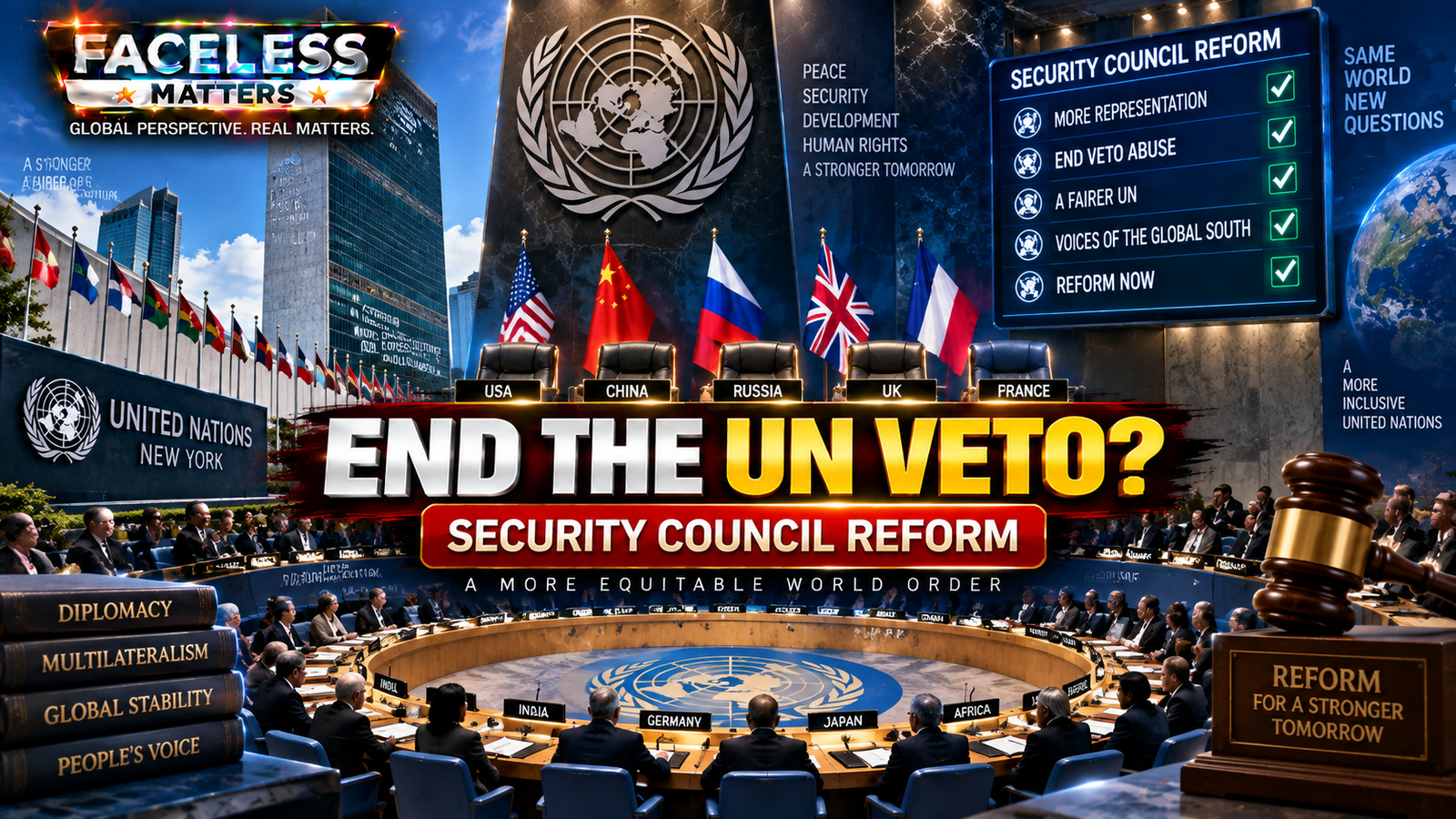
Under the existing UN Charter system, the Security Council has 15 members: five permanent members — China, France, Russia, the United Kingdom and the United States — and 10 members elected by the General Assembly for two-year terms. On substantive matters, nine affirmative votes are required, including the concurring votes of the permanent members. A negative vote by any permanent member blocks adoption of the resolution.
That structure is at the centre of the current reform debate.
The question surrounding UN Security Council veto power is not simply whether it should exist. It is whether the existing system provides sufficient representation, accountability and decision-making capacity for a world that has changed dramatically since the UN was created.
What Did Erdogan Demand?
Erdogan has renewed his long-standing call for fundamental reform of the United Nations Security Council.
In a Bloomberg opinion article, he argued that the international system should move away from permanent membership and veto privileges toward a structure in which Security Council members are elected by the wider UN membership for fixed, rotating terms.
The Turkish proposal is therefore broader than simply adding more permanent members.
According to Jang’s report, Erdogan’s preferred model would make all Security Council members elected and require countries to continue earning the support of the wider membership.
The slogan associated with his position is:
“The world is bigger than five.”
Reuters reported that Erdogan told the UN General Assembly that a system in which the will of more than 190 countries is effectively subject to five countries is neither fair nor capable of fully establishing trust.
That argument places representation at the centre of the debate.
Why the UN Veto Exists
The veto was built into the UN Charter when the United Nations was created after the Second World War.
The five permanent members were given special status because the architects of the post-war international system believed their participation was essential to maintaining international peace and security.
Those five countries are:
- China
- France
- Russia
- United Kingdom
- United States
The Security Council currently has 15 members in total, with the remaining 10 elected by the General Assembly for two-year terms.
The system was designed around the reality of great-power politics at the time.
But the global balance of population, economics, regional influence and political power has changed substantially since 1945.
That gap between the original institutional design and today’s international system is one of the central reasons the debate over UN Security Council veto power and wider reform has continued for years.
How the Current Veto Works
The UN Security Council’s voting rules are set out in Article 27 of the UN Charter.
Each Council member has one vote.
Procedural matters require nine affirmative votes.
For other substantive decisions, nine affirmative votes are required, including the concurring votes of the permanent members. If a permanent member casts a negative vote, the resolution cannot be adopted.
An abstention by a permanent member is different from a veto.
If the required nine affirmative votes are achieved and a permanent member abstains rather than voting against the resolution, the resolution can still pass.
This distinction is important when assessing claims about Security Council deadlock.
The veto is not simply one vote among 15.
UN Security Council veto power is a constitutional feature of the Council that gives each permanent member the ability to block substantive action.
Why Turkey Wants the System Changed
Turkey’s argument focuses on representation, effectiveness and accountability.
In its latest position, Ankara describes the veto as an outdated element of the post-Second World War structure.
Turkey has also argued in formal UN discussions that veto use can limit the Council’s credibility and effectiveness, particularly when the international community faces humanitarian emergencies.
In a UN General Assembly intergovernmental-negotiations statement, Türkiye said the veto should ideally be abolished while also acknowledging that practical measures to restrict its use may be more achievable if permanent members do not agree to surrender the privilege.
This reveals an important distinction.
There are actually two reform debates:
Abolishing veto power entirely
and
Restricting or regulating how veto power is used.
The second option, involving limits on UN Security Council veto power, has attracted support from a number of countries and initiatives even while the first remains politically difficult.
The Argument for Greater Representation
The central reform argument is based on sovereign equality.
The United Nations currently has 193 member states, while only five countries hold permanent Security Council seats with veto authority.
Many countries in Africa, Asia and Latin America have no permanent representation in the Council.
The argument advanced by reform advocates is that a modern international institution should reflect today’s geopolitical, demographic and economic realities.
This is particularly relevant to developing countries.
A country may be directly affected by war, sanctions, refugee flows, energy disruption or food insecurity while having no permanent seat or veto.
That creates a recurring question:
Should the ability to block international action depend on historical great-power status or on a broader principle of equal representation?
There is no universally accepted answer.
But the question of how UN Security Council veto power should operate is increasingly central to the global governance debate.
What Would Change If Veto Power Were Removed?
If the veto were abolished, a substantive Security Council decision could no longer be blocked simply because one permanent member opposed it.
That could make collective decision-making more responsive to majority support inside the Council.
It could also change diplomatic incentives.
Permanent members would need to negotiate more actively with other Council members instead of relying on a unilateral blocking mechanism.
For countries without permanent seats, this could potentially increase the importance of coalition-building and General Assembly diplomacy.
But removing UN Security Council veto power would not automatically make the UN effective.
A Council could still fail to reach nine votes.
Member states could still disagree.
Implementation of resolutions could still be difficult.
Major powers could still resist policies they consider contrary to their national interests.
So abolishing UN Security Council veto power would change the decision-making mechanism, but it would not eliminate geopolitical competition.
Why Abolishing the Veto Would Be Difficult
The most important obstacle is built into the UN Charter itself.
Article 108 states that amendments to the Charter require approval by two-thirds of the General Assembly and ratification by two-thirds of UN members, including all permanent members of the Security Council.
That means a fundamental change to the veto system would require the agreement of the very states that possess veto power.
This creates a structural challenge.
The countries that would lose the privilege must participate in the legal process required to remove it.
That does not make reform impossible in theory, but changing UN Security Council veto power makes comprehensive abolition extraordinarily difficult in practice.
This is why many reform discussions also examine intermediate options.
Russia’s Position
The reform debate does not have a single international consensus.
Russia has publicly taken a position in favor of Security Council expansion while opposing the removal of veto power.
Reuters reported that Kremlin spokesman Dmitry Peskov said Russia supports adding permanent members but considers permanent membership and veto rights important parts of the UN structure.
This creates an important distinction between two reform models.
One model would:
Expand the number of permanent members while retaining veto power.
Another would:
Replace or substantially change permanent membership and veto privileges.
Erdogan’s proposal is closer to the second model.
Russia’s position is closer to the first.
That difference illustrates why reform of UN Security Council veto power has remained difficult.
The General Assembly’s Role
The General Assembly has already become more involved in the debate over veto accountability.
The UN’s “Veto Initiative,” established in 2022, requires the General Assembly to meet when a permanent Security Council member exercises its veto.
This does not remove the veto.
But it creates greater political scrutiny of its use.
The UN General Assembly President has described the initiative as a way to increase accountability around the use of veto power.
This represents an important middle ground.
Rather than immediately changing UN Security Council veto power through the Charter, countries can attempt to strengthen transparency and political accountability around the existing system.
What It Could Mean for Developing Countries
The developing world has a particular interest in Security Council reform.
Countries across Africa, Asia and Latin America frequently face the consequences of decisions involving:
- International security
- Conflict resolution
- Sanctions
- Humanitarian assistance
- Refugee movements
- Energy security
- Food security
- International law
- Peacekeeping
- Global economic stability
Yet representation in the permanent membership structure remains limited.
Erdogan’s proposal explicitly argues that emerging economies and political centres in Asia, Africa and developing regions deserve greater representation.
The debate therefore extends beyond Turkey.
It concerns how global institutions represent countries that have significant populations, economies and regional responsibilities but lack permanent influence over UN Security Council veto power.
Humanitarian Crises and Security Council Action
One of the strongest arguments in the reform debate concerns humanitarian crises.
Supporters of veto restrictions argue that a single permanent member should not be able to block collective action when civilians face mass atrocities or severe humanitarian emergencies.
The UN’s 2026 reform discussions identify growing support among member states for voluntary restraint on veto use in cases involving genocide, crimes against humanity and war crimes.
However, advocates of the existing system can argue that permanent members provide a mechanism for preventing the Council from taking actions that could escalate major-power confrontation.
This is one of the fundamental tensions.
Effectiveness versus great-power consensus.
Removing the veto could increase the ability of the Council to act.
Retaining it can preserve a mechanism through which the most powerful states prevent decisions they regard as unacceptable.
The reform question is therefore also a question about how the international system manages disagreement among major powers.
Global Governance, Trade and Economic Stability
The veto debate is not limited to diplomacy.
Global political instability can affect:
- Oil prices
- Shipping insurance
- Currency markets
- Foreign direct investment
- Supply chains
- Sovereign risk
- Infrastructure investment
- Defence spending
- International trade
When Security Council action is blocked during a crisis, uncertainty can persist.
For businesses and investors, geopolitical uncertainty can translate into higher risk premiums.
For developing countries, prolonged conflict can increase fiscal pressure, food costs, energy costs and external financing needs.
This is why UN reform can also become an economic-security issue.
A more predictable international decision-making system could potentially improve confidence, but reform of UN Security Council veto power by itself would not eliminate geopolitical risk. Investors, governments and humanitarian agencies would still have to respond to wars, sanctions, energy disruptions, shipping risks and competing national interests, meaning institutional reform would remain only one part of a much wider global stability challenge.
Five Questions Behind the Reform Debate
1. Who Should Have the Power to Block?
Should veto authority remain concentrated among five permanent members, or should major decisions depend more heavily on elected representation?
2. Does More Voting Produce More Justice?
A larger role for elected members could increase representation, but voting rules alone cannot guarantee that every decision will be fair or effective.
3. Can Great-Power Security and Equal Representation Coexist?
The original veto system was designed around great-power cooperation.
The reform challenge is finding a structure that preserves international stability while broadening representation.
4. Should Humanitarian Crises Have Special Rules?
One possible reform approach is voluntary or legally structured restraint on veto use in cases involving genocide, crimes against humanity or war crimes.
5. Who Will Agree to Reform?
This may be the hardest question.
Because Charter amendments require ratification by all permanent Security Council members, fundamental veto reform ultimately requires cooperation from the states that currently possess the veto.
What About “One Country, One Vote”?
The idea of greater voting equality is politically powerful because every UN member state already has one vote in the General Assembly.
But the Security Council serves a different function.
It was created as the UN’s principal body for maintaining international peace and security, and its structure deliberately gives permanent members a special role.
That means a reform model based entirely on General Assembly-style voting would represent a major institutional change.
It would need to address not only fairness, but also enforcement, peacekeeping, sanctions, military crises and major-power confrontation.
The debate is therefore more complicated than simply changing five votes into 193 votes.
FACELESS MATTERS Analysis
The latest Erdogan proposal has reopened one of the oldest questions in modern international governance:
Can an institution designed around the power structure of 1945 adequately represent the world of 2026?
The argument for reform is fundamentally about representation and accountability.
The argument for retaining the existing veto is fundamentally linked to the role of major powers in maintaining international security and preventing decisions that could deepen major-power conflict.
Neither side eliminates the underlying problem.
A system based entirely on veto power can face paralysis.
A system based entirely on majority voting could face resistance from the most powerful states whose cooperation may be essential to implementing international decisions.
The most consequential reform debate may therefore be about finding a workable balance.
That could involve several possible approaches:
Full abolition of veto power
Expansion of permanent membership
More elected seats
Voluntary veto restraint
Greater General Assembly scrutiny
Stronger transparency requirements
Special restraint during mass-atrocity situations
These are not identical proposals.
Each would distribute authority differently.
For poorer and weaker states, the core concern is whether international institutions can provide meaningful protection when national power is unequal.
For major powers, the core concern is whether the international system can preserve stability without allowing a coalition to impose decisions that fundamentally threaten their security interests.
That tension is unlikely to disappear.
But the fact that veto reform remains a central topic in the UN’s formal intergovernmental negotiations shows that the issue is not merely rhetorical. The General Assembly continues to conduct negotiations on equitable representation, Council membership and related questions.
The key test is therefore not whether one country wins the argument.
It is whether member states can construct a reform model that is both more representative and institutionally workable.
What Happens Next?
The immediate future of the UN Security Council veto power debate is likely to revolve around several tracks.
Formal UN negotiations
Intergovernmental negotiations on Security Council reform continue in the General Assembly.
Veto accountability
The General Assembly can continue scrutinizing vetoes through the Veto Initiative.
Voluntary restraint
Countries can pursue commitments to limit veto use in cases involving mass atrocities.
Membership reform
States may continue debating whether more countries should receive permanent or longer-term representation.
Great-power positions
The positions of China, France, Russia, the United Kingdom and the United States will remain central to any fundamental change involving UN Security Council veto power.
The current debate therefore represents a process rather than an imminent institutional transformation.
CONCLUSION
The Turkish president’s demand to end UN Security Council veto power has placed one of the most controversial questions in global governance back at the centre of international debate.
The existing system gives five permanent members — China, France, Russia, the United Kingdom and the United States — special veto authority over substantive Security Council decisions.
Erdogan argues that the system should be replaced with a more representative, elected and rotating structure.
Russia, meanwhile, supports Security Council expansion but says permanent membership and veto power remain important to the UN system.
The legal obstacle is equally important: fundamental Charter reform requires ratification by all five permanent members.
The deeper issue is therefore larger than one Turkish proposal.
It is about whether international justice, representation, peace and security can be reconciled with the realities of great-power politics.
For smaller and developing states, stronger representation could provide a greater voice in decisions that directly affect their security and economies.
For major powers, any reform must address concerns about strategic stability.
The future debate will ultimately be measured not by slogans, but by whether the international community can build institutions that are simultaneously representative, accountable, effective and capable of maintaining peace.
INTERNAL READING — FACELESS MATTERS
World News 2026: 4 Major Global Risks to Watch
Pakistan SCO Chairmanship: 5 Critical Tests Ahead
Iran China Security Proposal: 5 Critical Signals
Pezeshkian Saudi Arabia: 5 Key Signals for Regional Peace
AI Agents at the Edge: OpenAI’s RubyGems Incident Raises a Bigger Warning
Pakistan Energy 2026: 5 Critical Signals From Power Costs, LNG and Global Oil Markets
Gutenberg instruction: ہر headline کے نیچے والا standalone URL plain URL ہی رہنے دیں؛ اسی URL کو Gutenberg native WordPress Post Preview/Embed Card میں تبدیل کریں۔ Headline hyperlink اور native card دونوں برقرار رکھیں۔
SOURCES & EDITORIAL NOTE
Daily Jang — Erdogan demands UN veto power abolition in major reform push
اصل خبر اور Erdogan کی proposed elected/rotating Security Council structure: Daily Jang report
Reuters — Turkey’s Erdogan urges UN reform
Erdogan’s UN General Assembly remarks and his criticism of the current five-power structure: Reuters report
United Nations Security Council — Voting System
Article 27، nine-vote requirement اور permanent-member veto کی official explanation: UN Security Council voting rules
United Nations — Security Council Reform
General Assembly کی ongoing intergovernmental negotiations on equitable representation and Council reform: UN Security Council Reform process
United Nations — 2026 Co-Chairs’ Elements Paper
Veto reform، voluntary restraint اور mass-atrocity cases سے متعلق member-state positions: UN reform elements paper
Reuters — Russia’s position on veto reform
Russia’s support for additional permanent members while retaining veto power: Reuters on Russia’s position
Editorial Note: This article distinguishes Erdogan’s proposal, Russia’s position, official UN rules, ongoing reform negotiations and FACELESS MATTERS analysis. The article does not present abolition of veto power as an accomplished or imminent outcome. The potential effects on developing countries, humanitarian action, diplomacy and economic stability are analytical considerations rather than predictions.