

TABLE OF CONTENTS
Pakistan’s debate over administrative reforms has entered a new phase after Planning and Development Minister Ahsan Iqbal proposed a fundamental rethink of the country’s governance structure.
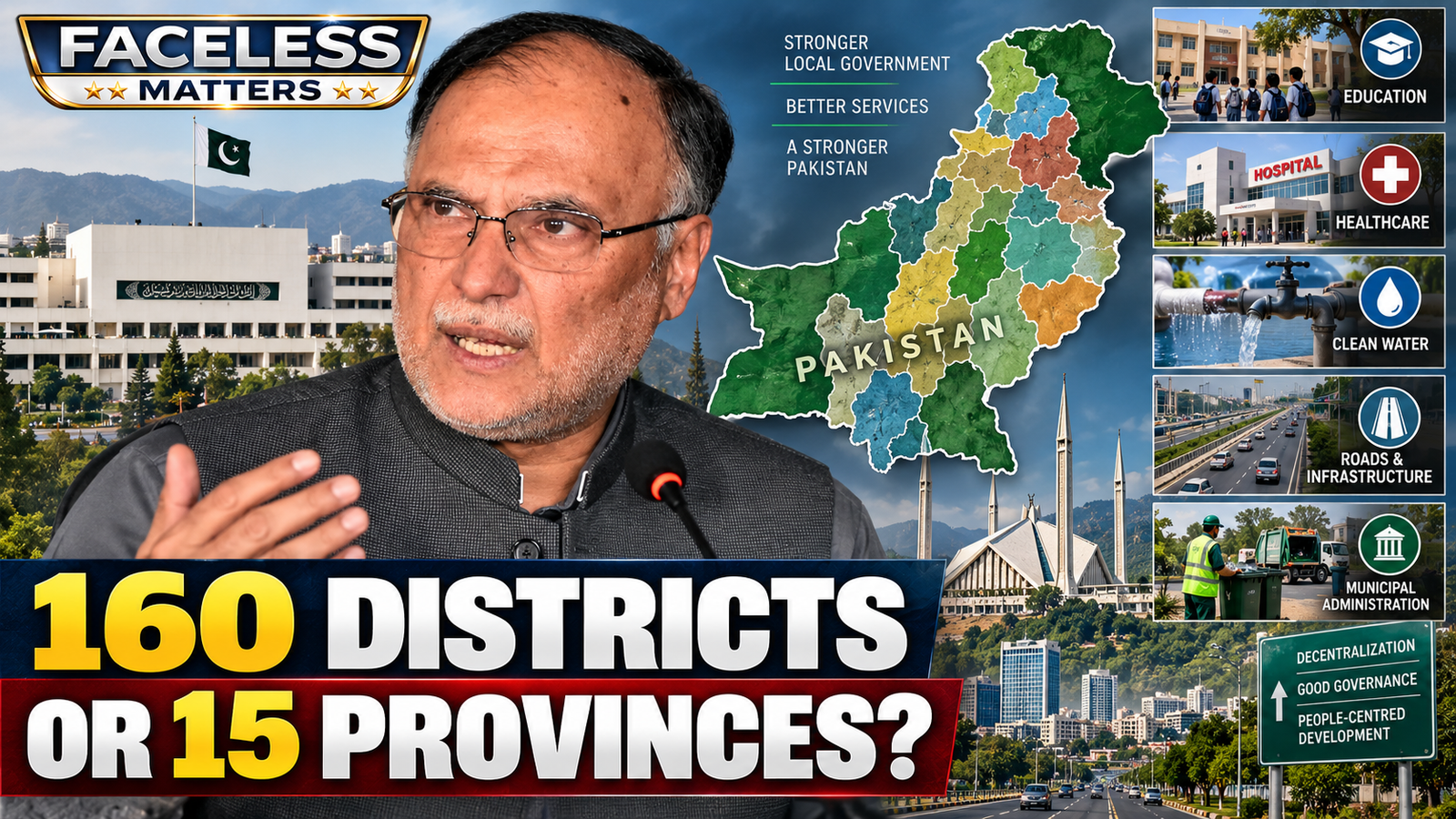
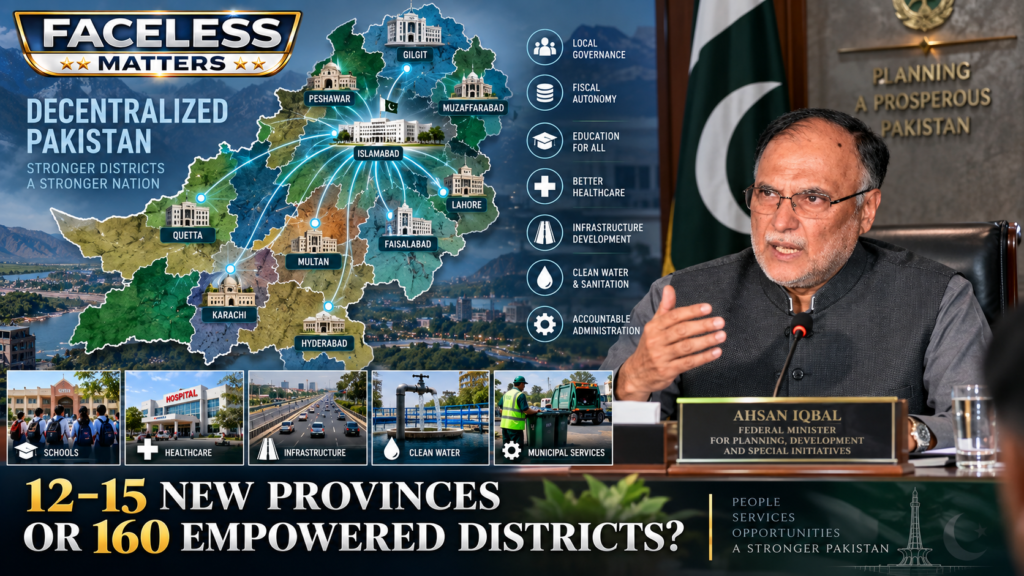
The minister has suggested two broad options: creating 12 to 15 provinces by dividing the existing four provinces into smaller units, or establishing around 160 empowered district governments so that decision-making and public services can move closer to citizens.
The proposal is politically sensitive because Pakistan’s provincial structure is closely connected with constitutional arrangements, political representation, federal revenues, water distribution, bureaucracy and regional identity.
But the issue is also economic.
A governance structure that is too centralized can make service delivery slower and administrative decisions more distant from citizens. At the same time, creating additional provincial governments could require new assemblies, offices, bureaucracies and financial resources.
That creates the central question behind the debate:
Would Pakistan gain more from creating new provinces, or from genuinely empowering the local governments that already exist?
FACELESS MATTERS examines the five most important questions.
What Exactly Has Ahsan Iqbal Proposed?
Ahsan Iqbal has argued that Pakistan’s current four-province structure has become increasingly centralized and is struggling to deliver essential services efficiently across a very large population and geographically diverse territory.
Speaking to The News, he proposed creating 12–15 new provinces, effectively dividing each existing province into roughly three units. However, he also presented empowered district governments as an alternative if there is insufficient political support for creating new provinces.
In another recent explanation of his position, Iqbal argued that it is administratively difficult to manage the entirety of Sindh from Karachi, Punjab from Lahore, Khyber Pakhtunkhwa from Peshawar and Balochistan from Quetta.
His proposed alternative is therefore not simply about changing a map.
It is about moving government closer to citizens.
The distinction is crucial.
A country can create more provinces without necessarily improving hospitals, schools, sanitation, municipal services or local accountability.
Likewise, a country can retain four provinces but potentially improve service delivery through genuinely empowered local governments.
That makes decentralization the real issue underneath the headline.
1. Can 160 Empowered District Governments Fix the Delivery Problem?
The first major question is whether Pakistan actually needs new provinces or simply needs stronger local government.
Iqbal has previously argued that the federal government transferred 17 subjects to provinces in 2010, but provinces did not similarly transfer powers to local governments. He has linked this gap to weak service delivery and an underdeveloped third tier of governance.
Under this argument, the fundamental problem is not necessarily the number of provinces.
It is where administrative, financial and political authority sits.
An empowered district government could theoretically control more local functions, budgets and development priorities.
Instead of a major decision moving through several layers of bureaucracy, a district administration could potentially respond more directly to local requirements.
For example, one district may need:
- better water infrastructure;
- another may need schools;
- another may require hospitals;
- another may prioritize roads;
- another may need municipal waste management.
A decentralized system could allow these priorities to be addressed according to local conditions rather than through a highly centralized provincial structure.
However, decentralization only works if districts receive genuine authority.
Giving a district government a new title while keeping financial and administrative control at the provincial level would not fundamentally solve the problem.
2. Would 15 Provinces Actually Improve Governance?
This is the most controversial part of the proposal.
Supporters of smaller provinces argue that smaller administrative units can bring government closer to citizens.
There is a logical argument behind this.
A provincial government responsible for a smaller geographic area may find it easier to monitor schools, hospitals, infrastructure and local administration.
Smaller political units could also potentially increase representation.
But smaller does not automatically mean better.
Pakistan’s new provinces would require substantial institutional restructuring.
Each province could require:
- an elected assembly;
- a chief minister;
- ministers and departments;
- administrative secretariats;
- judicial infrastructure;
- public-sector institutions;
- financial arrangements;
- elections;
- and potentially new bureaucratic structures.
That means the cost of governance becomes a central consideration.
Arab News reported on September 4 that economists and business leaders see potential benefits from greater devolution but also warned about the additional administrative cost of creating more provincial structures.
This creates a difficult policy equation:
More provinces may improve accessibility — but they may also increase administrative expenditure.
The question therefore cannot be answered simply by saying that smaller provinces are good or bad.
Pakistan would need evidence showing whether the additional cost produces measurable improvements in service delivery.
3. What Would Happen to Political Representation?
Any serious discussion of new provinces immediately enters constitutional politics.
Ahsan Iqbal has acknowledged that creating new provinces would require an equitable formula for political representation.
This matters particularly in the Senate and other federal institutions.
If one existing province is divided into three, the political representation of the successor units could change.
Iqbal has therefore emphasized that new provinces should not dramatically alter the balance of political representation.
That is easier said than done.
Different regions have different populations, geographic sizes, economic resources and political interests.
For example, a province with a very large population may argue for representation based primarily on population.
A smaller region may argue that equal provincial representation is necessary to protect its political voice.
This means administrative restructuring would require much more than drawing lines on a map.
It would require negotiations over:
population + representation + resources + constitutional powers + political authority.
Without political consensus, even a technically attractive administrative model could face serious resistance.
4. What Happens to Pakistan’s Economy?
The economic question may ultimately determine how realistic the proposal becomes.
Creating additional provinces could generate new administrative costs.
New governments require offices, personnel, institutions, elections and operating budgets.
Pakistan is also operating under significant fiscal constraints.
That means any restructuring proposal needs a credible financial model.
However, there is another side to the argument.
If stronger local governments improve infrastructure, education, healthcare, water management and municipal services, they could potentially support economic productivity.
Better infrastructure can reduce business costs.
Faster public services can improve the investment environment.
More accountable local institutions can potentially make government spending more responsive.
This is where the debate becomes economically interesting.
The question is not simply:
“How much will 15 provinces cost?”
It is:
“What economic value could better governance create, and would that value exceed the additional administrative cost?”
Arab News cited economists who argued that better infrastructure and faster resolution of public problems could eventually benefit economic activity, while also emphasizing the financial burden of additional provincial structures.
This cost-benefit calculation should be central to any future reform commission.
5. Could Local Governments Be the Better Answer?
There is a strong argument that Pakistan could first attempt deeper local-government reform before undertaking a major constitutional restructuring.
The constitutional framework already recognizes local government.
Article 140-A provides for local governments, but the practical question is how much administrative, financial and political authority should actually be transferred downward.
Ahsan Iqbal has argued that this third tier needs to become genuinely functional.
That approach could have several advantages.
Lower constitutional disruption
Empowering existing local structures could potentially require less structural change than creating numerous new provinces.
More direct service delivery
District-level institutions could focus on everyday services affecting citizens directly.
Better accountability
Citizens may find it easier to hold local representatives responsible for visible failures in sanitation, roads, water and municipal services.
More targeted development
Local authorities could theoretically prioritize spending according to local needs.
Potentially lower administrative cost
Strengthening existing institutions may cost less than replicating full provincial structures across 12–15 new units.
However, this model has its own challenge.
Local governments need money.
Without predictable fiscal transfers and genuine authority over spending, decentralization can become symbolic rather than functional.
Pakistan’s Biggest Governance Problem May Be Fiscal Devolution
One of the least discussed parts of the debate is money.
Power without financial resources is limited.
A district government may be given responsibility for schools, hospitals or municipal services, but if it cannot control sufficient revenue or receive predictable transfers, its authority will remain constrained.
This means administrative reform should be connected with:
- fiscal decentralization;
- provincial finance commissions;
- transparent transfers;
- local taxation;
- public procurement;
- auditing;
- performance measurement;
- and accountability.
A serious reform model would therefore need to answer a basic question:
Who pays for local government?
If the answer is unclear, administrative restructuring could create new institutions without creating better governance.
Why Pakistan’s Population Matters
The argument for smaller administrative units is partly driven by the scale of Pakistan’s population and geography.
A very large population governed through only four provinces can create significant administrative concentration.
The News reported that Ahsan Iqbal believes the current structure has become excessively centralized and has affected delivery of social services such as healthcare and education.
But population alone cannot determine whether new provinces are necessary.
Technology has changed government administration.
Digital identification, online payments, remote education, telemedicine, e-governance and digital public services can reduce some of the traditional disadvantages created by geographic distance.
This means Pakistan has two possible modernization paths:
administrative decentralization
and
digital decentralization.
The strongest model could potentially combine both.
The India Comparison: Useful but Limited
Ahsan Iqbal has pointed toward regional comparisons, including India’s larger number of states and Afghanistan’s provincial structure, as part of the argument that Pakistan’s four-province arrangement should be reconsidered.
But comparisons between countries need caution.
Administrative boundaries develop from different historical, constitutional, ethnic, economic and geographic conditions.
India’s state structure cannot simply be copied into Pakistan.
Afghanistan’s governance model is also fundamentally different from Pakistan’s constitutional system.
The useful lesson is not that Pakistan should have exactly the same number of provinces.
The useful lesson is that administrative structures can evolve when population, economic geography and governance requirements change.
Sindh Could Become the Biggest Political Test
The proposal has already generated opposition in Sindh.
Geo News reported that Sindh-based nationalist groups have strongly opposed any attempt to divide the province, while political figures have questioned the proposal.
This is a critical political obstacle.
Administrative boundaries are not merely bureaucratic lines.
For many communities, provincial identity is connected to:
- language;
- culture;
- history;
- political representation;
- economic resources;
- and regional identity.
Therefore, any attempt to divide an existing province could trigger significant political resistance.
This is why Ahsan Iqbal has emphasized political consensus rather than presenting the proposal as an immediate government decision.
No Final Federal Decision Yet
One of the most important facts for readers is that the proposal should not be interpreted as a finalized decision to create 12–15 provinces.
Geo News reported that Prime Minister’s Coordinator Rana Ihsaan Afzal Khan said no federal committee had been formed and that there was no official decision on creating new provinces or administrative units at that point.
Dunya News likewise reported that Iqbal was calling for a committee and national political debate, while stressing that political consensus would be necessary before moving forward.
Therefore, the current development is best understood as a proposal and political debate, not an implemented administrative restructuring.
That distinction is essential for accurate reporting.
What Could Go Right?
If Pakistan handles the debate carefully, several positive outcomes are possible.
Better public services
Smaller and more responsive administrative units could potentially improve delivery of education, healthcare, sanitation and clean water.
Stronger accountability
Citizens could have more direct access to decision-makers.
Faster infrastructure decisions
Local authorities could potentially prioritize projects based on immediate regional requirements.
Greater investment efficiency
Better governance can support the business environment and potentially improve investor confidence.
More balanced development
Economic activity may spread beyond major provincial capitals if secondary cities receive stronger administrative and infrastructure support.
What Could Go Wrong?
The risks are equally important.
Higher administrative expenditure
New provincial institutions could increase recurring government costs.
Political conflict
Boundary changes could intensify disputes between political parties and regional groups.
Resource disputes
Water, land, minerals and federal revenues could become contentious.
Bureaucratic duplication
Creating additional layers of government without eliminating existing inefficiencies could make the system more expensive.
Weak implementation
If political authority is transferred without financial resources, the reforms may fail to produce meaningful improvements.
Elite capture
Decentralization can theoretically bring government closer to citizens, but without transparency and accountability, local elites can capture institutions.
These risks explain why governance reform requires institutional design rather than slogans.
FACELESS MATTERS Analysis: 160 Districts vs 15 Provinces
The strongest part of the current debate is that it has moved beyond the simple question of whether Pakistan should have “more provinces.”
The real question is:
Where should political, administrative and financial power reside?
If the objective is better schools, hospitals, roads, sanitation, water and municipal services, creating a new provincial capital does not automatically achieve that objective.
A new province could simply create another centralized government.
By contrast, genuinely empowered district governments could potentially move authority much closer to citizens.
But district governments also need:
money + authority + professional administration + transparency + elected representation + measurable performance.
Without those elements, 160 districts could simply become 160 administrative labels.
Our assessment is therefore that Pakistan should compare the two models through a transparent economic and governance feasibility study rather than choosing a number first.
The Digital Government Opportunity
There is another dimension that deserves more attention.
Pakistan is simultaneously attempting to expand its digital economy.
Our previous analysis of the Pakistan Digital Economy Initiative 2026 examined technology infrastructure, digital connectivity, IT exports, innovation and digital services as potential drivers of economic development.
That transformation could become highly relevant to administrative reform.
Imagine a district government where:
- business registrations are digital;
- land records are accessible online;
- municipal complaints are tracked digitally;
- tax payments are automated;
- health data is integrated;
- school performance is monitored electronically;
- development projects are publicly tracked.
In such a model, decentralization could become more transparent and measurable.
This is potentially more important than simply increasing the number of provincial capitals.
What Investors Should Watch
For businesses and investors, governance reform matters because administrative efficiency affects operating costs.
Companies care about:
- permits;
- taxation;
- land administration;
- utilities;
- infrastructure;
- security;
- logistics;
- regulatory predictability;
- and dispute resolution.
If governance reforms reduce delays, improve infrastructure and make regulations more predictable, investment conditions could improve.
But if restructuring produces years of political uncertainty, duplicated bureaucracy and disputes over resources, investors could instead become more cautious.
Therefore, the investment impact will depend on implementation quality, not the number of provinces alone.
What This Means for Ordinary Pakistanis
For ordinary citizens, the debate should ultimately be judged through practical outcomes.
Will a child receive a better school?
Will a patient receive faster healthcare?
Will clean water reach more households?
Will waste be collected regularly?
Will roads be repaired faster?
Will citizens be able to hold officials accountable?
If the answer to those questions improves, administrative reform has achieved something meaningful.
If citizens only see new government offices, new titles and higher administrative spending, the reform would have failed its central purpose.
That is the standard Pakistan should use.
Five Questions the Government Must Answer
Before implementing either model, policymakers should publicly answer five questions.
1. What is the total cost?
A transparent five- and ten-year fiscal estimate should be published.
2. Who gets the money?
The distribution of federal and provincial resources must be clearly defined.
3. Who controls local services?
Responsibilities between federal, provincial and district institutions must be unambiguous.
4. How will accountability work?
Auditing, procurement, elections and performance monitoring must be built into the system.
5. How will citizens benefit?
Every reform should include measurable service-delivery targets.
These questions would transform the debate from political rhetoric into policy design.
Ahsan Iqbal’s Proposal: What Happens Next?
The immediate next step appears to be political discussion rather than implementation.
Ahsan Iqbal has called for a committee to examine administrative reforms and initiate a national debate. He has also indicated that political consensus would be necessary for the creation of new provinces.
That means the coming months could be more important than the headline itself.
The debate could develop in several directions:
- A formal reform committee could be established.
- Political parties could negotiate the question of provincial restructuring.
- Existing local-government laws could be reviewed.
- Fiscal-devolution mechanisms could be reconsidered.
- Provinces could face pressure to transfer more authority to districts.
- Opposition from regional political groups could intensify.
The eventual outcome will depend on whether political actors can move from slogans to institutional design.
Final FACELESS MATTERS Strategic Assessment
The renewed debate over Pakistan’s administrative structure is not simply about creating more provinces.
It is about whether the country’s governance system can keep pace with its population, economic needs and public-service expectations.
Ahsan Iqbal has put two options on the table: approximately 160 empowered district governments or 12–15 provinces.
Both models have potential advantages.
Both also carry serious risks.
Creating new provinces could bring administration closer to citizens, but it could also increase costs and trigger disputes over representation and resources.
Empowering district governments could potentially deliver services more directly, but only if districts receive real political and financial authority.
The strongest path may ultimately be a combination of decentralization, fiscal empowerment and digital government.
Pakistan does not necessarily need more government.
It needs more effective government closer to the citizen.
That is the real test behind this debate.
The broader significance of Ahsan Iqbal’s proposal is that Pakistan is now confronting a governance question that cannot be solved through administrative boundaries alone. Any successful reform will need stronger local institutions, predictable funding, digital public services and measurable accountability. Ahsan Iqbal’s proposal therefore opens a wider policy discussion about whether Pakistan should prioritize new provinces, empowered districts, or a combination of both approaches. The final test should remain better services, stronger accountability and more efficient use of public resources.
And until a formal process, constitutional framework and financial feasibility study are established, the proposal should be treated as an important political reform discussion rather than a confirmed decision to redraw Pakistan’s map.
INTERNAL LINKS
- Pakistan SCO Chairmanship 2026–27: 5 Critical Tests After Bishkek — FACELESS MATTERS — Fresh World News analysis examining Pakistan’s regional diplomacy, connectivity, economic cooperation and implementation challenges.
- Pakistan Digital Economy Initiative 2026: Powerful Digital Growth — FACELESS MATTERS — Technology/Economy analysis relevant to digital government, connectivity, innovation and modern public-service delivery.
- Pakistan Debt Repayment 2026: A Major Test of Fiscal Management — FACELESS MATTERS — Earlier Pakistan economy analysis relevant to fiscal space, government spending and the financial feasibility of major reforms.
TRUSTED EXTERNAL SOURCES
- Geo News — Planning minister proposes creation of up to 15 new provinces — current reporting on the proposal and political-consensus requirement.
- Dunya News — Ahsan Iqbal proposes creation of up to 15 new provinces — current reporting on administrative restructuring.
- Express Tribune — Ahsan Iqbal proposes 15 new provinces — detailed background on the 160-district-government alternative and governance structure.
- Arab News Pakistan — Pakistan weighs smaller provinces to improve governance — independent economic and governance analysis of potential benefits and costs.
SOURCE VERIFICATION & FACELESS MATTERS ANALYSIS
The supplied Jang report was used as the original news angle. Current reporting from Geo News and Dunya News confirms that Planning Minister Ahsan Iqbal has proposed 12–15 new provinces and called for a national political debate, while also presenting empowered district governments as an alternative.
The Express Tribune provides additional context on the proposed 160 district governments, Article 140-A, the 2010 devolution of subjects to provinces and the proposed governance model for Islamabad.
Arab News independently examined the economic and administrative implications, including the potential benefits of decentralization and concerns about the cost of replicating provincial structures.
Importantly, current reporting indicates that no final federal decision has been taken to create 12–15 new provinces. The proposal remains subject to political debate and consensus-building.
FACELESS MATTERS analysis in this article distinguishes reported statements from its own assessment of governance, fiscal decentralization, investment implications and digital-government opportunities.
[…] Ahsan Iqbal: 5 Critical Questions Behind Pakistan’s 15-Province Debate […]