

1 October 2026
Key Takeaway
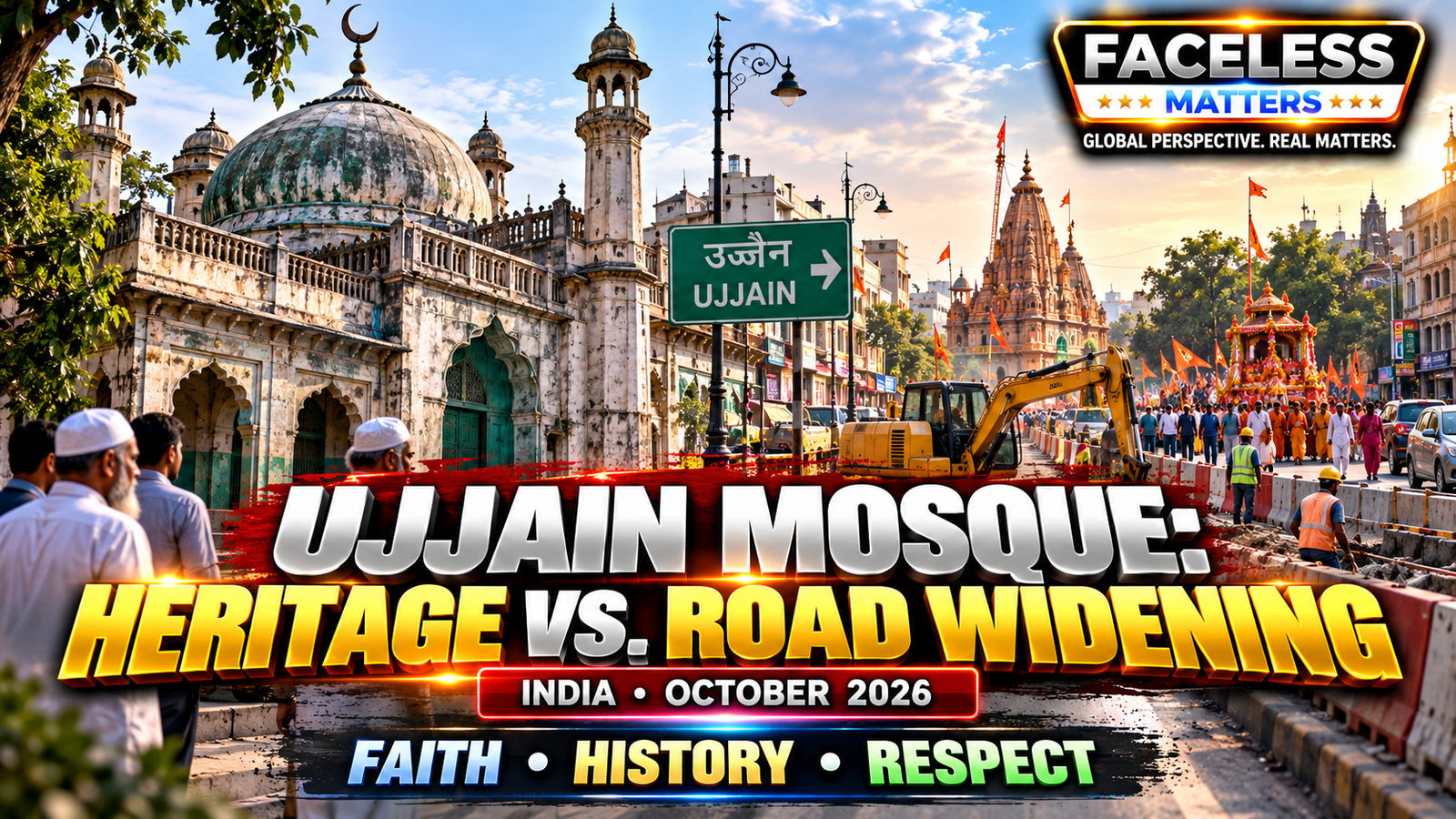
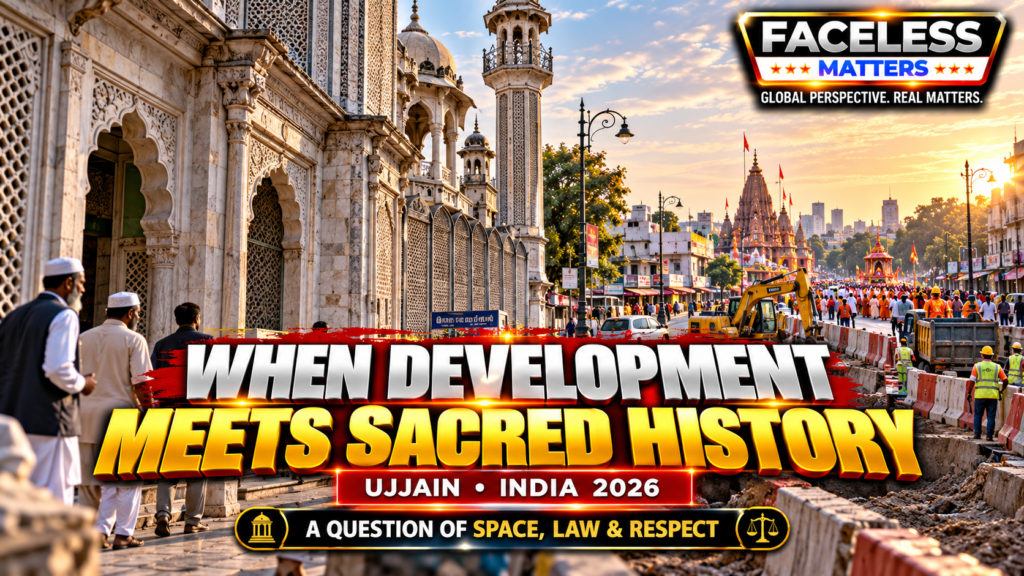
The Ujjain mosque demolition controversy in Madhya Pradesh has brought together three sensitive issues: religious space, historic heritage and road development ahead of the Simhastha Kumbh 2028 pilgrimage.
Recent reporting says a portion of the Shahi Masjid in Ujjain was removed after the Muslim community had opposed the proposed action and feared a larger demolition. Jang reported that part of the mosque was demolished by the community itself, while other reporting says authorities had required the community to remove the portion falling within the proposed road alignment or face administrative action.
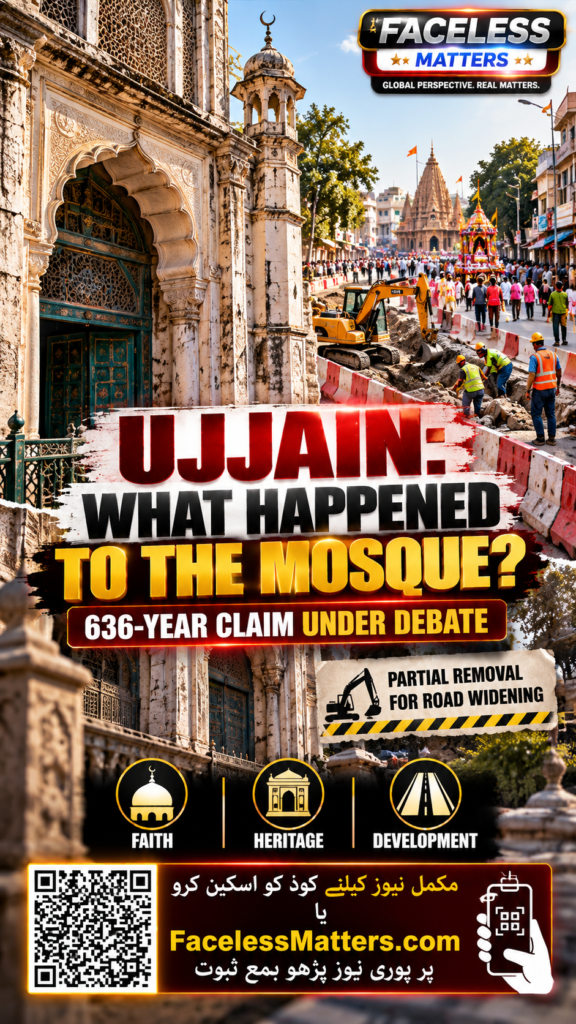
One important fact requires careful qualification: the mosque’s 636-year age is a claim made by its management/community representatives, based on a reported 1390 origin. Available reporting does not independently establish that the present structure dates to 1390.
The Madhya Pradesh High Court had already declined petitions challenging the partial removal, accepting the authorities’ road-widening and public-safety rationale and noting that other religious structures along the road had also been affected.
For FACELESS MATTERS, the deeper question is therefore not whether one community should defeat another. It is whether development, law and public religious life can coexist while preserving maximum respect for places of worship and historical memory.
TABLE OF CONTENTS
کیا ہوا؟ — What Happened in Ujjain?
The latest Ujjain mosque demolition controversy centres on the Shahi Masjid in the Chhatri Chowk area of the historic city.
Authorities are widening a road as part of preparations for the Simhastha Kumbh 2028, one of India’s largest Hindu pilgrimage gatherings. The proposed road project affects a portion of the mosque’s structure.
The dispute intensified in late September when members of the Muslim community gathered outside the mosque, fearing that authorities could remove more of the structure.
Jang reported that several hundred people protested through the night and that police action resulted in injuries and arrests.
Other reporting provides additional context.
Al Jazeera reported that the mosque management and authorities negotiated over how much space would be removed. According to that report, the administration initially sought more space, while the community agreed to remove a smaller portion.
The situation subsequently moved from Ujjain mosque demolition planning discussions to actual partial removal.
Indian Express reported that members of the Muslim community voluntarily removed part of the structure after fearing a larger administrative demolition, while authorities later removed part of the minaret.
That distinction matters.
It is not accurate to describe the current situation simply as the complete demolition of the entire mosque.
The dispute concerns partial removal of a portion affected by the road-widening plan.
What Is the Ujjain Mosque Demolition About?
At its core, the Ujjain mosque demolition controversy is about competing claims over public space.
The municipal authorities argue that the road needs to be widened as part of urban planning and preparations for the huge number of pilgrims expected during Simhastha 2028.
The mosque’s representatives and local Muslim residents argue that a historic place of worship should receive special consideration and that alternative ways of widening the road should be examined.
Indian Express reported that the road is planned to become 15 metres wide under the Ujjain Development Plan 2035. The affected mosque portions include part of the prayer hall, a 120-foot minaret and the Mazhar Chouk Shahi, according to the petitioners’ submissions recorded in court.
This creates a genuine public-policy tension:
How should a city expand infrastructure without unnecessarily damaging places that carry religious or historical significance?
That question applies far beyond India.
Cities around the world constantly balance roads, transport, housing, commercial development, archaeological sites and places of worship.
The quality of that balance can influence public trust.
Is the Mosque Really 636 Years Old?
This is one of the most important factual questions.
The claim that the mosque is 636 years old comes from representatives of the mosque and local Muslim community.
Indian Express reported that Imam Mohammad Ibrahim said the mosque dates to 1390, which would make it approximately 636 years old in 2026.
Moneycontrol subsequently reported that the mosque management claimed the structure dates to 1390.
But Moneycontrol also noted that the currently cited historical documentation establishes the mosque’s existence by 1925, with another reference in a 1985 Madhya Pradesh government gazette. Those records, by themselves, do not establish that the current structure was built in 1390.
Therefore, responsible reporting should say:
The mosque’s management claims a 636-year history.
It should not present 636 years as an independently verified historical fact unless stronger documentary evidence establishes it.
This distinction is particularly important in a religiously sensitive story.
Historical claims can become politically and emotionally powerful very quickly.
Accuracy must therefore come before rhetoric.
Why Was Part of the Mosque Removed?
The stated reason is road widening.
The Ujjain Municipal Corporation wants to develop a 15-metre-wide road as part of the city’s development plan.
The project is connected to preparations for Simhastha Kumbh 2028, when very large numbers of pilgrims are expected to visit the city.
The authorities told the court that road widening is necessary to manage traffic and improve movement and safety during major religious events.
The administration’s position therefore frames the matter as an urban infrastructure and public-safety issue.
The opposing concern is that religious structures are not ordinary buildings.
A mosque, temple, church, synagogue or other place of worship can represent generations of community identity.
That is why the same physical structure can have two different meanings:
For a municipal planner, it may be an obstruction within a road alignment.
For a community, it may be a place of worship, memory and belonging.
Good governance has to recognise both realities.
What Did the Court Decide?
The legal background is important.
The Madhya Pradesh High Court dismissed petitions challenging the proposed partial removal.
According to Indian Express, the court accepted the municipal corporation’s position that the action was connected to the Ujjain Development Plan 2035 and the need to manage traffic and public safety during Simhastha 2028.
The court also noted that portions of 10 temples and one mosque had already been removed along the same road and that authorities had taken action affecting around 80 religious structures in the broader road-development process.
That point is relevant because it complicates the debate.
The factual record does not support reducing the entire issue to a simple claim that only a mosque was affected.
At the same time, the religious significance of the mosque explains why the dispute generated strong community opposition.
The court’s decision does not remove the importance of the broader public debate about heritage protection and respectful urban development.
Why Did Muslims Protest?
The protest was driven largely by fear that the partial removal could become a larger demolition.
Indian Express reported that residents gathered overnight before the expected action and that community members wanted the mosque excluded from the road-widening exercise.
Al Jazeera reported that hundreds of Muslims gathered near the mosque and that tensions escalated after bulldozers were brought to the area. Police used tear gas and batons after clashes involving protesters.
The later decision by mosque representatives to remove part of the structure themselves should also be understood in that context.
According to Al Jazeera, community representatives feared a larger administrative demolition and agreed to remove a portion themselves.
This is where the human dimension becomes difficult.
A community may accept physical removal because it fears losing more.
That does not necessarily mean it considers the removal acceptable.
What Does the Dispute Say About Heritage?
The Ujjain mosque demolition debate raises a broader question: how should historic religious buildings be treated when modern infrastructure plans reach them?
Heritage is not limited to officially designated monuments.
Communities often attach historical value to buildings long before governments place them on formal heritage lists.
At the same time, not every old building automatically has a legally protected heritage status.
That distinction matters in Ujjain.
Ujjain mosque demolition involves claims about the mosque’s age, but the available reporting does not establish that the structure has been independently recognised as a 636-year-old heritage monument.
That means the discussion should focus on evidence rather than slogans.
If historical claims can be documented, they should be documented.
If a structure has legal heritage protection, that protection should be applied.
If infrastructure work is legally authorised, authorities should still explain why the affected religious space cannot reasonably be preserved or modified through a less damaging alternative.
That is how public trust is strengthened.
Development vs. Religious Respect
A growing city needs roads.
A pilgrimage city needs traffic management.
Large public gatherings require safety infrastructure.
These are legitimate considerations.
But development does not have to mean that historical or religious identity becomes irrelevant.
The best urban planning seeks alternatives before removing culturally significant structures.
This can include:
- changing road alignment;
- reducing the amount of structure affected;
- redesigning pedestrian routes;
- creating traffic-management systems;
- protecting important architectural elements;
- documenting historical structures;
- and involving local communities before irreversible action.
Ujjain mosque demolition is not simply development versus religion.
A more constructive question is:
Can development be designed in a way that respects religion, history and community dignity at the same time?
That question is more useful than turning Ujjain mosque demolition into a competition between communities.
The Human Dimension
The Ujjain mosque demolition story is ultimately about people as much as architecture.
For a worshipper, a mosque is not simply walls, stone and a minaret.
For a pilgrim, a temple is not simply an obstacle on a city map.
For a city planner, however, roads have to function.
These different perspectives can coexist only when decision-making recognises the emotional and cultural meaning of public spaces.
This is particularly important in a diverse country such as India.
Respect for another community’s place of worship does not require abandoning one’s own faith.
Similarly, preserving a religious structure does not inherently mean rejecting urban development.
A mature society should be capable of holding both ideas simultaneously.
What India Can Learn From the Ujjain Debate
This is where FACELESS MATTERS takes a broader editorial view.
The purpose is not to declare one religion or one community morally superior.
The principle is simpler:
A country’s size should not be measured only by population, economic output, military capability or the scale of its cities.
It can also be measured by how confidently it protects dignity, pluralism, historical memory and the rights of people who belong to different communities.
India is one of the world’s largest countries by population and one of its major economies.
That makes the way it handles sensitive religious and cultural disputes important not only for Indians but also for observers around the world.
The Ujjain case therefore provides an opportunity to ask a larger question:
Can a country become economically and technologically larger while simultaneously becoming more generous in its treatment of difference?
FACELESS MATTERS’ answer as an editorial principle is that national progress should ideally include both.
A stronger society should be capable of building wider roads without making communities feel smaller.
It should be capable of celebrating its majority culture without making minorities feel that their history has no value.
And it should be capable of enforcing development laws while communicating decisions with transparency and respect.
That is not an anti-India argument.
It is an argument for a bigger idea of India—one in which economic growth and human empathy develop together.
What Happens Next?
Several issues remain important.
1. Will the remaining mosque structure be protected?
Authorities have indicated that the action concerns the portion required for the road project. Continued monitoring will show how much of the structure is ultimately affected.
2. Will the historical claim be investigated?
The 1390/636-year claim deserves documentary examination rather than repetition as established fact.
3. Will the road project deliver the promised public benefit?
The infrastructure rationale should eventually be judged through the actual improvement in traffic management and public safety.
4. Will tensions decrease?
Authorities have deployed security around the area, while reporting indicates continued sensitivity around Ujjain mosque demolition.
5. Can community trust be rebuilt?
This may be the most important question.
Even when a government action is legally authorised, public confidence depends on how the decision was communicated and implemented.
FACELESS MATTERS Analysis
The Ujjain mosque demolition controversy should not become another reason for Indians to hate one another.
It should become an opportunity to discuss what responsible development looks like in a diverse society.
There is a legitimate public-interest argument for improving roads before a massive pilgrimage.
There is also a legitimate community interest in protecting places of worship and historical identity.
These interests do not have to be mutually exclusive.
The most constructive approach would be to establish the historical facts, explain the legal basis clearly, minimise physical loss wherever practical, protect remaining religious space and ensure that similar rules are applied consistently to structures belonging to different communities.
The court record’s reference to other religious structures being affected is relevant here.
Consistency matters.
Transparency matters.
Respect matters.
And evidence matters.
FACELESS MATTERS hopes India can continue becoming larger in its economy, technology and global influence while also becoming larger in empathy, restraint, pluralism and respect for human dignity.
That aspiration is not directed against India.
It is a wish for India to become stronger in every dimension of national life.
Why This Story Matters Beyond Ujjain
Ujjain mosque demolition has implications beyond one road and one mosque.
Heritage
Historic religious buildings can carry community memory across generations.
Urban Planning
Modern infrastructure often intersects with older neighbourhoods and cultural sites.
Rule of Law
Legal authority and public trust are both important components of governance.
Religious Coexistence
Diverse societies require institutions and communities to manage disagreement without turning every dispute into communal confrontation.
International Reputation
How major countries handle religious and cultural differences can influence how their social institutions are viewed internationally.
Human Dignity
The strongest development model is one in which physical infrastructure improves without unnecessarily diminishing people’s sense of belonging.
Conclusion
The Ujjain mosque demolition controversy is more complicated than a headline suggesting that a 636-year-old mosque was simply demolished.
The 636-year history is a claim by mosque representatives and has not been independently established by the currently cited documentary record. The confirmed dispute concerns partial removal of the structure as part of a road-widening project connected to preparations for Simhastha 2028.
The Madhya Pradesh High Court has already declined challenges to the action, citing the development plan, public safety and traffic requirements.
At the same time, the protests and community reaction demonstrate that legal authority does not automatically eliminate the emotional significance of a religious place.
That is the deeper lesson.
A country’s progress should not be measured only by how many people it has, how large its economy becomes or how modern its cities look.
It should also be measured by how it treats people who are different from the majority, how carefully it handles historical memory and how much respect it shows toward places that communities consider sacred.
FACELESS MATTERS wishes for an India that is not only bigger in population, business and technology, but also bigger in empathy, tolerance, dignity and respect for every community.
That would be a form of national strength that no road, building or economic statistic could measure by itself.
INTERNAL READING — FACELESS MATTERS
World News 2026: 4 Major Global Risks to Watch
Iran Says It Is Not at War With Saudi Arabia
Pakistan JI Long March 2026: Key Security & Economic Risks
Pakistan SCO Chairmanship 2026–27: 5 Critical Tests After Bishkek
Pakistan Defense 2026: 5 Critical Security Signals
Pakistan Oil Crisis: 5 Proven Lessons From the Iran War
SOURCES & EDITORIAL NOTE
Jang — بھارت، اجین میں ہندو یاترا کیلئے 636 سال قدیم مسجد کا حصہ خود مسمار کردیا گیا
Indian Express — Tensions over mosque demolition in Ujjain: What did the court rule?
Indian Express — Ujjain: Part of Shahi Masjid being removed
Al Jazeera — India’s Ujjain tense as mosque partially demolished for Hindu pilgrimage
Moneycontrol — Ujjain Shahi Masjid row: How old is the mosque and what is its history?
Editorial Note
FACELESS MATTERS distinguishes between confirmed developments, court findings, community claims and editorial analysis. The 636-year age is presented as a claim attributed to mosque representatives because the currently available documentary record cited by independent reporting does not independently establish the 1390 date. The article also distinguishes partial removal from complete demolition.
The broader editorial message—wishing for greater empathy, religious respect, pluralism and dignity—is an editorial principle, not a claim that every Indian citizen, institution or community shares the same view.