

TABLE OF CONTENTS
The life of a national military leader cannot be fully understood by beginning at the moment he enters uniform. Before military training, command appointments and national-security responsibilities, there is usually a family story shaped by place, history and circumstances.
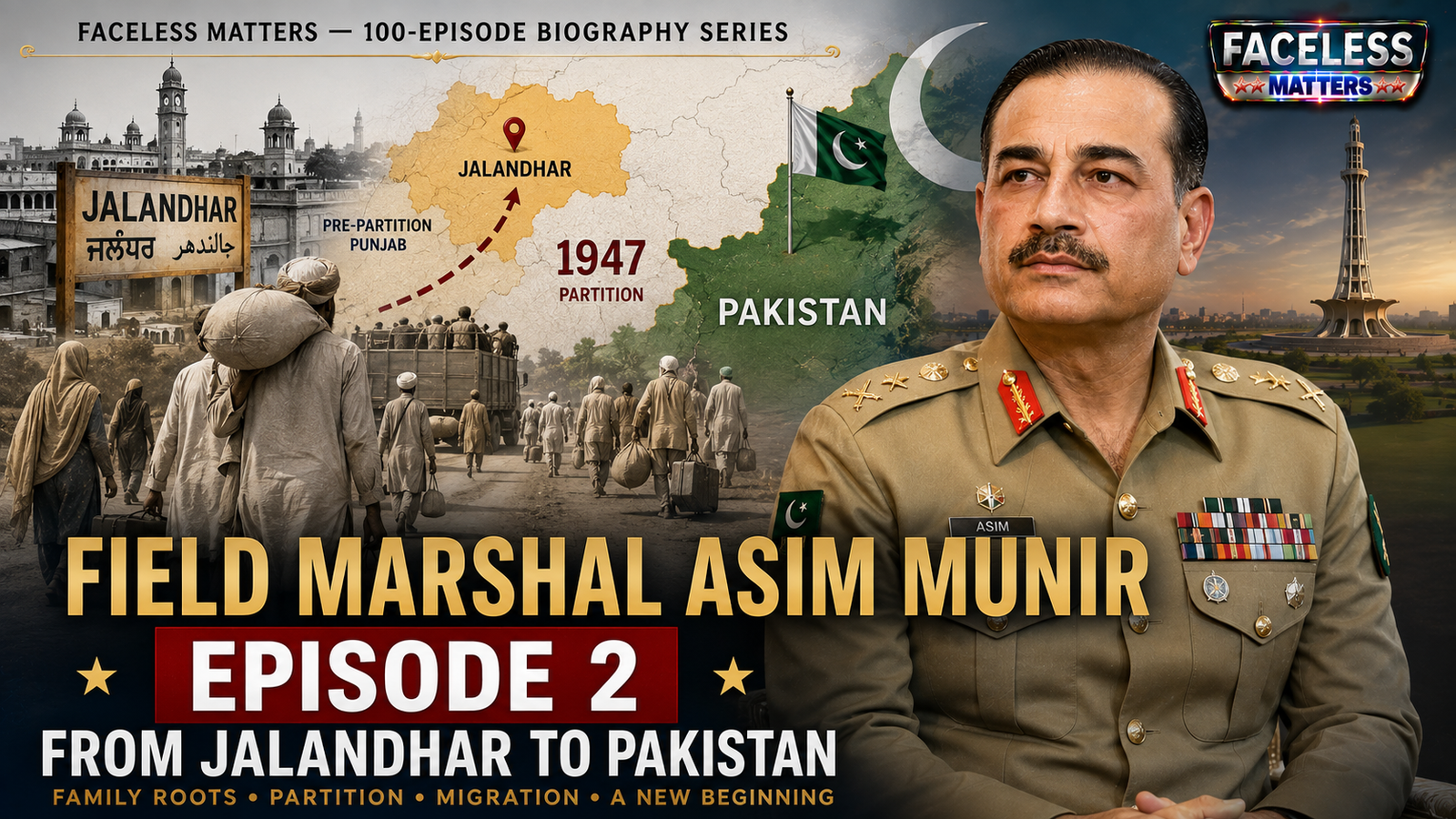
For Field Marshal Syed Asim Munir, the Asim Munir family history reaches back beyond Pakistan’s creation to Jalandhar in the Punjab of British India. Published biographical accounts report that his family had roots in Jalandhar and migrated to Pakistan around the time of the 1947 Partition. Other published accounts describe the family’s subsequent movement through Toba Tek Singh before settlement in Rawalpindi.
This episode examines that journey carefully.
The purpose is not to turn family history into mythology, nor to attribute every later characteristic to migration. Instead, the aim is to establish what the public record supports, explain the historical context and understand how the family’s movement from one side of Punjab to another became part of the background of a future Pakistani military leader.
The Jalandhar Connection
The documented Asim Munir family history begins, in available public accounts, with roots in Jalandhar.
Jalandhar was an important city of the Punjab region before the 1947 Partition. Like many parts of Punjab, it was home to communities whose lives, businesses, educational institutions and family networks had developed over generations.
The Partition transformed that environment.
When British India was divided into India and Pakistan in 1947, Punjab became one of the regions most profoundly affected by the upheaval. Communities moved across the new border, often leaving behind homes and established social networks.
In the case of the Munir family, reputable published reporting consistently connects the family’s roots to Jalandhar and its subsequent migration to Pakistan. India Today reports that Syed Sarwar Munir’s family migrated from Jalandhar after Partition. The Indian Express similarly reports that his father arrived in Rawalpindi from Jalandhar in 1947.
These are the essential facts that provide the historical foundation for understanding the Asim Munir family history in this episode.
More detailed claims about the family’s exact residence, individual relatives or the precise circumstances of departure are less consistently documented and therefore should not be presented as established fact without stronger evidence.
Punjab Before the Partition
To understand the family’s migration, it is important to understand the historical setting.
Before 1947, Punjab was not divided by the international border that exists today. Jalandhar was part of British India’s Punjab, while areas that later became Pakistani Punjab were connected through extensive economic, cultural and family networks.
People travelled for education, employment, trade and family relationships across what would later become an international boundary.
The Partition changed this geography almost overnight.
For millions of people, places that had previously been part of an interconnected regional world became separated by a new international border.
This is why the Asim Munir family history cannot be separated completely from the larger history of Partition. The family’s movement was part of a much wider demographic transformation affecting Punjab.
That historical context is essential to understanding the Asim Munir family history, and it is more important than any attempt to turn the migration into a dramatic personal legend.
1947 and the Transformation of Family Life
The year 1947 represents a fundamental dividing line in South Asian history.
Pakistan emerged as an independent state in August 1947, while British rule in India ended and the subcontinent was divided into two new dominions.
The political transformation was accompanied by enormous human movement.
Families moved in both directions. Some relocated because of insecurity, some because of expectations about belonging in the new political order, and many because the circumstances surrounding Partition made their previous homes difficult or impossible to maintain.
The public sources used for this biography establish that the Asim Munir family history is rooted in Jalandhar and that the family migrated to Pakistan around the Partition period. They do not provide enough evidence to reconstruct every private reason for the family’s decision.
That distinction matters.
A responsible biography should not fill historical gaps with assumptions simply because a dramatic story might attract more attention.
From Jalandhar Toward Pakistan
Several published biographical accounts describe a route in which the family moved from Jalandhar toward Pakistan and subsequently spent time in Toba Tek Singh before settling in Rawalpindi. The sequence is reported in multiple biographical sources, although the level of detail varies between accounts.
Toba Tek Singh is significant because it represents an intermediate stage in the family’s settlement story.
Rather than presenting migration as a single journey with an immediate destination, this account shows something more common in the experience of displaced families: relocation could involve temporary settlement, adjustment and another move before a family found a permanent home.
For the Munir family, that longer process eventually led to Rawalpindi.
And Rawalpindi would become the city most closely associated with the next generation.
Toba Tek Singh: A Transitional Chapter
The reported connection with Toba Tek Singh deserves attention because migration is rarely only about crossing a border.
Families also had to rebuild.
They needed homes, employment, schools, community connections and social stability. Parents had to establish new livelihoods while children grew up in an environment that was different from that of previous generations.
The available sources do not provide a complete day-by-day account of this stage of the Asim Munir family history or the Munir family’s time in Toba Tek Singh.
Therefore, this episode does not invent such details.
What can reasonably be said is that published biographical accounts place Toba Tek Singh between Jalandhar and the family’s eventual settlement in Rawalpindi.
That reported sequence gives us an important framework for understanding the Asim Munir family history and the family’s movement from Jalandhar toward Pakistan.
The Journey Toward Rawalpindi
The final major destination in this family migration story was Rawalpindi.
Rawalpindi would later become the birthplace of Asim Munir in 1968, according to published biographical accounts.
The significance of this transition is considerable when viewed within the wider Asim Munir family history.
A family whose roots were connected to Jalandhar became established in a Pakistani city that would later have an especially prominent association with the country’s military and administrative institutions.
This does not mean the family could have predicted the future.
There is no evidence that the migration itself was part of a predetermined path toward military leadership.
But historically, the sequence is striking:
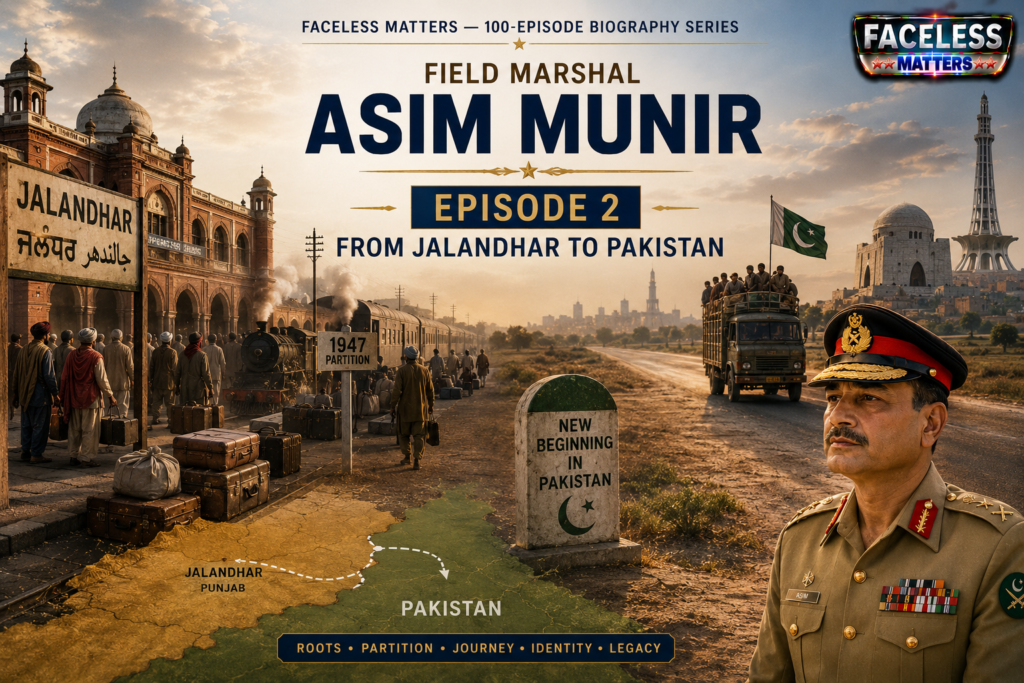
Jalandhar → migration to Pakistan → Toba Tek Singh → Rawalpindi → the birth of a future Pakistani military leader.
That is the geographical foundation of this biography.
Dheri Hassanabad and a New Generation
Published accounts identify Dheri Hassanabad in Rawalpindi as the locality where the family eventually settled. Some biographical sources also associate Asim Munir’s father, Syed Sarwar Munir, with a mosque in the area and with educational work in Rawalpindi.
This marks an important transition in the Asim Munir family history, from migration and settlement to the upbringing of a new generation in Pakistan.
The migration story of one generation became the childhood environment of the next.
The family was no longer living through the immediate upheaval of Partition. Instead, the new generation was growing up inside Pakistan.
That distinction is central to understanding the Asim Munir family history.
His biography is therefore not simply a story of migration. It is also a story of settlement and generational transition.
The generation that crossed the border experienced the creation of a new state directly.
The generation born afterward experienced Pakistan as the country in which they were raised.
That difference can shape identity in ways that are historical rather than merely personal.
A Family Story Within Pakistan’s Founding Generation
Many Pakistani families carry stories of migration from areas that became part of India after Partition.
The reported movement documented in the Asim Munir family history therefore belongs to a much wider national history of migration and settlement.
The story also illustrates how the consequences of 1947 continued beyond the first generation.
A family could migrate in 1947, establish itself in a new city, educate its children and grandchildren, and eventually produce individuals whose professional lives became deeply connected with the institutions of the new country.
The Asim Munir family history should therefore be read within this wider context rather than as an isolated migration narrative.
It is a small family chapter within one of the largest political and demographic transformations of modern South Asian history.
What We Know About the Family’s Settlement
The strongest public record allows us to establish several points with reasonable confidence.
First, Asim Munir was born in Rawalpindi in 1968.
Second, published biographical reporting connects his father’s family to Jalandhar and says the family migrated to Pakistan after Partition.
Third, other biographical accounts report that the family moved through Toba Tek Singh before eventually settling in Dheri Hassanabad, Rawalpindi.
Fourth, his father, Syed Sarwar Munir, is described in published sources as an educator and imam in Rawalpindi.
These points form the reliable foundation for the next stage of the biography.
Other details should remain clearly identified as reported claims unless supported by stronger primary documentation.
Why Family Migration Matters to a Biography
There is a temptation in modern biography to treat childhood and family background merely as introductory material.
That would be a mistake here.
Migration can influence the environments in which families establish their economic, educational and social lives.
It can also create a strong connection between personal identity and national history.
But influence is not destiny.
The fact that a family migrated during Partition does not explain why a later family member became a military officer, intelligence leader or Field Marshal.
Those later achievements came through education, professional selection, training, performance and decades of service.
The value of the migration story is different.
It tells us where the family journey began before the individual career began.
That is exactly where a long-form biography should start.
FACELESS MATTERS Analysis: From Migration to National Service
FACELESS MATTERS Analysis:
The most powerful element of this episode is not the distance between Jalandhar and Rawalpindi.
It is the generational transition represented by that journey.
A family rooted in pre-Partition Punjab crossed into the newly created Pakistan. It then moved through a period of settlement and eventually established itself in Rawalpindi.
Decades later, a child born into that settled family would enter Pakistan’s military profession and eventually reach the highest levels of national defence leadership.
It would be too simplistic to say that Partition created the Field Marshal.
History does not work through such direct equations.
But history does create environments.
The creation of Pakistan changed the geography in which the family lived. Migration changed where the next generation would grow up. Settlement in Rawalpindi placed the family in a city that would later become central to the young man’s educational and professional environment.
The significance is therefore contextual rather than deterministic.
This is also why Asim Munir family history deserves to be examined with both respect and restraint.
A biography becomes stronger when it acknowledges what the sources establish and refuses to manufacture what they do not.
The Human Meaning of Migration
Migration statistics can make historical movement seem abstract.
Behind every migration figure, however, there are families making decisions in uncertain circumstances.
They carry belongings.
They leave familiar streets.
They enter communities where they may know few people.
They establish new livelihoods.
They educate their children.
Over time, the temporary becomes permanent.
The Munir family’s reported journey belongs to this broader human story of Partition.
But because the available sources do not provide a complete personal diary or first-hand account of the family’s journey, this biography should not pretend to know every emotional detail.
Respect for history sometimes means acknowledging what cannot be recovered.
From Family Roots to a Future Career
By the time Asim Munir was born in Rawalpindi, the family’s migration chapter had already become part of the previous generation’s history.
The new chapter was different.
It would involve schooling, religious education, youth activities and eventually military training.
The next episode will move from family migration to the environment in which he grew up.
That means Rawalpindi, and particularly the locality associated with the family’s settlement, becomes the natural focus of Episode 3.
The sequence is deliberate.
Episode 1 established the beginning.
Episode 2 established the family migration story.
Episode 3 will examine the environment of childhood.
This chronological structure allows readers to follow the biography without jumping randomly between decades.
The Continuing Historical Connection
The Jalandhar connection also demonstrates how personal biographies can intersect with wider South Asian history.
Partition is not merely an event in a textbook.
Its consequences continue to appear in family histories, migration patterns, cultural identities and relationships between India and Pakistan.
For a biography of a Pakistani military leader, this historical background can also help international readers understand why questions of geography, national identity and security carry such emotional and strategic weight in South Asia.
The purpose is not to revive old divisions.
It is to understand the historical context in which modern identities developed.
That approach is particularly important for a publication seeking readers beyond Pakistan.
What the Record Does Not Establish
A high-quality biography must also state what remains uncertain.
The available public sources do not provide a complete verified account of every member of the extended Munir family who lived in Jalandhar.
They do not establish every date associated with the family’s movement.
They do not provide a complete first-person narrative of the journey from Jalandhar to Pakistan.
They also do not justify attributing a specific political motivation to every family member’s migration.
Therefore, this episode uses the most consistently reported facts to present the Asim Munir family history while avoiding unsupported additions.
That is not a weakness.
It is a strength.
Historical credibility depends as much on acknowledging limits as it does on presenting facts.
The Road From Jalandhar to Rawalpindi
The reported family route can therefore be summarized carefully:
Jalandhar: family roots before Partition.
1947 Partition: migration to Pakistan.
Toba Tek Singh: reported intermediate settlement.
Rawalpindi: eventual family settlement.
Dheri Hassanabad: the locality associated with the family’s later home.
1968: birth of Syed Asim Munir Ahmed Shah in Rawalpindi.
The military career comes later.
For now, this is the family map from which the biography proceeds.
FACELESS MATTERS Analysis: The Meaning of a Beginning
FACELESS MATTERS Analysis:
Every major biography contains a geographical story.
For Field Marshal Asim Munir, the Asim Munir family history begins in a Punjab that existed before today’s international border.
A careful reading of the Asim Munir family history also shows why chronology matters in a long-form biography. The movement from Jalandhar to Pakistan should be understood within the wider transformation of Punjab during Partition, rather than treated as an isolated family event. The available public record provides a broad sequence of roots, migration, settlement and the emergence of a new generation in Rawalpindi. That sequence helps readers understand the historical setting without assuming that later military achievements were predetermined by childhood circumstances. It also allows this biography to distinguish documented information from interpretation. By keeping that distinction clear, FACELESS MATTERS can present a respectful account of family background while maintaining historical caution, editorial credibility and useful context for readers interested in Pakistan history, migration, national identity and the development of a future military leader.
It continues through one of the largest migrations in modern history.
It then settles in Rawalpindi, where the next generation begins its own story.
This perspective gives the 100-episode series a broader purpose.
It is not only a biography of a military leader.
It is also an examination of how personal history intersects with Pakistan’s national history.
The later episodes will discuss military training, command, intelligence, strategic responsibilities and national defence.
But none of those chapters should erase the earlier one.
Before the officer there was the family.
Before the command there was the home.
Before the rank there was a city.
And before the future military career there was a family journey shaped by the transformation of Punjab in 1947.
That is the central historical meaning of Episode 2.
Looking Ahead to Episode 3
The family’s settlement in Rawalpindi leads naturally to the next question:
What was the environment in which the future Field Marshal actually grew up?
The answer takes us to Dheri Hassanabad and Rawalpindi.
There, the story moves from migration history to childhood environment, education, family life and the social setting that surrounded the young Asim Munir.
That will be the subject of Episode 3.
Relevant Internal Reading
Readers interested in Pakistan’s broader security environment can also explore the FACELESS MATTERS analysis “The Role of Institutions and Citizens in Ending Pakistan Terrorism.” The article examines national security, institutional coordination, stability and the relationship between security and long-term development.
Readers following Pakistan’s wider geopolitical and economic environment can also explore “Strait of Hormuz Crisis: Oil Above $90 in 2026,” which examines energy security, shipping disruption, inflation and the potential economic effects on Pakistan.
Source Verification & Analysis
The principal historical claims in this episode were cross-checked against multiple published biographical accounts.
- India Today — Reports that Syed Asim Munir was born in Rawalpindi and that his father, Syed Sarwar Munir, came from a family that migrated from Jalandhar after Partition. It also reports his father’s educational and religious roles.
- The Indian Express — Reports that Munir’s father arrived in Rawalpindi from Jalandhar in 1947 and provides additional background on the family’s educational and religious environment.
- Published biographical reference material — Reports the family’s movement from Jalandhar to Toba Tek Singh and subsequently to Dheri Hassanabad in Rawalpindi. These details are treated as reported biographical information rather than independently reconstructed primary-history evidence.
- The Print — Provides additional reporting on the family’s Jalandhar roots, Rawalpindi background and religious education.
Where sources differ in detail, this episode deliberately uses cautious language and does not present disputed or insufficiently documented personal details as established facts.
Suggested Future Internal Articles
- Episode 1 — THE BEGINNING, FAMILY ROOTS AND EARLY FORMATION
FIELD MARSHAL ASIM MUNIR — EPISODE 1: THE BEGINNING, FAMILY ROOTS AND EARLY FORMATION. - Episode 3 — Dheri Hassanabad: The Environment of His Childhood
Examines the Rawalpindi locality associated with the family’s settlement and the environment in which Asim Munir grew up. - Episode 4 — Syed Sarwar Munir: The Father Behind the Early Years
Examines the documented educational and religious career of his father and its place in the family’s history.
These are future-topic recommendations only. Real internal URLs should be added after the respective articles are actually published.
Fresh News Link
Source: Reuters
Article/Report Title: Pakistan and Iran made “significant progress” in talks on conflict, minister says
Why it matters: On August 25, 2026, Reuters reported that Pakistan and Iran made significant progress in talks focused on preventing further escalation, reopening the Strait of Hormuz and pursuing a path toward peace. The report provides current context for understanding the later stages of the career that this 100-episode biography is documenting.
Read the latest Reuters report
Previous FACELESS MATTERS Coverage
Article Title: Pakistan Terrorism in 2026: President & PM Renew Resolve
Short explanation of relevance: This FACELESS MATTERS article examines Pakistan’s national-security environment, institutional coordination and the continuing challenge of terrorism, providing useful context for readers following the later national-security chapters of the Asim Munir biography.
Read the FACELESS MATTERS analysis
Recommended Categories
Primary Category: Pakistan
Secondary Categories: Pakistan History, Military History, Geopolitics, National Security, Leadership, International Affairs, World News
[…] Asim Munir Family History — Episode 2: From Jalandhar to Pakistan […]
[…] Episode 2 followed the reported migration journey from Jalandhar to Pakistan and the family’s eventual settlement in Rawalpindi. […]
[…] Asim Munir Family History — Episode 2: The Remarkable Journey from Jalandhar to Pakistanhttps://facelessmatters.com/asim-munir-family-history/ […]
[…] Asim Munir Family History — Episode 2: The Remarkable Journey from Jalandhar to Pakistan […]