


By Shahid Faridi | Senior Journalist, FACELESS MATTERS
Date: 3 November 2026
Pakistan has announced a successful flight test of its first indigenously developed Fa’az air-to-air missile, a development that places renewed attention on the country’s efforts to strengthen domestic aerospace engineering and reduce dependence on imported air-combat weapons.
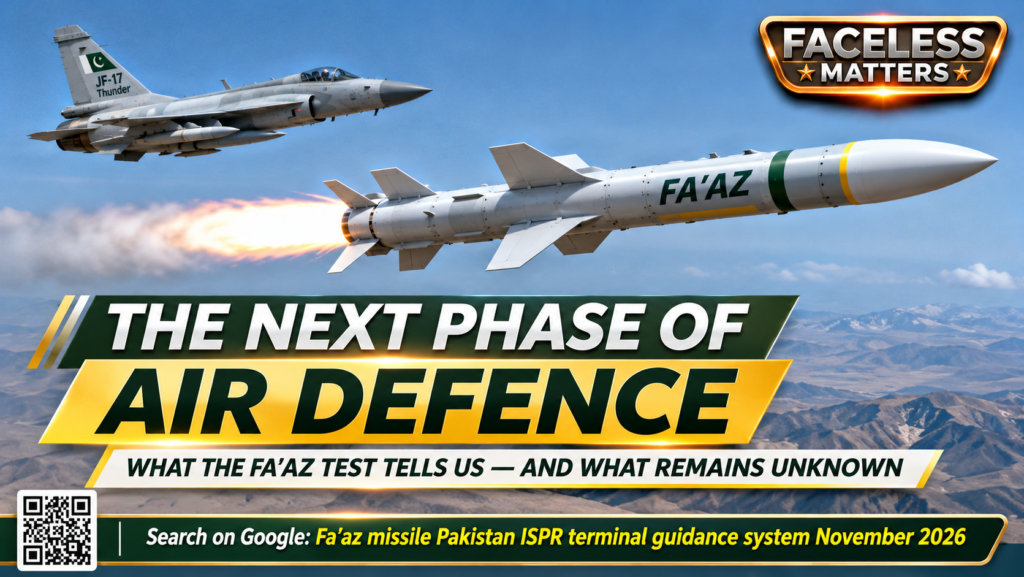
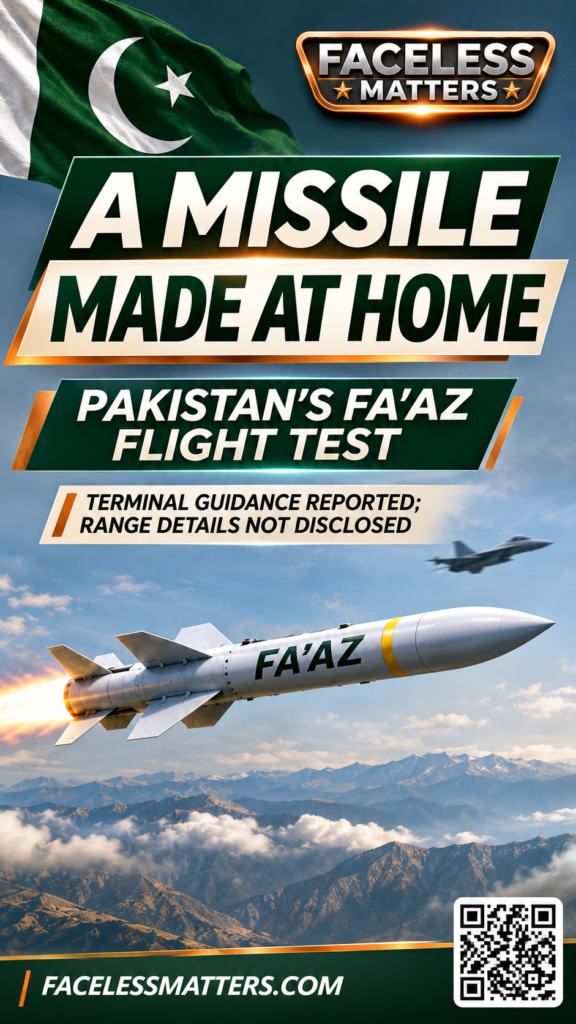
The announcement, reported by Pakistan’s military media wing, the Inter-Services Public Relations (ISPR), identifies the Fa’az as an air-to-air weapon equipped with an advanced terminal guidance system. The missile is described as capable of engaging aerial targets at longer ranges, while its successful flight test is presented as an important achievement for Pakistan’s defence industry.
The development matters because modern air forces depend not only on combat aircraft but also on the weapons, sensors, guidance technologies, maintenance systems and industrial capabilities that allow those aircraft to operate effectively. A locally developed missile programme can contribute to that wider ecosystem, although a successful test alone does not establish that a weapon has entered operational service or achieved every performance objective.
For Pakistan, the Fa’az programme raises several important questions: what has actually been confirmed, what remains undisclosed, how indigenous missile development can support the Pakistan Air Force, and what further evidence would be needed before the system’s operational capabilities can be independently assessed.
1. What Pakistan Has Confirmed About the Fa’az Test
According to the ISPR statement reported on 3 November, Pakistan successfully conducted a flight test of its first locally developed Fa’az air-to-air missile.
The announcement highlighted three central points:
- The missile is an indigenous development.
- It incorporates a modern terminal guidance system.
- It is designed to engage aerial targets at longer ranges.
The military’s media wing also described the test as evidence of technical progress, innovation and growing self-reliance in the national defence industry.
Senior officers of the Pakistan Armed Forces, together with scientists and engineers involved in the programme, witnessed the launch. The announcement further stated that the president, prime minister, chief of army staff and chief of defence forces, and the services chiefs congratulated the teams associated with the missile’s development.
These details establish the central news event. They do not, however, provide a complete technical description of the weapon.
No independently verifiable performance data on the test’s precise range, flight speed, propulsion system, target profile or complete guidance architecture was included in the reports reviewed for this article.
That distinction is important. Defence reporting should separate an official announcement about a successful test from technical claims that have not been publicly documented.
2. Why an Air-to-Air Missile Matters to a Modern Air Force
An air-to-air missile is designed to be launched from an aircraft to engage another airborne target. Depending on its design and guidance system, it may be intended for engagements at relatively short distances or for beyond-visual-range missions.
The significance of such a weapon extends beyond the missile itself.
A modern fighter aircraft operates as part of a wider combat system. Its effectiveness can depend on radar performance, electronic warfare equipment, data links, pilot training, target identification, mission planning and the weapons available for a particular task.
An air-to-air missile must work within that wider system. Its design, integration and testing therefore involve more than demonstrating that a missile can fly.
The Fa’az announcement is relevant because it points to domestic progress in one of the specialised areas of modern aerospace technology: the development and testing of an air-launched weapon intended to engage aerial targets.
The Fa’az air-to-air missile also highlights the importance of developing specialised aerospace technologies within the country. For Pakistan, the Fa’az air-to-air missile represents a development effort that deserves assessment through verified testing and integration data. The long-term value of the Fa’az air-to-air missile will depend on how successfully it progresses from testing towards a reliable defence capability.
However, the operational value of any such weapon can only be assessed by examining its verified performance, compatibility with aircraft, reliability, production status and integration with the air force’s wider systems.
3. Terminal Guidance: The Technical Feature Highlighted by ISPR
One of the most important technical details in the official announcement is the reference to a terminal guidance system.
In general terms, terminal guidance refers to the part of a weapon’s guidance process concerned with the final stage of its flight towards a target.
Different missile designs use different approaches. Depending on the system, terminal guidance may involve radar-based, infrared or other seeker technologies. These systems are not interchangeable, and the specific method used by a particular missile cannot be established merely from the phrase “terminal guidance”.
The ISPR announcement did not specify the exact seeker configuration. However, Quwa’s analysis of the released test footage identifies an imaging infrared (IIR) seeker configuration on the missile shown during the test. This is an independent assessment of the available video, not a complete official technical specification of the Fa’az system.
The available video analysis points to an imaging infrared configuration in the missile shown during the test, while the full technical architecture and any alternative seeker configurations remain matters for further confirmation.
The distinction matters because guidance technology influences how a missile detects, tracks and engages a target, as well as the conditions under which it may be effective.
For an independent technical assessment, further information would be required about the missile’s seeker, guidance architecture, testing conditions and demonstrated performance.
At this stage, the responsible conclusion is limited: the official announcement identifies terminal guidance as a key feature, but does not disclose enough information to establish its detailed technical configuration. Quwa’s independent analysis of the released test footage identifies an imaging infrared (IIR) seeker configuration on the missile shown during the test. This assessment adds useful context to the Fa’az air-to-air missile programme, but it should not be confused with a complete technical specification officially confirmed by the Pakistan military.
The Fa’az air-to-air missile should therefore be evaluated through confirmed technical disclosures rather than assumptions about its seeker technology. Independent analysis of released test footage may add useful context to the Fa’az air-to-air missile programme, but it should remain clearly attributed. A complete assessment of the Fa’az air-to-air missile requires further information about its guidance and qualification process.
4. What Does “Longer Range” Actually Tell Us?
The reported announcement says that the Fa’az is capable of engaging aerial targets at longer ranges. This is a significant description, but it is not a published numerical range specification.
The difference between a qualitative capability statement and a verified performance figure should not be overlooked.
A missile’s advertised or estimated range can differ from the distance at which it can reliably engage a particular target. Actual engagement conditions may depend on launch altitude, aircraft speed, target direction, target manoeuvres, atmospheric conditions and the missile’s energy during flight.
The term “beyond visual range”, commonly abbreviated as BVR, is used for engagements that take place beyond the pilot’s direct visual identification distance. It does not, by itself, establish a missile’s exact range or performance.
Earlier reporting on the Fa’az programme has discussed beyond-visual-range development. In 2023, GIDS displayed Fa’az-related prototypes at the IDEF defence exhibition in Türkiye. Defence News reported that the displayed Fa’az-RF and Fa’az-IIR models were mock-ups at that event, while GIDS provided descriptions of their intended guidance approaches and claimed performance figures.
Those earlier exhibition disclosures provide background to the programme, but they should not be treated as proof that every displayed specification applies to the missile tested in November 2026.
The latest test announcement does not publish a confirmed maximum range. FACELESS MATTERS therefore does not assign a numerical range to the tested Fa’az missile.
5. The Earlier Fa’az Programme: From Public Display to Flight Testing
The Fa’az name did not first appear in Pakistan’s defence discussion in November 2026.
The programme had already attracted attention at the IDEF 2023 defence exhibition in Istanbul, where Pakistan’s Global Industrial and Defence Solutions (GIDS) presented models of air-launched weapons.
Defence News reported that GIDS displayed the Fa’az-RF and Fa’az-IIR concepts. The report described the RF version as an active-radar-guided concept and the IIR version as an imaging-infrared concept. It also noted that the displayed systems were mock-ups rather than operational missiles.
A separate technical review by Quwa, published in December 2024, discussed the Fa’az-1 and Fa’az-2 programmes and their proposed beyond-visual-range roles. The review noted that several technical details remained unconfirmed.
This history is useful because it shows that the Fa’az programme has been part of Pakistan’s publicly presented defence-development roadmap for several years.
The November 2026 announcement represents a further reported milestone: a successful flight test of an indigenously developed Fa’az missile.
The Fa’az air-to-air missile programme has consequently moved into a more closely watched stage of public discussion. Its earlier exhibition history and the reported November flight test provide two different points of reference for understanding the Fa’az air-to-air missile. Future disclosures will help establish how the Fa’az air-to-air missile has progressed from its earlier development concepts.
Nevertheless, a public exhibition model, a development programme, a successful test and an operationally inducted weapon are four different stages. They should not be presented as if they mean the same thing.
6. Why Indigenous Missile Development Has Strategic Value
Developing a complex air-to-air missile domestically can have value beyond the immediate acquisition of a new weapon.
Countries that rely heavily on imported defence systems may face challenges involving supply restrictions, export approvals, maintenance arrangements, replacement components and access to technical support.
Domestic research and production can help build local engineering knowledge and improve the ability to maintain or modify equipment over time.
For Pakistan, the Fa’az programme may contribute to several broader objectives:
Technical expertise: Missile development requires work across propulsion, aerodynamics, electronics, guidance, software, materials and testing. Building expertise in these areas can support other aerospace projects.
Industrial capability: A sustainable programme may create demand for local suppliers, specialised manufacturing, quality-control systems and testing infrastructure.
Supply resilience: Domestic capability may reduce exposure to certain external supply constraints, although the degree of independence depends on the origin of components and production inputs.
Long-term planning: Local research can allow a country to develop equipment around its own operational requirements rather than relying exclusively on systems designed for another military’s needs.
These potential benefits should not be confused with proof that every component of the Fa’az is locally manufactured. The latest public announcement does not provide a complete component-origin breakdown.
The extent of domestic control over propulsion, seekers, electronics and other critical subsystems remains an important unanswered question.
7. The Pakistan Air Force and the Importance of Weapon Integration
The ISPR statement says the Fa’az is expected to improve the operational flexibility of the Pakistan Air Force.
That expectation is understandable in the context of modern air operations, where aircraft and weapons must operate as an integrated system.
A missile’s performance cannot be considered separately from the aircraft expected to carry it. Integration can involve mechanical compatibility, electrical interfaces, mission computers, software, launch procedures, radar support and testing under different flight conditions.
Although the ISPR announcement does not list the intended aircraft platforms, Quwa’s analysis of the released test footage identifies a JF-17 Thunder Block-I as the aircraft shown launching the Fa’az air-to-air missile. This visual identification provides useful additional context, but it does not establish the missile’s complete aircraft-integration or certification status. Further official information would be needed to confirm the full range of platforms cleared to carry the Fa’az air-to-air missile.
It would therefore be inaccurate to claim, without further confirmation, that the Fa’az has already been integrated with every particular fighter aircraft operated by Pakistan.
The next important public milestones would include official information on aircraft compatibility, additional test phases, certification and the eventual status of the weapon within the Pakistan Air Force.
8. A Successful Test Is Not the Same as Operational Induction
The word “successful” is important in a test announcement, but it should be understood within the context of defence development.
A flight test can examine specific aspects of a weapon’s performance. Depending on the programme and test objectives, it may assess flight behaviour, system operation, guidance functions or other technical parameters.
A successful test does not automatically establish that a missile has completed its entire development programme.
Before a new weapon becomes a dependable operational capability, a number of questions normally require attention:
- Have the required development and evaluation tests been completed?
- Has the missile demonstrated reliability under different conditions?
- Has it been integrated and certified for the intended aircraft?
- Are production arrangements ready?
- Are maintenance, storage and training procedures established?
- Has the relevant service formally announced its induction?
The public announcement reviewed for this report does not answer all these questions.
The responsible description is therefore that Pakistan has reported a successful flight test of the Fa’az missile. Its precise operational status and the extent of completed qualification remain matters for further official disclosure.
The Fa’az air-to-air missile has therefore reached a publicly reported flight-test milestone, but that achievement should not be confused with completed operational induction. For readers assessing the Fa’az air-to-air missile, the next important evidence will be formal qualification, integration and service-related announcements. Until such information becomes available, the Fa’az air-to-air missile should be described as a tested development rather than an independently verified fully operational system.
9. Fa’az Is Not the Same as the Fatah Missile Series
The Fa’az test has taken place during a period of wider activity in Pakistan’s missile-development announcements. That makes it especially important to distinguish between different weapon categories.
The Fa’az is described as an air-to-air missile, meaning it is intended to engage aerial targets from an airborne platform.
The Fatah-2 and Fatah-4 systems discussed in recent Pakistani announcements belong to different categories.
On 13 October 2026, the Pakistan Army announced a successful test launch of the extended-range Fatah-2 ballistic missile. The ISPR statement referred to advanced navigation and avionics, along with the system’s intended ability to engage targets at extended ranges.
On 6 October 2026, Pakistan also announced a test of an extended version of the Fatah-4 ground-launched cruise missile.
These systems should not be confused with the Fa’az. They have different roles, launch arrangements and operational contexts.
The distinction is not merely a matter of naming. Accurate classification helps readers understand the purpose of each programme and prevents incorrect comparisons between weapons designed for different missions.
10. What the Test Could Mean for Pakistan’s Defence Industry
The successful test announcement is also relevant to the broader development of Pakistan’s defence-industrial base.
A complex missile programme requires cooperation among research organisations, engineers, manufacturing facilities, testing teams and military users.
The long-term value of such a programme depends on whether the country can maintain the knowledge and industrial processes needed to support the system after its initial development.
A sustainable domestic capability requires more than a successful launch. It involves consistent quality, dependable components, production capacity, maintenance support, technical upgrades and a skilled workforce.
The Fa’az programme may provide opportunities to strengthen these areas, but the actual economic and industrial impact will depend on future production decisions and the extent of local manufacturing.
There is also a difference between displaying a defence product for potential export and having a fully qualified system ready for delivery. Export prospects would require separate evidence concerning certification, customer requirements, production capacity and applicable export controls.
No export contract or delivery arrangement should be inferred from the successful test announcement alone.
11. Regional Security: Why the Development Will Attract Attention
Air-to-air missile development is closely connected with regional military planning because air forces assess their capabilities in relation to aircraft, sensors, weapons and potential threats.
South Asia has a complex security environment, and Pakistan’s defence developments are likely to be examined by regional observers.
However, a single missile test does not establish a change in the regional military balance.
Such an assessment would require reliable information about the weapon’s actual performance, production numbers, deployment status, aircraft integration and the capabilities of other systems in the region.
It would also require an understanding of the wider air-defence environment, including radar networks, electronic warfare, command-and-control arrangements and pilot training.
The Fa’az test is a relevant development in Pakistan’s aerospace programme. It should not be turned into an unsupported claim that one country has gained decisive superiority over another.
A balanced assessment recognises the importance of defence research while avoiding exaggerated predictions about regional outcomes.
12. The Questions That Still Need Official Answers
The latest announcement confirms a successful flight test, but a number of technical and operational details remain undisclosed in the public reporting reviewed by FACELESS MATTERS.
The following questions would help provide a clearer picture of the programme:
What is the confirmed range?
A numerical range has not been established in the latest official announcement reviewed for this report.
Which guidance technology is used?
The announcement refers to terminal guidance but does not publicly identify the exact seeker type.
Which aircraft can carry the missile?
The public information reviewed does not provide a complete aircraft-integration list.
How many test phases remain?
No full development or qualification schedule has been publicly confirmed in the reports reviewed.
Has the missile entered service?
The announcement confirms a successful flight test, not a formal operational induction.
How much of the system is manufactured domestically?
A detailed breakdown of locally produced and externally sourced components has not been released in the material reviewed.
These are not minor details. They are the information needed to move from a general announcement to a serious technical assessment.
13. What to Watch After the Fa’az Flight Test
The next stage of the programme will be judged by evidence rather than headlines.
Further official statements may clarify the missile’s test programme, guidance technology, intended aircraft platforms and production status.
Independent defence analysis may also provide additional context as more technical information becomes available.
For Pakistan’s aerospace industry, the most meaningful indicators will include repeatable test performance, successful integration, production readiness, maintenance arrangements and the development of local expertise.
For the public, transparent and carefully attributed information will be essential. Defence reporting should explain what has been achieved without presenting undisclosed specifications as confirmed facts.
FACELESS MATTERS Analysis: The Real Achievement Is the Development Path
Pakistan’s reported successful Fa’az flight test is an important development because it signals progress in a technically demanding area of aerospace engineering.
The achievement should be viewed in the context of a longer effort to develop domestic defence technologies and strengthen the country’s ability to design, test and support advanced weapon systems.
But the value of the programme will not be determined by a single announcement. It will depend on the quality of further testing, the reliability of the missile, the extent of local industrial participation and its eventual integration into the Pakistan Air Force.
The most important measure of self-reliance is not simply whether a weapon carries a national label. It is whether the country can sustain the research, production, maintenance and technical improvements needed throughout the system’s service life.
Conclusion: A Significant Test, With More Evidence Still Needed
Pakistan’s successful Fa’az flight test marks a reported milestone in the development of indigenous air-to-air missile technology.
The official announcement highlights a terminal guidance system and the ability to engage aerial targets at longer ranges. It also recognises the contribution of the scientists, engineers and military personnel involved in the programme.
The test may support Pakistan’s wider ambitions in aerospace engineering and defence-industrial development. Yet important details—including the missile’s confirmed range, exact seeker configuration, aircraft compatibility, production status and operational induction—remain undisclosed in the public material reviewed for this report.
For that reason, the Fa’az should be recognised as a meaningful development without overstating what has been demonstrated.
The next phase will be important: further technical validation, transparent information, reliable integration and the ability to sustain the system domestically.
FACELESS MATTERS will continue to distinguish confirmed developments from technical estimates and strategic speculation as more verifiable information becomes available.
INTERNAL READING — FACELESS MATTERS
Pakistan’s Defence and Security Developments: Makkah Defence Alliance 2026
Makkah Defense Alliance 2026: 7 Critical Facts on Rapid Deployment
https://facelessmatters.com/makkah-defence-alliance-2026-rapid-deployment
Makkah Joint Defence Agreement: 3 Critical Istanbul Risks
Asim Munir Saudi Defence Minister Meeting 2026: Vital Update
Pakistan Qatar De-escalation Efforts: Proven Support 2026
Shehbaz Sharif Pezeshkian Meeting 2026: Key New York Signals
Pakistani Army in Saudi Arabia: 5 Strong, Proven Signals
SOURCES & EDITORIAL NOTE
1. Inter-Services Public Relations (ISPR), as reported by The News International
The report published on 3 November 2026 describes the successful flight test, terminal guidance system, longer-range aerial engagement capability and the participation of military officers, scientists and engineers.
The News — Pakistan conducts successful flight test of homegrown Fa’az missile
2. Hum News — Urdu coverage of the Fa’az test
Provides a second Pakistani news report of the announcement, including the stated terminal guidance feature and the expected operational-flexibility benefit for the Pakistan Air Force.
3. Daily Pakistan — Fa’az flight-test coverage
Reports the 3 November 2026 announcement and the expected contribution of the missile to Pakistan’s aerospace and defence capabilities.
Daily Pakistan — Pakistan tests first indigenous Fa’az air-to-air missile
4. Defense News — Earlier Fa’az programme disclosures
Provides historical context from the 2023 IDEF exhibition, including GIDS’s display of Fa’az-RF and Fa’az-IIR mock-ups and the reported intended guidance approaches.
Defense News — Pakistani defense conglomerate unveils new drone, missiles at IDEF
5. Quwa — Technical background on the Fa’az programme
Reviews the publicly discussed Fa’az-1 and Fa’az-2 concepts and highlights technical details that were not confirmed in the available programme information.
Quwa — GIDS FAAZ and FAAZ-2 Air-to-Air Missiles
6. Janes — IDEF 2023 defence technology coverage
Provides independent defence-industry context on the prototypes displayed by GIDS and the wider family of air-launched weapons presented at the exhibition.
Janes — IDEF 2023: GIDS reveals details of prototype air-launched missiles
7. Radio Pakistan — Fatah-2 test, for category distinction
Official reporting on the separate Fatah-2 extended-range ballistic missile test on 13 October 2026. Included to distinguish that programme from the Fa’az air-to-air missile.
Radio Pakistan — Pakistan Army test-fires Hypersonic Fatah-2 ER Ballistic Missile
8. Daily Jang — Original news reference supplied for this assignment
The original Pakistani news link supplied as the starting point for this report.
Jang — Pakistan’s successful Fa’az missile test
Editorial Note
This is an original FACELESS MATTERS report prepared by Shahid Fareedi. The article uses the publicly reported ISPR announcement as the basis for the immediate news development and adds historical programme context from defence-industry reporting.
The article does not treat previously displayed prototypes or proposed specifications as confirmed performance data for the missile tested on 3 November 2026. It does not assign an unverified range, speed, seeker type, aircraft compatibility or operational status to the tested system.
The distinction between a successful flight test and formal operational induction has been maintained throughout. The report does not endorse military escalation or make claims of regional superiority. Its purpose is to explain the reported development, its possible industrial significance and the technical information that remains unavailable to the public.