

Date: September 14, 2026
Key Takeaway
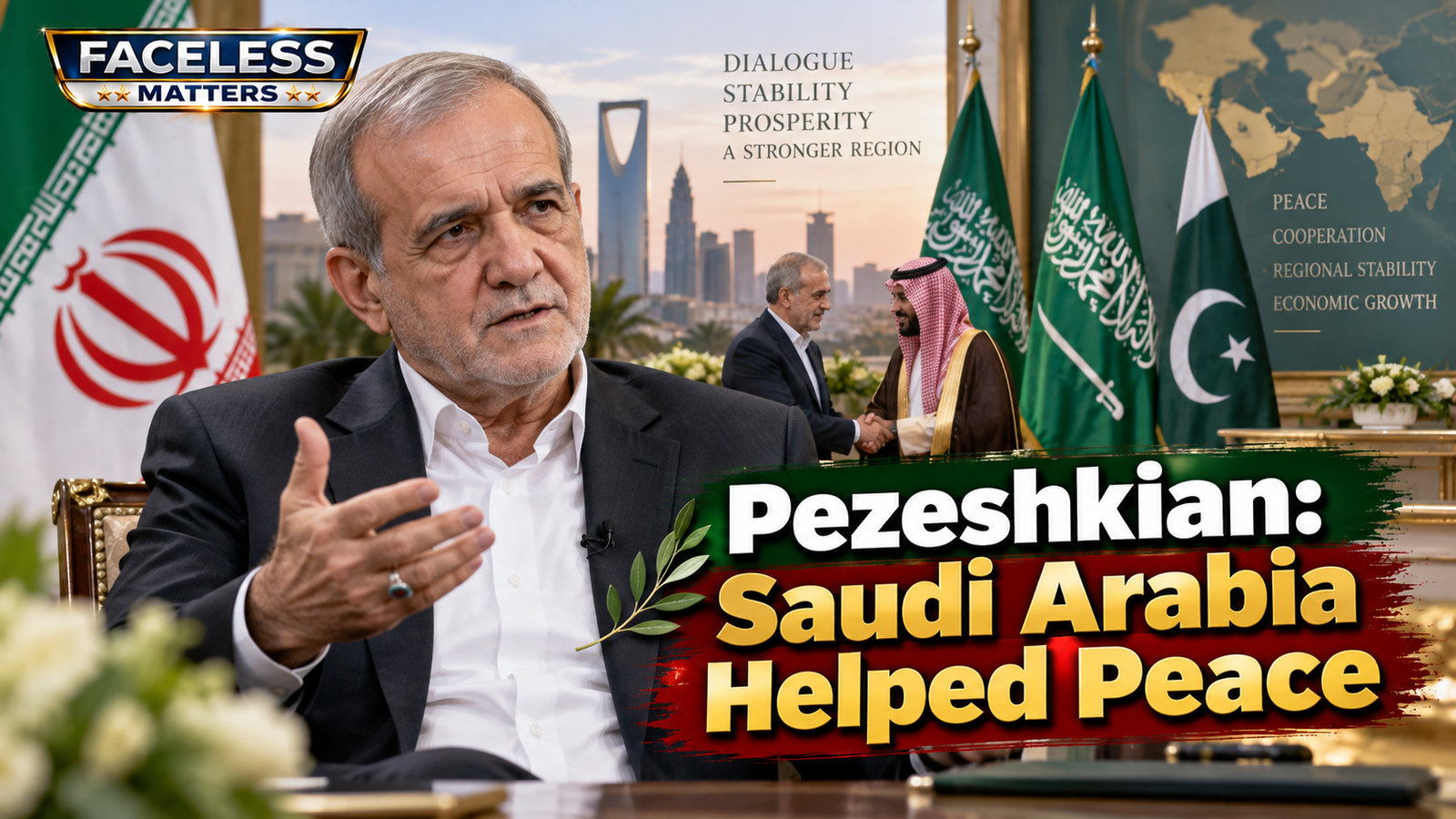
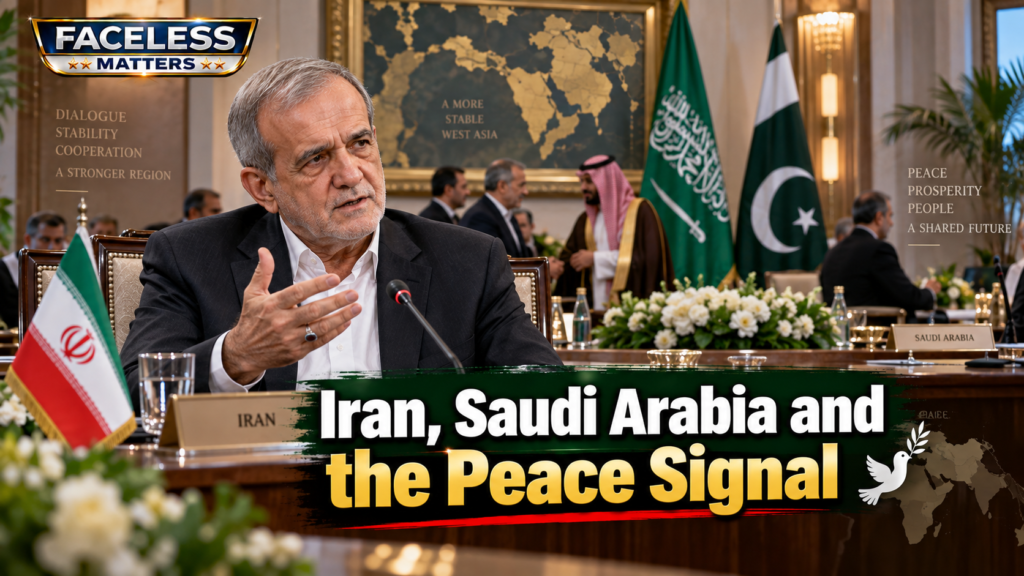
Pezeshkian Saudi Arabia remarks have drawn renewed attention to Saudi Arabia’s role in efforts aimed at reducing tensions and supporting peace. The report shown to FACELESS MATTERS describes Saudi Arabia as a friendly country that has provided significant help for peace.
The development matters for Pakistan because Islamabad has also been pursuing a diplomatic role in efforts to reduce tensions between Iran and the United States. Pakistan’s Foreign Office has confirmed high-level contacts involving Prime Minister Shehbaz Sharif, Iranian President Masoud Pezeshkian and other regional governments.
At the same time, the wider regional environment remains fragile, particularly around the Strait of Hormuz and the broader Gulf security situation.
TABLE OF CONTENTS
Article Content — What Happened?
A fresh regional diplomatic message attributed to Iranian President Masoud Pezeshkian has placed Saudi Arabia back at the center of discussion over Middle Eastern peace efforts.
According to the news screenshot supplied to FACELESS MATTERS, Pezeshkian described Saudi Arabia as a friendly country and said it had provided substantial assistance for peace.
The statement comes at a sensitive moment. Iran’s relationship with Gulf countries remains strategically important because the region is dealing with security concerns, disrupted energy routes and continuing diplomatic efforts to prevent further escalation.
The broader context is also important for Pakistan. Islamabad has repeatedly positioned itself as a supporter of dialogue and regional de-escalation. Pakistan’s Foreign Office said Prime Minister Shehbaz Sharif had met Pezeshkian during the SCO Summit and reiterated Pakistan’s commitment to peace through restraint, dialogue and sustained diplomacy.
1. Saudi Arabia’s Diplomatic Importance
The importance of Pezeshkian Saudi Arabia remarks goes beyond the wording of a single statement.
Iran and Saudi Arabia have historically been major regional rivals, although their relationship has experienced periods of diplomatic engagement and reconciliation. Any public Iranian acknowledgment of Saudi Arabia’s contribution to peace therefore carries wider significance.
The screenshot’s central message presents Saudi Arabia not simply as another Gulf state, but as a country that has allegedly contributed to peace efforts.
That framing can matter because regional diplomacy increasingly depends on communication between countries that do not always share the same strategic interests.
Saudi Arabia also has major influence over Gulf security, energy markets and regional diplomatic initiatives. Any reduction in tension between Tehran and Riyadh can therefore affect calculations far beyond their bilateral relationship.
The Pezeshkian Saudi Arabia signal should consequently be viewed as part of a larger diplomatic environment rather than as an isolated political statement.
2. What Pezeshkian’s Message Signals
The second important signal is the emphasis on peace.
The report shown in the screenshot also highlights an Iranian position that Tehran does not have a fundamental dispute with Muslim countries.
That message is significant because Iran’s current regional challenges cannot be separated from its relationships with neighboring Arab states.
Pezeshkian has also recently said that the Middle East does not need the United States to act as a regional policeman and argued that regional countries themselves should be able to guarantee the region’s security. He also said Iran did not desire war or its continuation and described peace as a priority.
This gives the Pezeshkian Saudi Arabia message a broader diplomatic context.
The language suggests that Tehran wants regional states to have a greater role in determining the security architecture of the Gulf.
That does not automatically mean all disputes have been resolved.
It does, however, indicate that diplomatic messaging toward neighboring Muslim countries may be increasingly important as Iran attempts to manage multiple regional relationships simultaneously.
3. Why Pakistan Matters
For Pakistan, the development has particular importance.
Islamabad has maintained close relations with Saudi Arabia while also maintaining a longstanding relationship with Iran. That places Pakistan in a potentially useful diplomatic position when tensions rise between Tehran and Gulf capitals.
Pakistan’s Foreign Office has publicly described Islamabad’s efforts to support dialogue and de-escalation in the wider Iran-US crisis. It also confirmed high-level Pakistani engagement with Iranian officials and Saudi Arabia under broader regional peace initiatives.
The Pezeshkian Saudi Arabia development therefore intersects directly with Pakistan’s diplomatic interests.
Pakistan does not want instability on either side of its borders or in the Gulf.
Millions of Pakistanis work in Gulf countries, while Pakistan’s economy depends heavily on energy imports, remittances and stable relations with major Middle Eastern partners.
A prolonged regional crisis can therefore affect Pakistan through several channels:
- energy prices;
- shipping costs;
- remittances;
- Gulf employment;
- foreign exchange pressures;
- investment sentiment; and
- regional security.
This is why Islamabad has an interest in encouraging dialogue rather than allowing regional disputes to expand.
4. Iran’s Position Toward Muslim Countries
Another point highlighted in the screenshot is the reported Iranian message that Tehran does not regard Muslim countries as its fundamental adversaries.
That distinction matters.
Iran’s relationship with the United States and Israel is fundamentally different from its relationships with neighboring Muslim-majority states.
Even where serious disagreements exist with Gulf governments, maintaining channels of communication can help reduce the possibility of accidental escalation.
The Pezeshkian Saudi Arabia message can therefore be interpreted as an attempt to emphasize regional diplomacy over permanent confrontation.
However, public statements should not be treated as proof that strategic disagreements have disappeared.
Questions surrounding security arrangements, regional influence, energy routes and military activity remain.
The practical test will be whether diplomatic language is followed by sustained engagement.
5. The Strait of Hormuz Factor
No discussion of Gulf diplomacy can ignore the Strait of Hormuz.
The waterway is one of the world’s most strategically important energy routes, and instability around it can quickly affect oil prices, shipping and inflation.
Recent reporting has shown how continuing regional tensions have affected energy markets and alternative oil routes. Reuters reported that Saudi Arabia’s East-West pipeline was temporarily shut following a drone attack while oil prices were approaching $100 a barrel.
For Pakistan, this issue is particularly important.
Higher oil prices can increase the country’s import bill and put pressure on transport costs, inflation and foreign exchange reserves.
That makes every diplomatic effort aimed at reducing Gulf tensions economically relevant to Pakistan.
The Pezeshkian Saudi Arabia signal should therefore also be viewed through the energy-security lens.
A calmer Gulf environment would not solve Pakistan’s economic challenges, but it could reduce one important source of external pressure.
What It Means for Pakistan
Pakistan’s position is unusually sensitive.
Islamabad has strong ties with Saudi Arabia and other Gulf states while sharing a long border and important economic relationship with Iran.
The country therefore has a clear interest in maintaining balanced relations.
Pakistan’s diplomatic engagement has already included senior-level discussions with Iranian leadership. The Foreign Office has said that Prime Minister Shehbaz Sharif discussed the evolving regional situation with Pezeshkian and reiterated Pakistan’s commitment to dialogue and diplomacy.
Earlier diplomatic reporting also highlighted Saudi Arabia’s support for Pakistan’s mediation efforts between Washington and Tehran.
That message is relevant to Islamabad’s broader diplomatic strategy.
For Pakistan, the preferred outcome is clear: lower tensions, secure energy routes, stable Gulf relations and continued diplomatic space.
What Happens Next?
The next stage will be more important than the statement itself.
There are five indicators worth watching.
1. Direct Iran-Saudi Engagement
If Tehran and Riyadh continue high-level communication, the diplomatic message will gain greater weight.
2. Pakistan’s Mediation Role
Islamabad may continue using its relationships with both sides to encourage dialogue.
3. Strait of Hormuz Stability
Any improvement or deterioration around the waterway could quickly affect global energy markets.
4. Gulf Security
Saudi Arabia’s security environment will remain an important factor in regional diplomacy.
5. Iranian-US Negotiations
Any progress between Washington and Tehran could change the strategic environment across the Gulf.
The Pezeshkian Saudi Arabia statement is therefore best understood as one signal within a much larger diplomatic process.
Conclusion
The latest remarks attributed to Masoud Pezeshkian place Saudi Arabia in a notably positive diplomatic frame and underline the importance Iran appears to attach to regional peace messaging.
For Pakistan, the development is particularly relevant because Islamabad has maintained relationships with both Iran and Saudi Arabia while promoting dialogue and de-escalation.
The Pezeshkian Saudi Arabia signal does not mean that every regional disagreement has disappeared.
But if public statements are followed by practical diplomacy, sustained communication and greater cooperation among regional states, they could contribute to a less confrontational Gulf environment.
For Pakistan, that would carry both diplomatic and economic benefits.
The central question now is whether the latest peace language develops into concrete regional engagement.
INTERNAL READING — FACELESS MATTERS
Iran Says It Is Not at War With Saudi Arabia
Iran Strait of Hormuz: 5 Strategic Signals Behind Tehran’s Latest Warning
Iran US Drone Display: 5 Strategic Signals Behind the Move
Iran China Security Proposal: 5 Critical Signals
World News 2026: 4 Major Global Risks to Watch
Sources & Editorial Note
Pakistan Ministry of Foreign Affairs — Pakistan’s official September 2, 2026 press briefing confirms Prime Minister Muhammad Shehbaz Sharif’s meeting with Iranian President Masoud Pezeshkian and Pakistan’s stated commitment to peace through restraint, dialogue and sustained diplomacy.
Associated Press of Pakistan — APP reported in July 2026 that the Punjab government was providing more than Rs20 billion in subsidies to support affordable flour and stable bread prices, with subsidized wheat supplied to operational flour mills.
Anadolu Agency — Anadolu Agency reported that Prime Minister Shehbaz Sharif praised Saudi Crown Prince Mohammed bin Salman for supporting Pakistan’s mediation efforts between Washington and Tehran.
Reuters — Reuters reported on September 11, 2026 that Saudi Arabia said drones launched from Iraq had struck its East-West pipeline, while Riyadh said it would hold off on retaliation for the time being.
Editorial Note
The specific statement attributed to Iranian President Masoud Pezeshkian in the supplied screenshot is presented by FACELESS MATTERS as an attributed claim. The screenshot itself is not treated as independent proof of the statement’s full context.
The broader diplomatic context in this article is supported by the verified sources listed above. FACELESS MATTERS distinguishes between official statements, independently reported developments and editorial analysis. Where the precise wording of a statement could not be independently verified from a primary source, it is presented with attribution rather than as an established fact.
FACELESS MATTERS welcomes official clarification or additional primary-source documentation concerning the reported remarks. Any substantive clarification can be incorporated into an updated version of this report.