

Key Takeaway
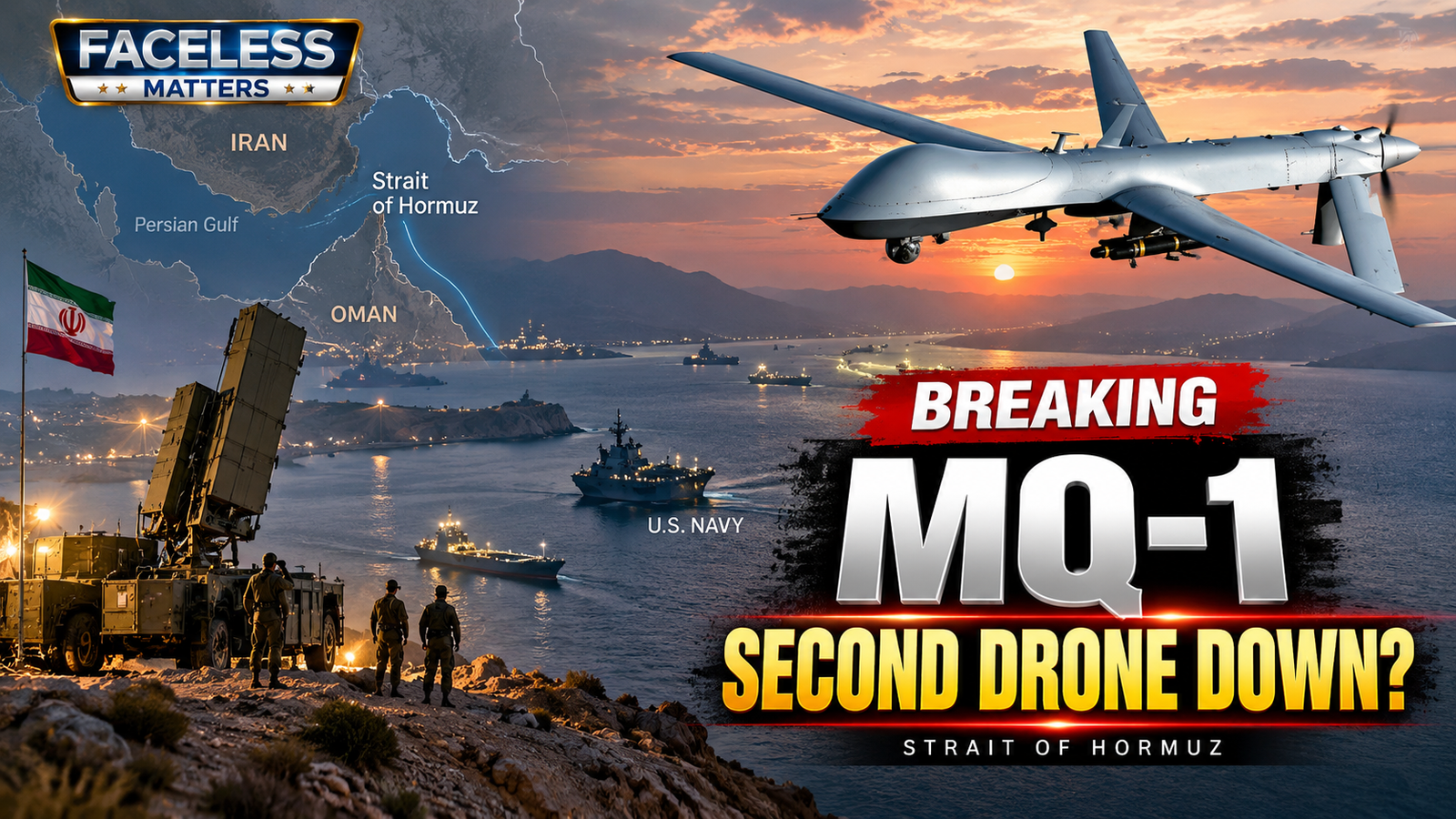
Iran MQ-1 drone reports have drawn attention after Iranian authorities said their forces intercepted and destroyed another U.S. unmanned aircraft over or near the Strait of Hormuz, describing it as the second such incident within 24 hours. The claim has not been independently confirmed by the U.S. military at the time of publication.
The significance goes beyond one aircraft. If independently confirmed, another U.S. unmanned-aircraft loss would raise questions about air-defense effectiveness, surveillance operations, military escalation, shipping security and the growing risk premium around the Strait of Hormuz. It could also prompt closer scrutiny of how unmanned aircraft are being used in contested airspace, how effectively air-defense networks are detecting them, and whether repeated incidents could alter operational planning. At the same time, the available evidence remains incomplete, so the incident should not be treated as proof of a wider change in the regional military balance. Further statements, imagery and independent reporting may clarify the circumstances and determine whether this was an isolated event or part of a developing pattern.
What Happened?
Iran’s Islamic Revolutionary Guard Corps has reported another U.S. MQ-1 drone incident around the Strait of Hormuz, with Iranian reporting describing the aircraft as intercepted and destroyed by an advanced air-defense system. Iranian sources have presented the incident as another successful interception within a short period.
The timing is important.
Iran had already reported an MQ-1 interception around the Strait on September 14. The latest announcement therefore immediately raised the possibility that another U.S. unmanned aircraft had been lost within approximately 24 hours.
However, this distinction is essential: an Iranian military claim is not the same as independently verified confirmation.
At the time of writing, publicly available U.S. Central Command material confirms an earlier MQ-1 loss in the broader Iran conflict but does not independently confirm the latest reported September 15 incident. In May, CENTCOM said Iranian forces had shot down a U.S. MQ-1 operating over international waters and said U.S. aircraft subsequently struck Iranian air-defense and drone-related sites.
That makes the latest report significant, but still developing.
What Iran Has Claimed
Iran’s Revolutionary Guard says its aerospace forces detected and destroyed an MQ-1 over the western part of the Strait of Hormuz using an advanced air-defense system operating within Iran’s integrated air-defense network. Iranian-affiliated reporting has described the latest incident as another drone loss within a short period.
The exact circumstances surrounding the Iran MQ-1 drone report remain unclear, including the aircraft’s precise mission and operating location.
Public reporting does not yet establish with sufficient independent evidence:
- the precise aircraft configuration;
- its exact operator;
- its mission;
- its flight path;
- the precise location of the interception;
- the weapon or air-defense system used;
- or whether the aircraft was operating inside Iranian territorial airspace.
Those questions matter because an MQ-1 designation can refer to unmanned aircraft within a broader family of systems, while the historical U.S. Air Force MQ-1 Predator was officially retired in 2018.
Therefore, the safest description is a reported MQ-1 incident, rather than treating every technical detail as established fact.
What Is Confirmed and What Is Not?
This is where the story requires careful source separation.
Confirmed background
The United States has previously acknowledged the loss of an MQ-1 during the current conflict.
On May 31, CENTCOM said an Iranian action included the shoot-down of a U.S. MQ-1 operating over international waters. CENTCOM also said American forces subsequently destroyed Iranian air-defense equipment, a ground-control station and two one-way attack drones.
That establishes that MQ-1 losses have occurred in the wider confrontation, giving the Iran MQ-1 drone report important operational context.
Currently reported
Iran has now reported another MQ-1 interception over the Strait of Hormuz and Iranian sources describe it as another incident occurring within a short period.
Not independently established
The latest aircraft loss, its exact circumstances and the identity of the specific platform have not been independently established by a publicly available U.S. confirmation at the time of writing.
That distinction is central to responsible defense reporting.
Why the MQ-1 Matters
An unmanned aircraft is more than an individual airframe.
Its value can include surveillance, intelligence collection, communications support and battlefield awareness. Depending on the configuration, unmanned systems can also support strike operations.
That means an aircraft loss can potentially reveal information about:
- air-defense coverage;
- surveillance routes;
- electronic warfare;
- operational risk;
- force protection;
- and the changing tactics of both sides.
The Iran MQ-1 drone story therefore matters even before every detail is independently resolved.
The strategic question is not simply whether one aircraft was destroyed.
The bigger question is whether repeated incidents are forcing U.S. planners to modify how unmanned systems operate around the Gulf.
Signal One: Air-Defense Pressure
The first major signal is the growing importance of Iranian air-defense networks.
Iran’s latest statement attributes the interception to an advanced system integrated into its wider air-defense network.
If independently confirmed, repeated interceptions could indicate that operating unmanned aircraft in certain areas has become more difficult or costly.
But one incident cannot establish a complete change in the military balance.
Air-defense effectiveness depends on many variables, including radar coverage, electronic warfare, altitude, route selection, aircraft signature, command-and-control and the availability of defensive support.
The Iran MQ-1 drone incident therefore should be treated as a possible indicator of changing operational risk rather than proof of complete air-defense superiority.
Signal Two: Hormuz Is Becoming More Dangerous
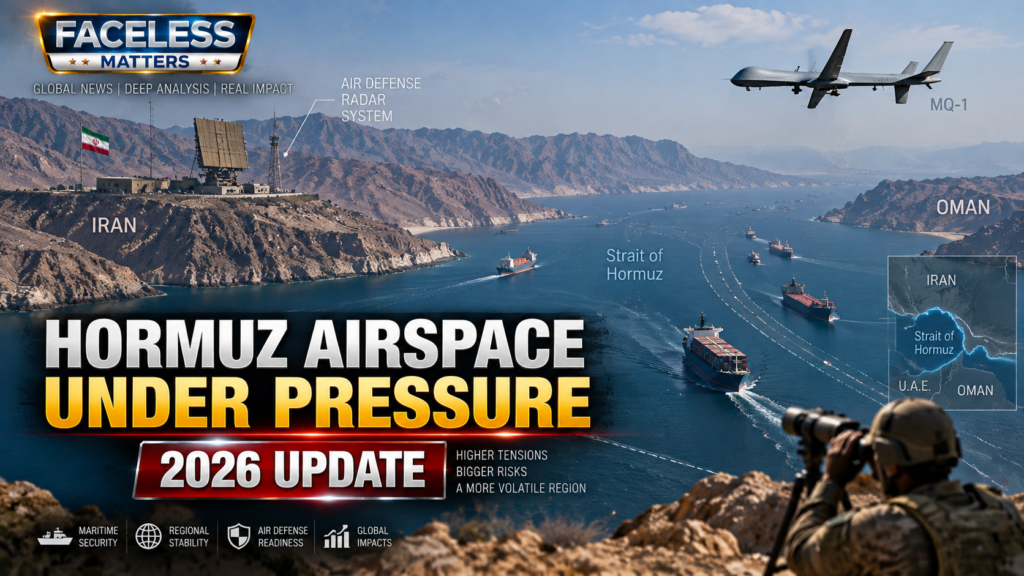
The second signal is geographical, because the Iran MQ-1 drone report concerns one of the world’s most strategically important maritime corridors.
The Strait of Hormuz is not an ordinary military operating area.
It is one of the world’s most important energy corridors, connecting the Persian Gulf with the Gulf of Oman and wider international maritime routes.
The waterway has already been at the center of intense military and economic pressure.
A reported drone interception over this area therefore affects more than military planners.
It can influence:
- commercial shipping;
- maritime insurance;
- tanker operations;
- oil prices;
- regional diplomacy;
- and investor confidence.
FACELESS MATTERS has previously examined how disruption around Hormuz can create wider energy-market consequences.
The Iran MQ-1 drone claim adds an air-domain dimension to an already complicated maritime-security environment.
Signal Three: The Information War Matters
Modern conflicts are fought in two environments simultaneously.
One is the physical battlefield.
The other is the information environment.
A reported drone interception can become powerful strategic messaging because it gives governments an opportunity to demonstrate that sophisticated military technology is vulnerable.
For Iran, showing that an American unmanned aircraft can allegedly be intercepted supports a deterrence narrative.
For the United States, the more important issue is whether the loss affects actual operational capability.
These are different questions.
A single drone loss does not automatically change the overall balance of power.
At the same time, repeated losses can force changes in tactics, deployment patterns and force protection.
This is why the Iran MQ-1 drone report should be examined through both the military and information-war lenses.
Signal Four: Military Escalation Risk
The fourth signal is the possibility of another escalation cycle, making the Iran MQ-1 drone report relevant to wider U.S.-Iran military risks.
The historical pattern already provides a warning.
When CENTCOM confirmed the May MQ-1 loss, it said U.S. forces responded by striking Iranian air-defense and drone-related targets.
That does not prove that the same sequence will follow the latest report.
But it demonstrates why unmanned-aircraft incidents can become strategically sensitive.
A possible sequence could be:
drone loss → attribution → military response → counter-response → wider regional risk
The danger becomes greater when the incident occurs around a strategic maritime corridor.
For policymakers, the question is therefore not only:
Was the drone destroyed?
It is also:
What happens after the reported interception?
Signal Five: Oil and Global Markets
The fifth signal is economic, because the Iran MQ-1 drone report comes against a background of shipping, oil and energy-market uncertainty.
The Strait of Hormuz is closely connected to global energy markets. Any new military incident can increase concerns about shipping, insurance and supply security.
Oil markets do not necessarily require an actual physical supply shortage to react.
Expectations can be enough.
If traders believe that military escalation could further restrict shipping, the market can price in additional geopolitical risk.
That can affect:
- crude oil;
- refined fuels;
- tanker rates;
- insurance;
- transportation costs;
- inflation expectations;
- and energy-importing economies.
This matters particularly for countries that depend heavily on imported energy.
The latest Iran MQ-1 drone report therefore has a potential economic dimension even though the aircraft itself is a military asset.
The broader issue is whether repeated incidents eventually affect the confidence of shipping operators and energy traders.
Why the Second Incident Matters
The word “second” is important.
A single reported interception can be treated as an isolated event.
Two reported incidents within a short period raise a different question: is there a developing operational pattern?
At present, there is not enough independently verified evidence to answer that question conclusively.
But if further evidence confirms multiple MQ-1 losses in the same operating environment, military planners would likely need to reassess:
- aircraft routes;
- altitude profiles;
- electronic protection;
- air-defense suppression;
- intelligence collection methods;
- escort and support requirements;
- and the overall cost of unmanned operations.
That would make the incident strategically more important than the loss of a single aircraft.
What We Should Not Assume
Several conclusions would be premature.
The latest report does not by itself prove that Iran has achieved complete control of the airspace over Hormuz.
It does not prove that every MQ-1 operating in the region is vulnerable.
It does not establish that the aircraft was conducting an offensive mission.
It does not establish the precise Iranian weapon used.
And it does not automatically mean that the United States will retaliate.
Those questions require additional evidence.
The responsible approach is to separate:
Iranian claim → available evidence → independent confirmation → strategic analysis.
That is particularly important in a rapidly developing military conflict where competing narratives can appear before independent verification becomes available.
What Happens Next?
The next 24–72 hours could be more informative than the initial announcement.
Readers should watch for five developments.
1. A CENTCOM statement
The most important immediate question is whether the U.S. military confirms, denies or otherwise comments on an MQ-1 loss.
2. Additional evidence
Satellite imagery, aircraft debris, geolocation evidence or credible independent reporting could help establish what actually happened.
3. Iranian technical details
Further Iranian statements could identify the air-defense system, location or circumstances of the interception.
4. U.S. military response
Any new strikes against Iranian air-defense or drone-related infrastructure would raise the escalation risk.
5. Oil and shipping reaction
Changes in tanker traffic, insurance costs and crude prices could reveal whether markets consider the incident isolated or part of a broader escalation.
FACELESS MATTERS Analysis
The most important lesson from this developing story is that modern military power increasingly depends on systems rather than individual weapons.
A sophisticated drone can provide valuable surveillance and operational reach.
An integrated air-defense network can potentially turn that advantage into a vulnerability.
The competition is therefore not simply:
drone versus missile.
It is:
sensor → radar → command network → electronic warfare → air defense → aircraft survivability.
That is why the reported MQ-1 incident deserves attention beyond the aircraft itself.
If confirmed, repeated losses could encourage changes in how unmanned systems are deployed around contested airspace.
For Iran, successful interceptions would strengthen its deterrence narrative.
For the United States, the challenge would be maintaining intelligence and surveillance capabilities while reducing exposure to increasingly sophisticated air defenses.
For the Gulf region, the greatest concern is escalation around a waterway that already carries enormous economic importance.
And for global markets, the key issue remains whether military incidents translate into longer-lasting disruption of energy and shipping.
Conclusion
Iran has reported another U.S. MQ-1 drone interception over the Strait of Hormuz, describing it as the second such incident within roughly 24 hours. The claim is significant, but the latest loss should remain classified as reported rather than independently confirmed until additional evidence emerges.
The bigger story is the intersection of air defense, unmanned warfare, maritime security and energy markets.
If confirmed, repeated incidents could signal a more dangerous operating environment for unmanned aircraft around Hormuz.
If not independently confirmed, the episode still demonstrates how quickly military claims can become part of the wider information war.
Either way, the next response from Washington, Tehran and the markets will matter more than the initial headline.
The Strait of Hormuz remains the central strategic variable.
And the Iran MQ-1 drone episode is another reminder that a single military incident can have consequences far beyond the sky where it occurs.
INTERNAL READING — FACELESS MATTERS
Asim Munir Military Transition — Episode 6: From Education Toward Service
Asim Munir Formative Years — Episode 5: Growing Up in Rawalpindi
Asim Munir Father — Episode 4: Powerful & Remarkable Family Role
FIELD MARSHAL ASIM MUNIR — EPISODE 3: DHERI HASSANABAD AND THE ENVIRONMENT OF HIS CHILDHOOD
FIELD MARSHAL ASIM MUNIR — EPISODE 2: FROM JALANDHAR TO PAKISTAN
SOURCES & EDITORIAL NOTE
IRGC / Iranian reporting — Latest MQ-1 claim
Reported IRGC MQ-1 incident
Iran’s Revolutionary Guard reported that an MQ-1 drone had been intercepted and destroyed over the Strait of Hormuz. The latest report has not been independently confirmed by publicly available U.S. military material at the time of publication.
U.S. Central Command — Previous MQ-1 Loss
CENTCOM official release
CENTCOM previously confirmed that Iranian forces shot down a U.S. MQ-1 operating over international waters and said U.S. forces subsequently struck Iranian air-defense and drone-related sites.
FACELESS MATTERS — Strait of Hormuz Crisis
Strait of Hormuz Crisis: Oil Above $90 in 2026
Used for broader context on Hormuz, energy security, shipping disruption and oil-market risks.
Editorial Note: This article deliberately distinguishes Iranian military claims from independently confirmed facts. The latest reported MQ-1 incident remains a developing story. FACELESS MATTERS does not present the aircraft’s exact mission, operator, location, weapon used or circumstances as confirmed unless reliable evidence establishes them.