

TABLE OF CONTENTS
ASIM MUNIR FATHER — EPISODE 4: SYED SARWAR MUNIR’S ROLE
Before Syed Asim Munir became a senior military commander, Chief of Army Staff and later Field Marshal, his biography began within an ordinary family and community setting in Rawalpindi.
Episode 1 examined the beginning of his story and the family roots associated with Jalandhar.
Episode 2 followed the reported migration journey from Jalandhar to Pakistan and the family’s eventual settlement in Rawalpindi.
Episode 3 examined Dheri Hassanabad and the broader environment of his childhood.
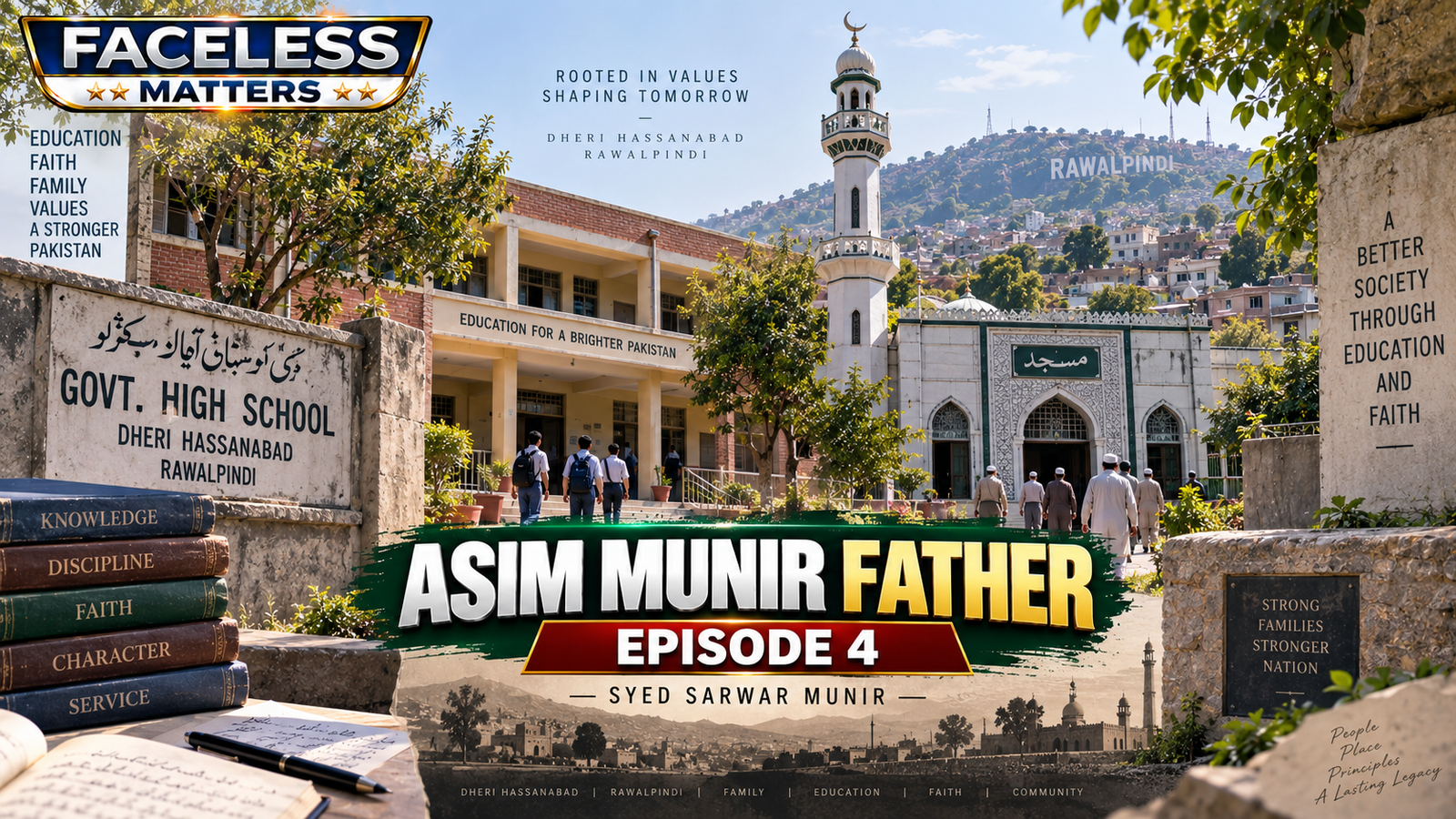
Episode 4 moves one generation closer to the family itself: Syed Sarwar Munir, Asim Munir’s father.
Published biographical accounts describe Syed Sarwar Munir as an educator who also served as an imam at a local mosque in Dheri Hassanabad. Other reporting identifies him as principal of the FG Technical High School in Lalkurti, Rawalpindi.
This episode examines what can responsibly be established about that background — and, equally importantly, what cannot.
Who Was Syed Sarwar Munir?
The available published biographies identify Syed Sarwar Munir as the father of Syed Asim Munir, making the Asim Munir father story an important part of the family’s documented background.
Several reports describe him as a school educator and religious figure in Rawalpindi. India Today described him as a schoolteacher who also served as an imam and delivered Friday sermons at a local mosque. ThePrint similarly described him as a school principal and imam associated with Dheri Hassanabad.
Other Pakistani reporting identifies him more specifically as the principal of FG Technical High School, Lalkurti, Rawalpindi, while also associating him with Masjid-al-Quraish in Dheri Hassanabad.
This combination of roles is one of the most consistently reported elements of the family background.
It places education and religious service within the immediate environment surrounding Asim Munir’s early years.
However, a responsible biography should stop there unless stronger evidence exists.
There is not enough reliable public documentation to reconstruct Syed Sarwar Munir’s complete personal biography, his private conversations with his children, or the exact nature of his influence on every stage of Asim Munir’s later life.
Those details should not be invented.
An Educator in Rawalpindi
The educational role attributed to Syed Sarwar Munir is particularly relevant to understanding the Asim Munir father story and the family’s social environment.
Published reports identify him with a school in Lalkurti, Rawalpindi, and some specifically describe him as its principal.
Education therefore appears as a recurring element in the documented family story.
That does not mean that Asim Munir’s later military career can automatically be explained by his father’s profession.
Such a conclusion would go beyond the available evidence.
What can be said is more modest and more useful:
Asim Munir grew up in a household associated in published reporting with education and religious service.
That is a documented part of the background.
The rest requires caution.
The Religious Role of Syed Sarwar Munir
Published accounts also associate the Asim Munir father, Syed Sarwar Munir, with religious service.
He is reported to have served as an imam at Masjid-al-Quraish in Dheri Hassanabad and to have delivered Friday sermons there.
This detail helps explain why several later biographies describe Asim Munir’s early environment as one in which religious education was present alongside conventional community life.
The connection is especially relevant because other published biographies report that Asim Munir received early religious education at Markazi Madrasa Dar-ul-Tajweed in Rawalpindi.
But again, there is an important distinction.
The evidence establishes an environment.
It does not provide a complete psychological explanation of the future military commander.
A professional biography should avoid turning background information into an unsupported theory of personality.
Dheri Hassanabad and the Family Environment
Dheri Hassanabad is an important recurring location in the first part of this biography.
Earlier episodes established the reported connection between the family and the Rawalpindi locality.
Episode 4 adds another layer to the Asim Munir father story by examining the family and community environment in Dheri Hassanabad.
The available accounts place Syed Sarwar Munir’s religious role within the same broader community environment.
That means the family story was not detached from the neighborhood.
Education, religious activity and community life existed within the same physical setting.
For a biography, geography can matter.
The places where people grow up can help explain the institutions, schools, religious centres and social networks available to them.
But geography should be treated as context rather than destiny.
Dheri Hassanabad can help us understand the environment.
It cannot, by itself, explain the future career of Field Marshal Syed Asim Munir.
Education and Religious Learning Appeared Together
One of the more distinctive elements of the available biographical record is the combination of educational and religious references.
On one side, the family is associated with formal schooling through Syed Sarwar Munir’s reported educational position.
On the other, the father is associated with mosque-based religious service.
Asim Munir’s own early education is also reported to have included religious study at Markazi Madrasa Dar-ul-Tajweed.
This creates a documented picture of a childhood environment in which religious learning was not an isolated element.
It existed alongside school education and ordinary community life.
That is a more defensible observation than attempting to assign a direct cause-and-effect relationship between his father’s occupation and his eventual military leadership.
What Do Reliable Sources Actually Establish?
A useful biography must distinguish between what is well reported and what remains uncertain.
The available material supports several points about the Asim Munir father background and the wider family history.
First: Syed Asim Munir was born in Rawalpindi in 1968.
Second: published accounts connect his family background with Jalandhar and migration to Pakistan after Partition.
Third: the family is reported to have settled in Dheri Hassanabad, Rawalpindi.
Fourth: Syed Sarwar Munir is identified in published reporting as an educator and religious figure.
Fifth: multiple accounts associate him with the FG Technical High School in Lalkurti and with religious service at Masjid-al-Quraish in Dheri Hassanabad.
Sixth: Asim Munir is reported to have received early religious education at Markazi Madrasa Dar-ul-Tajweed.
These points form a reasonable documentary foundation.
Beyond them, the public record becomes thinner.
What We Should Not Assume
There is a temptation in biographies of powerful public figures to explain their later personality through their childhood.
That approach can easily become speculative.
For example, it would be inappropriate to claim without evidence that:
- Syed Sarwar Munir personally decided that Asim Munir would join the military;
- his father’s religious service directly determined Asim Munir’s later leadership style;
- a particular childhood event caused his military ambitions;
- specific private conversations shaped his worldview;
- every later decision can be traced back to his family environment.
The available sources do not establish these claims.
FACELESS MATTERS will therefore maintain a strict distinction between documented family background and interpretation.
That distinction will become increasingly important as this 100-episode biography reaches the military career.
Why the Father’s Profession Matters to the Biography
The significance of the Asim Munir father background is not that it provides a simple explanation for Asim Munir’s career.
Its value lies in establishing the environment in which the future military leader grew up.
An educator’s household naturally exists within an institutional world of schools, students and learning.
An imam’s role exists within a community world of worship, sermons and social interaction.
When both descriptions appear in the published record, they provide a useful picture of the family environment without requiring speculation.
That is precisely the kind of context a long-form biography needs.
The purpose is not to manufacture a heroic origin story.
It is to build a documented chronology.
The Difference Between Family Background and Personal Achievement
Asim Munir’s later military achievements are documented independently of the Asim Munir father background and wider family history.
The Government of Pakistan states that he was commissioned in April 1986 into the 23 Frontier Force Regiment and was the recipient of the Sword of Honour of the 17th Officers Training School course. The official biography also records later command, staff and intelligence assignments.
Those achievements belong to his professional record.
The documented Asim Munir father background should therefore remain separate from the professional achievements that came through his own military career.
They should not be retroactively attributed to his father’s occupation.
This distinction strengthens the biography.
It allows readers to understand both:
where he came from
and
what he later achieved
without confusing family background with professional accomplishment.
From Dheri Hassanabad Toward the Military Path
The chronological sequence now becomes clearer.
The family background is connected to migration from Jalandhar.
The family later settled in Rawalpindi.
Dheri Hassanabad became an important part of the reported family environment.
Syed Sarwar Munir appears in published biographies as an educator and imam.
Asim Munir received early religious education in Rawalpindi.
Then, at a later stage, his life moved toward military training.
The official Pakistani record confirms that he entered military service through the Officers Training School route and was commissioned into the 23 Frontier Force Regiment in 1986.
That transition will be explored more deeply in later episodes.
For Episode 4, the important point is simply that the Asim Munir father story is one part of the family context, not a complete explanation. A careful chronology matters because family background can show the setting in which a person grew up without proving why that person later made particular professional choices. In this case, the documented record gives readers useful information about education, religious service and community life in Rawalpindi. It also provides continuity between the earlier family-history episodes and the later stages of the biography. At the same time, the available evidence does not justify turning those details into a fixed explanation of military ambition or leadership. Keeping that boundary clear makes the narrative more credible and gives readers a stronger basis for understanding what is documented, what is reasonably interpreted, and what remains unknown. The biography can therefore move forward without overstating the influence of any single family factor.
Before the military institution came the family and community environment.
A Family Story Should Not Become a Myth
The further a public figure rises, the easier it becomes for biographies to turn ordinary early-life details into symbolic stories.
That can make an article more dramatic.
It does not necessarily make it more accurate.
The available information about the Asim Munir father, Syed Sarwar Munir, is valuable precisely because it is relatively straightforward.
He is reported as an educator.
He is reported as an imam.
He was associated with Rawalpindi.
His family environment was connected with Dheri Hassanabad.
These details are enough to establish an important layer of the biography.
There is no need to invent dramatic childhood scenes around them.
What Episode 4 Adds to the 100-Episode Biography
Episode 1 established the beginning of the story.
Episode 2 examined the family’s reported migration history.
Episode 3 examined Dheri Hassanabad and the childhood environment.
Episode 4 now identifies the documented role of the father within that environment.
This creates a more complete foundation before the biography moves toward adolescence, education and military ambition.
The chronological method is deliberate.
A long biography should not begin with the most famous events and then work backward.
It should allow the reader to understand how the story developed.
That is particularly important when the subject eventually becomes one of Pakistan’s most prominent military figures.
FACELESS MATTERS Analysis
The most useful conclusion from the available evidence is not that the Asim Munir father, Syed Sarwar Munir, “created” the future Field Marshal.
There is insufficient evidence for such a claim.
The stronger conclusion is that Asim Munir’s documented early environment included a father associated with education and religious service, within a Rawalpindi community setting.
That gives the biography an important social and institutional context.
It also helps explain why early education and religious learning appear repeatedly in published accounts of his youth.
But a responsible biography must resist the temptation to turn context into causation.
A person’s later career is shaped by many factors: education, personal choices, institutions, professional opportunities, mentors, training, historical circumstances and decisions made over decades.
The father is one part of the story.
He is not the entire explanation.
That distinction is particularly important for a 100-episode biography because the further the series progresses, the more evidence will become available about Asim Munir’s own professional decisions and responsibilities.
Looking Ahead to Episode 5
The next episode should move naturally from the family environment toward the young Asim Munir himself.
The focus will be the formative years in Rawalpindi:
- education;
- community environment;
- reported interests;
- the development of the young student;
- and the transition toward the choices that eventually led him toward military service.
This will allow the biography to move gradually from family background to personal development, and later from personal development to professional life.
Conclusion: The Family Context Before the Uniform
Before the military uniform, there was a family environment.
Before command appointments, there was a neighborhood.
And before the public career of Field Marshal Syed Asim Munir, there was a household associated in published reporting with education and religious service.
Syed Sarwar Munir’s reported role as an educator and imam provides an important piece of that early-life record.
But the responsible conclusion is deliberately measured.
The sources establish the family environment.
The Asim Munir father story adds important family context to that record while leaving later professional achievement to the documented military history.
They do not provide enough evidence to write an invented psychological portrait.
That distinction is not a weakness in the biography.
It is its strength.
A serious historical profile should tell readers what the evidence supports — and clearly identify what remains unknown.
The documented Asim Munir father background therefore adds essential family context without becoming an unsupported explanation for the Field Marshal’s later career.
Episode 4 therefore adds another documented layer to the story:
Jalandhar → Pakistan → Rawalpindi → Dheri Hassanabad → family and educational environment → the formative years ahead.
The military career comes later.
For now, the story remains at home.
Source Verification & Analysis
The principal biographical claims in this episode were cross-checked against multiple published and official sources.
- India Today — Reports that Syed Asim Munir Ahmed Shah was born in Rawalpindi, that his father Syed Sarwar Munir’s family migrated from Jalandhar after Partition, that his father was a schoolteacher who also served as an imam, and that Asim Munir studied at Markazi Madrasa Dar-ul-Tajweed in Rawalpindi.
- ThePrint — Reports that Asim Munir was born in Rawalpindi to a family that migrated from Jalandhar after Partition and identifies his father, Syed Sarwar Munir, as a school principal and imam associated with Dheri Hassanabad. It also reports his early Islamic education at Markazi Madrasa Dar-ul-Tajweed.
- Reuters factbox via ThePrint — Provides additional background on Munir’s early life, identifying him as the son of a schoolteacher and confirming the broader Rawalpindi and military-service context.
- Government of Pakistan — Press Information Department — Provides the official current institutional record confirming that President Asif Ali Zardari approved Field Marshal Syed Asim Munir’s concurrent appointment as Chief of Defence Forces for five years on December 4, 2025.
Where sources differ slightly over the precise description of Syed Sarwar Munir’s educational position, FACELESS MATTERS uses the common factual ground rather than presenting an uncertain employment detail as absolute fact.
The article deliberately avoids inventing private conversations, childhood memories or unsupported claims that the father’s profession directly caused Asim Munir’s later military career.
Fresh News Link
For the latest official institutional context, the Government of Pakistan’s Press Information Department reported on December 4, 2025 that President Asif Ali Zardari approved Field Marshal Syed Asim Munir’s concurrent appointment as Chief of Defence Forces for a five-year period.
Read the latest official Government of Pakistan update.
INTERNAL READING — FACELESS MATTERS
1. Asim Munir Childhood — Episode 3: Powerful Foundations
This directly precedes Episode 4 and examines Dheri Hassanabad, childhood environment and the early educational setting.
2. Asim Munir Family History — Episode 2: The Remarkable Journey from Jalandhar to Pakistan
This provides the earlier family-migration context needed to understand how the family reached Pakistan and eventually Rawalpindi.
3. Episode 1 — The Beginning and Family Roots
The opening episode establishes the earliest chronological foundation of the 100-episode biography series.
Suggested Future Internal Articles
Episode 5 — Asim Munir Formative Years: Growing Up in Rawalpindi
Focus: education, community environment, interests and the documented transition toward adulthood.
Episode 6 — Asim Munir Military Ambition: From Education to Service
Focus: the transition from early education toward the military path.
Episode 7 — Asim Munir OTS 1986: The Road to Commissioning
Focus: Officers Training School, the 17th OTS course, Sword of Honour and commissioning into the 23 Frontier Force Regiment.
These are future article ideas only. No unpublished URLs are being invented.
[…] Asim Munir Father — Episode 4: Remarkable Family Legacyhttps://facelessmatters.com/asim-munir-father-episode-4/ […]
[…] Asim Munir Father — Episode 4: Remarkable Family Legacy […]