

Key Takeaway
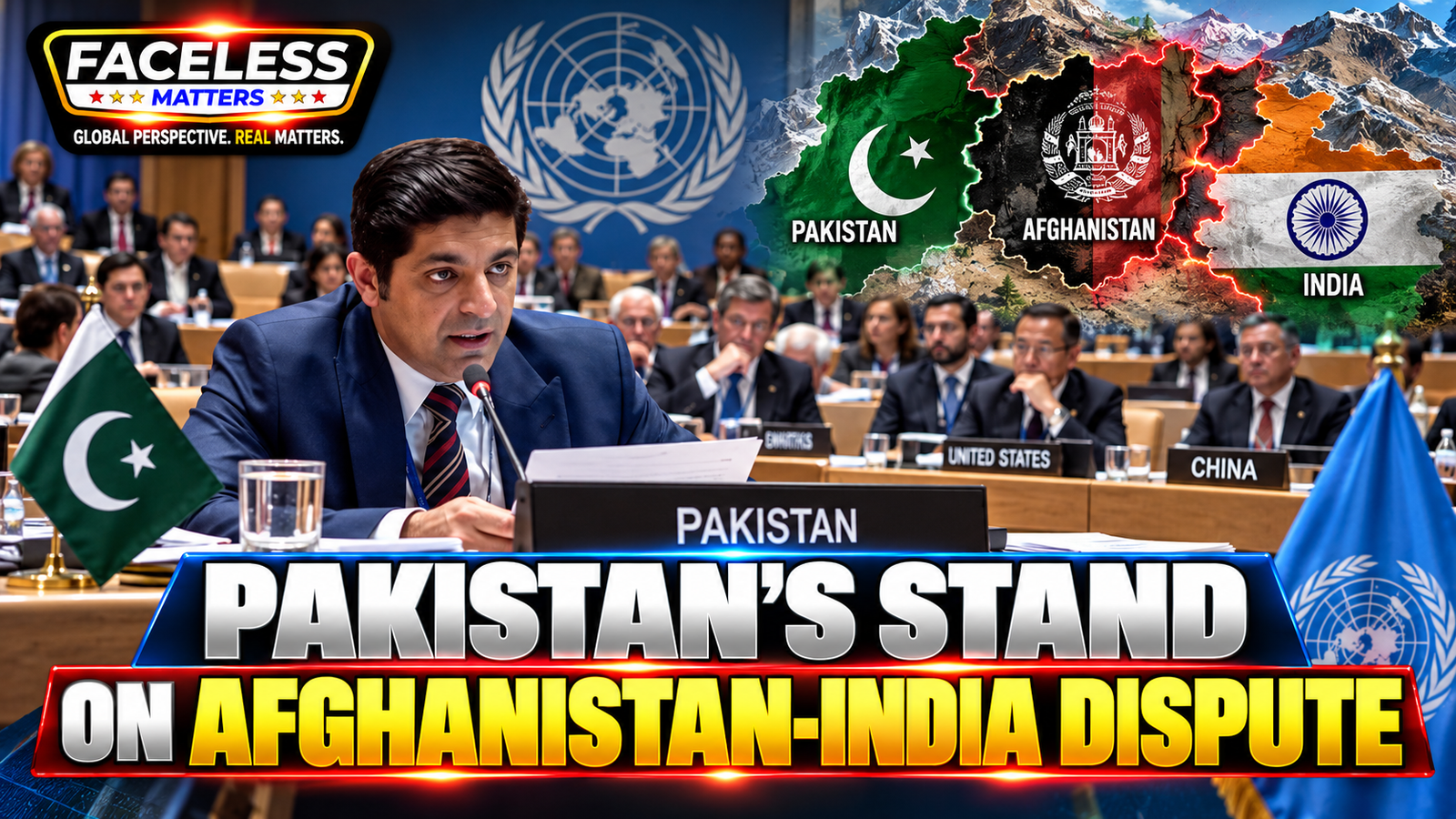
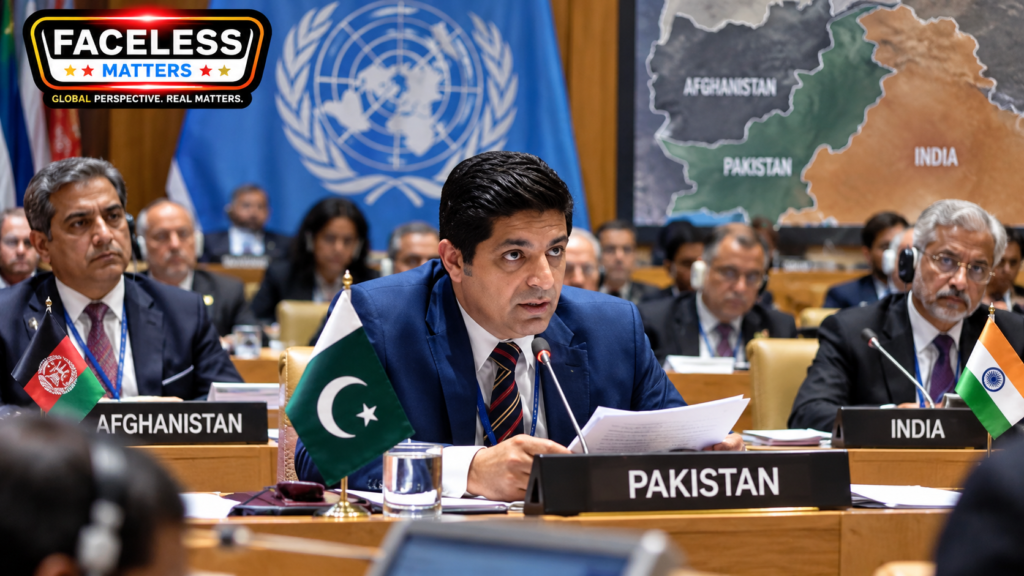
India Taliban support is at the center of a serious allegation raised at the United Nations, where Counsellor Muhammad Jawad Ajmal of the Permanent Mission of Pakistan said that India is providing material and logistical assistance to the Taliban government under the cover of humanitarian aid for terrorist attacks against Pakistan.
The allegation is part of a wider and increasingly contested dispute over India–Afghanistan relations, Pakistan’s security concerns, Taliban governance, cross-border militancy and competing narratives at international forums.
India Taliban support allegations therefore need to be examined alongside the wider security and diplomatic relationship between New Delhi, Kabul and Islamabad.
However, an important editorial distinction is necessary: the specific allegation reported by Daily Jang is a statement by a Pakistani diplomat, not an independently established fact. Publicly available Indian statements reviewed by FACELESS MATTERS document substantial humanitarian, development and logistical assistance to Afghanistan, while India presents that engagement as support for Afghan stability and development. Permanent Mission of India to the UN
This report therefore separates Pakistan’s allegation, India’s documented position, independently reported context and FACELESS MATTERS analysis.
TABLE OF CONTENTS
What Happened at the United Nations?
According to Daily Jang’s report published on 8 October 2026, Muhammad Jawad Ajmal, Counsellor at Pakistan’s Permanent Mission, responded to remarks made by an Indian representative and alleged that India was providing material and logistical assistance to the Taliban government under the cover of humanitarian assistance.
He further alleged that India was actively supporting proxies inside Afghanistan and assisting groups that Pakistan identifies as terrorist organisations, including the TTP and BLA. He also referred to allegations concerning India’s involvement in extraterritorial killings and targeted operations. Jang
The diplomat said Pakistan would defend its sovereignty, territorial integrity, population and national security.
The immediate significance of the statement is diplomatic rather than judicial.
There is a difference between a government representative making an allegation at an international forum and an international body independently establishing that allegation as fact.
That distinction is particularly important in India–Pakistan disputes, where competing accusations regarding terrorism, proxies, Afghanistan and cross-border security have repeatedly appeared in international diplomatic exchanges.
India Taliban Support: What Exactly Is Pakistan Alleging?
The India Taliban support allegation reported by Daily Jang contains several connected elements, while the India Taliban support claim itself requires careful evidence-based assessment.
Pakistan’s diplomat alleged that:
- India is providing material assistance to the Taliban authorities.
- The assistance is being provided under the cover of humanitarian aid.
- India is allegedly using logistical support to advance objectives against Pakistan.
- Indian support allegedly extends to proxies operating from Afghan territory.
- Pakistan associates some of these alleged networks with the TTP and BLA.
- Pakistan views these activities as part of a wider external-security challenge.
These are serious allegations.
But they should not be converted into established facts without independent evidence.
The Daily Jang report itself attributes the claims to Muhammad Jawad Ajmal. It does not provide documentary evidence, an independently verified intelligence file, or an international investigation establishing the alleged material and logistical support. Jang
That is why responsible reporting should use terms such as “Pakistan alleges,” “according to the Pakistani diplomat,” and “the claim has not been independently established” rather than presenting the allegation as a proven fact.
India’s Documented Position on Afghanistan
India’s public record provides an important part of the broader picture.
In a September 2026 statement to the UN Security Council on Afghanistan, India’s Permanent Representative said India supported peace, stability and development in Afghanistan and described its relationship with Afghanistan as a longstanding partnership.
India stated that it had more than 500 development partnership projects across all 34 Afghan provinces and said its programmes covered healthcare, infrastructure, education, humanitarian assistance and capacity building. Permanent Mission of India to the UN
India also reported supplying more than 50,000 tonnes of wheat, more than 450 tonnes of medicines and vaccines, and 40,000 litres of pesticides to Afghanistan since August 2021.
The same statement said India was providing medical equipment, essential medicines, assistance for Afghan returnees, scholarships and support for economic and trade links. Permanent Mission of India to the UN
This establishes an important factual point:
India openly acknowledges substantial material, humanitarian and logistical engagement with Afghanistan.
What remains disputed is the purpose and nature of that assistance. The India Taliban support allegation therefore requires a distinction between documented humanitarian engagement and claims about security-related use of that assistance. Publicly available statements can establish that India has provided humanitarian, development and logistical assistance to Afghanistan, but they do not by themselves establish that such assistance was intended to support attacks against Pakistan. Any stronger conclusion would require independently verifiable evidence linking specific assistance, personnel, institutions or resources to prohibited activity. This distinction is essential for responsible reporting because allegations made in diplomatic forums should be clearly identified as allegations unless independently supported by evidence.
India describes it as humanitarian and development assistance.
Pakistan alleges that at least part of the broader Indian engagement is being used for activities harmful to Pakistan.
Those are two fundamentally different interpretations of some of the same regional activity.
Why the Difference Between Humanitarian Assistance and Security Support Matters
The distinction is central to the India Taliban support controversy, and the India Taliban support allegation requires careful evidence-based assessment.
and the India Taliban support allegation should not be treated as independently established without evidence.
Humanitarian assistance can include:
- Food
- Medicines
- Vaccines
- Medical equipment
- Disaster-relief supplies
- Shelter materials
- Educational assistance
- Agricultural inputs
- Support for health facilities
India’s own UN statements document many of these categories. In June 2026, for example, India reported delivering flood-relief supplies and vaccines and described healthcare and infrastructure projects in Afghanistan. Permanent Mission of India to the UN
Security or military assistance would be fundamentally different.
It could potentially involve:
- Weapons
- Intelligence
- Training
- Operational logistics
- Financing of armed groups
- Communications support
- Military equipment
- Assistance designed to facilitate attacks
The current Daily Jang report contains Pakistan’s allegation that material and logistical assistance is being used against Pakistan, but the report does not independently establish that India’s humanitarian programmes are being diverted into such activities. Jang
That is precisely where evidence becomes critical.
The Afghanistan Dimension
The India Taliban support controversy cannot be separated from the broader deterioration in Pakistan–Afghanistan security relations.
Pakistan has repeatedly accused Afghan territory of being used by militant organisations to plan or launch attacks against Pakistan.
Pakistan’s Foreign Ministry stated in February 2026 that attacks attributed by Islamabad to Fitna-al-Khawarij and Fitna-al-Hindustan were emanating from Afghan territory and accused the Taliban authorities of providing support and backing to such groups. Pakistan said it reserved the right to act in self-defence under international law. Ministry of Foreign Affairs Pakistan
Pakistan has also continued diplomatic efforts alongside security measures.
In a September 2026 briefing, Pakistan’s Foreign Ministry said Islamabad had used direct engagement as well as mediation through countries including Qatar, Türkiye and China to address the Afghanistan issue. It said Pakistan remained prepared to reopen borders and restore trade and transit if terrorism concerns were addressed. Ministry of Foreign Affairs Pakistan
This demonstrates that Islamabad’s Afghanistan policy is not based solely on military pressure.
It combines:
Security + diplomacy + border management + counterterrorism + regional engagement.
India Taliban Support and the Changing India–Afghanistan Relationship
India’s relationship with the Taliban-led Afghanistan has changed substantially from the period before 2021.
India’s relationship with Taliban-ruled Afghanistan has changed substantially from the period before 2021.
India historically supported the Afghan Republic and was not politically aligned with the Taliban during their previous period of rule.
After the Taliban returned to power in 2021, however, India gradually increased practical engagement with Afghan authorities and maintained a presence in Kabul.
India’s September 2026 UN statement described continuing bilateral consultations on humanitarian assistance, development, healthcare, food security, counter-narcotics, education, trade and connectivity. Permanent Mission of India to the UN
The India Taliban support debate therefore exists within a larger regional transformation.
India wants influence and engagement in Afghanistan.
Pakistan wants security guarantees and an Afghan government that does not permit attacks against Pakistani territory.
The Taliban authorities seek international engagement, economic assistance and greater regional connectivity.
These objectives overlap in some areas but conflict in others.
The TTP and BLA Allegations
Pakistan’s diplomat specifically referred to the TTP and BLA in the remarks reported by Daily Jang. Jang
These allegations should be understood within Pakistan’s broader security narrative.
Pakistan has repeatedly said that militant organisations operating from or connected to Afghanistan pose a serious threat to its citizens and security forces.
International reporting has also documented the continuing dispute over militant activity in Afghanistan.
For example, the Associated Press reported in October 2026 on Pakistani military allegations concerning a meeting in Kandahar involving representatives of the BLA, AQIS and another militant group, while noting that Afghan Taliban representatives denied the allegations and that security experts expressed skepticism about aspects of the claimed coordination. AP News
This is important because it demonstrates why India Taliban support claims require careful attribution.
There are multiple layers:
- Pakistan’s official security allegations.
- Afghanistan’s denials.
- India’s denials or alternative explanations where applicable.
- Intelligence-based claims reported by media.
- Independent evidence that may or may not be available.
- International assessments.
A credible news report should keep those layers separate.
India Taliban Support: What Evidence Is Publicly Available?
At present, the public evidence reviewed for this report supports the following:
Established: India openly provides extensive humanitarian and development assistance to Afghanistan. Permanent Mission of India to the UN
Established: India has maintained diplomatic and practical engagement with Afghan authorities.
Established: Pakistan publicly alleges that India is using Afghan territory, proxies and material/logistical support in ways harmful to Pakistan. Jang
Established: Pakistan and India have repeatedly exchanged accusations over terrorism and cross-border activities.
Not independently established by the sources reviewed: That India’s documented humanitarian assistance is being diverted to facilitate terrorist attacks against Pakistan.
Not established by the Daily Jang report itself: A specific quantity, shipment, intelligence document or independently verified operational mechanism proving the alleged Indian logistical support.
That distinction should remain central to the article.
Why Pakistan Is Raising the Issue Internationally
Pakistan’s decision to raise such allegations at international forums serves several possible diplomatic purposes.
First, it places Pakistan’s security concerns on the international record.
Second, it seeks international attention toward alleged cross-border militant networks.
Third, it challenges India’s narrative that its engagement in Afghanistan is exclusively humanitarian and developmental.
Fourth, it links Afghanistan with the wider question of terrorism financing, proxies and regional security.
Fifth, it gives Pakistan an opportunity to argue that counterterrorism discussions should address not only non-state actors but also alleged state support for armed groups.
Pakistan has made similar arguments in earlier UN discussions.
In October 2025, Muhammad Jawad Ajmal told a UN counterterrorism-related discussion that terrorism should be addressed at stages including recruitment, financing and cross-border threats. Arab News
This indicates that the latest statement is part of a longer Pakistani diplomatic approach rather than an isolated comment.
The International Community Faces a Difficult Verification Challenge
The India Taliban support dispute illustrates a wider problem in international security reporting.
Modern proxy conflicts rarely produce simple evidence.
States may possess intelligence that cannot be publicly released.
Militant organisations may operate through intermediaries.
Humanitarian and development networks may exist alongside security structures.
And rival governments may present entirely different interpretations of the same events.
This makes independent verification particularly important.
International institutions, journalists and researchers need to distinguish between:
Evidence → allegation → denial → interpretation.
If those categories are mixed together, public understanding quickly becomes distorted.
What Would Stronger Evidence Look Like?
If Pakistan wants the international community to accept its allegations concerning Indian assistance to militant groups, stronger publicly verifiable evidence would increase the credibility of the claim.
Such evidence could include independently authenticated:
- Financial-transfer records
- Communications intercepts
- Weapons-tracing evidence
- Photographic or satellite evidence
- Identifiable logistics records
- Court documents
- Captured operational material
- Independent intelligence assessments
- Verified testimony
- International investigative findings
Conversely, India could strengthen its own position by providing transparent documentation showing that its Afghan assistance is distributed through recognised humanitarian, UN or development mechanisms and is not being diverted to armed actors.
This would move the debate away from competing diplomatic assertions toward verifiable evidence.
Regional Security Implications
The India Taliban support controversy has implications beyond Pakistan and Afghanistan.
Afghanistan occupies a strategically important position between South Asia, Central Asia and Iran.
India sees Afghanistan as an important regional partner and development space.
Pakistan views Afghan stability through the lens of border security and terrorism.
Central Asian states are concerned about militant networks, narcotics and regional connectivity.
China has interests in regional stability, terrorism prevention and economic connectivity.
Iran has its own security and border interests.
Therefore, the Afghanistan question increasingly forms part of a wider regional-security equation.
What Pakistan Can Do Diplomatically
Pakistan’s most effective international approach would require evidence-based diplomacy.
1. Present verifiable evidence
Specific allegations should be supported wherever possible by material that can be independently examined.
2. Keep humanitarian issues separate
Afghan civilians should not become collateral victims of geopolitical competition.
3. Maintain international engagement
Pakistan can continue raising cross-border terrorism concerns at the UN and through bilateral diplomacy.
4. Strengthen border security
Better surveillance, documentation and lawful border management can reduce infiltration risks.
5. Continue regional diplomacy
Engagement with Afghanistan’s neighbours and other influential states can create additional pressure for verifiable counterterrorism commitments.
6. Preserve a diplomatic channel
Even amid serious disagreements, communication with Kabul remains important.
What India Can Do to Address the Allegations
India’s documented humanitarian assistance is substantial, and India has publicly presented it as support for the Afghan people. Permanent Mission of India to the UN
However, because Pakistan has raised specific security allegations, greater transparency about assistance mechanisms could help reduce suspicion.
That could include:
- Clear aid-distribution mechanisms
- Greater coordination with UN agencies
- Transparent project documentation
- Independent monitoring where practical
- Clear separation between humanitarian programmes and security activities
Such measures would not resolve the political dispute by themselves, but they could improve confidence in the humanitarian component of India’s Afghan engagement.
FACELESS MATTERS Analysis
The central issue is not simply whether India has a relationship with the Taliban authorities.
It clearly does.
The central question is what type of support is being provided, through which channels, for what purposes, and with what independently verifiable evidence.
India’s own public statements establish significant humanitarian, development and logistical engagement with Afghanistan. Permanent Mission of India to the UN
Pakistan’s public statements establish that Islamabad believes some Indian engagement goes beyond humanitarian assistance and supports activities harmful to Pakistan. Jang
Those two facts can exist simultaneously without automatically proving the more serious allegation.
That is why FACELESS MATTERS does not present the India Taliban support allegation as independently proven.
Instead, the evidence currently supports a more precise conclusion:
Pakistan has formally and publicly accused India of using its engagement with Afghanistan to provide material and logistical assistance that allegedly facilitates attacks against Pakistan, while India publicly describes its Afghan engagement as humanitarian, developmental and aimed at stability. The specific allegation of support for terrorist operations requires additional independently verifiable evidence.
This distinction is essential for responsible journalism, especially where accusations involve terrorism, state sponsorship and possible military escalation.
What Happens Next?
The issue is likely to remain part of the broader Pakistan–India and Pakistan–Afghanistan diplomatic dispute.
The key developments to watch are:
- Whether Pakistan presents additional evidence.
- Whether India formally responds to the latest allegation.
- Whether Afghan authorities comment on the claim.
- Whether the issue appears in future UN counterterrorism discussions.
- Whether new intelligence or investigative reporting provides independent verification.
- Whether Pakistan and Afghanistan resume meaningful security dialogue.
- Whether regional states become more involved in counterterrorism diplomacy.
For Pakistan, the challenge will be to convert security allegations into internationally credible evidence and diplomatic pressure.
For India, the challenge will be to demonstrate that its growing Afghan engagement remains consistent with its stated humanitarian and development objectives.
For Afghanistan, the larger challenge remains preventing its territory from becoming a platform for attacks against neighbouring states.
Final FACELESS MATTERS Assessment
The statement by Muhammad Jawad Ajmal is a significant diplomatic allegation, but it should be reported as an allegation rather than an independently established fact.
Pakistan says India is providing material and logistical support to the Taliban government under the cover of humanitarian assistance and alleges that Indian-backed networks are supporting groups responsible for attacks against Pakistan. Jang
India’s publicly available UN statements confirm extensive humanitarian, development and logistical engagement with Afghanistan, including food, medicines, vaccines, healthcare projects, scholarships, agricultural assistance and trade facilitation. Permanent Mission of India to the UN
The unresolved question is whether any part of that engagement is being diverted or used for covert security operations against Pakistan.
The sources reviewed for this report do not independently establish that specific claim.
That does not invalidate Pakistan’s concern.
Nor does it establish India’s innocence regarding an allegation that would require evidence beyond humanitarian programmes.
It means the appropriate journalistic position is to document the allegation, present the available evidence, acknowledge the competing positions and avoid converting an unverified claim into a fact.
For FACELESS MATTERS, this is the most important editorial lesson from the latest development:
In a highly contested regional security environment, credible journalism must be stronger than propaganda from any side.
INTERNAL READING — FACELESS MATTERS
- Pakistan at a Critical Hour: What Regional War, Oil Shock and Political Protests Mean for the Nation
- [Kashmir Black Day 2026: Strong Protest Marks India`s Independence Day](https://facelessmatters.com/kashmir-black-day-2026/?utm_source=chatgpt.com)
SOURCES & EDITORIAL NOTE
Daily Jang — Primary News Trigger
بھارت طالبان حکومت کو مادی اور لاجسٹک معاونت فراہم کر رہا ہے، محمد جواد اجمل — Daily Jang
Primary source for the reported statement by Muhammad Jawad Ajmal and Pakistan’s allegations concerning Indian material and logistical assistance.
Permanent Mission of India to the UN — Afghanistan Statement, September 2026
India’s UN statement on Afghanistan — September 2026
Provides India’s documented position concerning humanitarian assistance, development projects, healthcare, trade, education and engagement with Afghanistan.
Permanent Mission of India to the UN — Afghanistan Statement, June 2026
India’s UN statement on Afghanistan — June 2026
Provides further details of India’s humanitarian assistance and development activities in Afghanistan.
Government of Pakistan — Ministry of Foreign Affairs
Pakistan’s position on attacks and security concerns from Afghan territory
Government of Pakistan — Foreign Ministry Briefing
Pakistan Foreign Ministry briefing on Afghanistan relations and mediation
Provides Pakistan’s official position regarding alleged terrorism emanating from Afghan territory and its stated security response.
Provides context on Pakistan’s diplomatic engagement with Afghanistan and mediation efforts.
Associated Press — Regional Security Context
Pakistan’s allegations concerning militant coordination in Afghanistan — AP
Provides independent reporting and attribution concerning Pakistani military allegations and Afghan denial.
Editorial Note
This article distinguishes between reported allegations, official statements, documented humanitarian activity and FACELESS MATTERS analysis. The claim that India is providing material and logistical support for terrorist attacks against Pakistan is attributed to Pakistani diplomat Muhammad Jawad Ajmal and is not presented as independently established fact. India’s documented humanitarian and development engagement with Afghanistan is separately reported from Indian official sources. FACELESS MATTERS has not treated humanitarian assistance itself as evidence of covert terrorist support.