

Date: 7 October 2026
Key Takeaway
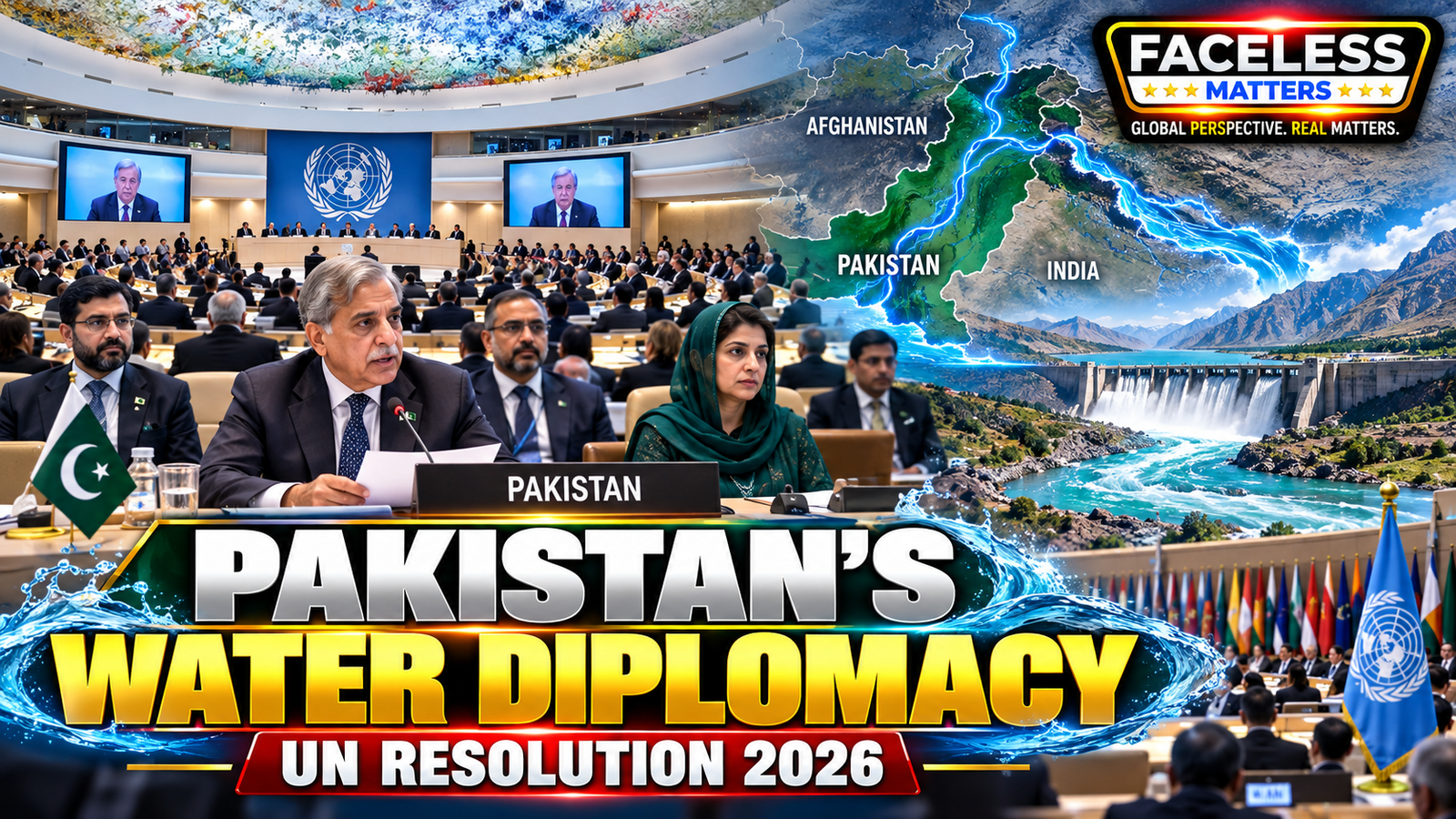
Pakistan water diplomacy is at the center of this development. Pakistan has achieved a notable diplomatic outcome at the United Nations Human Rights Council after a resolution on the human rights to safe drinking water and sanitation was adopted without a vote, with an explicit reference to transboundary water cooperation retained in the final text.
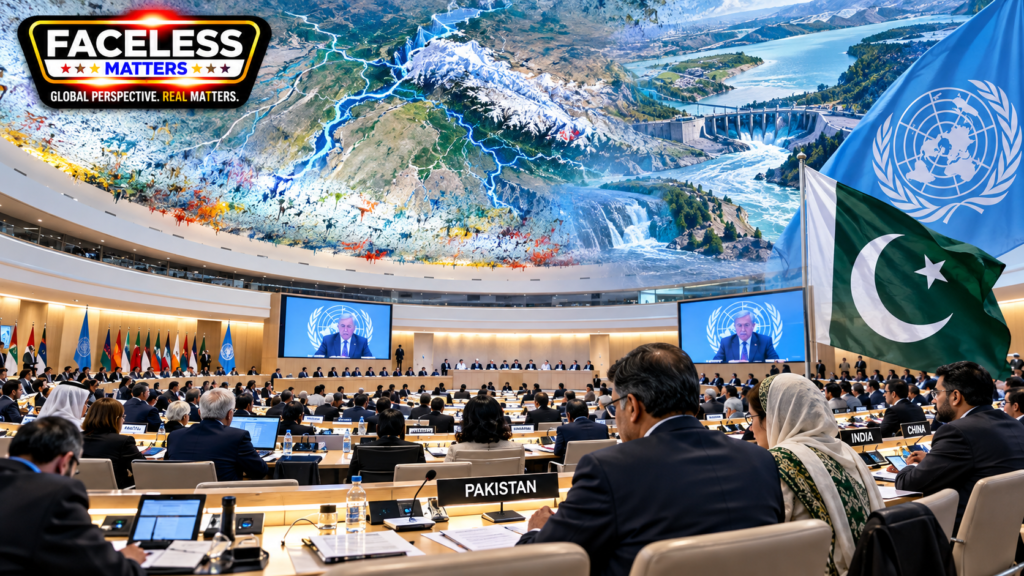
The resolution was presented by Germany and Spain during the 63rd session of the UN Human Rights Council in Geneva. Pakistan played an active role in arguing that cooperation over shared waters is directly connected to the human right to safe drinking water and sanitation. UN Web TV
For Pakistan, this development gives its water diplomacy a broader human-rights and international-cooperation dimension. The issue is not only about the Indus River system or relations between neighboring states; it is also about the principle that shared water resources require cooperation, responsibility and respect for international obligations.
FACELESS MATTERS congratulates Pakistan on this constructive diplomatic achievement and welcomes the country’s emphasis on cooperation, dialogue, international law and responsible management of shared water resources.
What Happened at the UN Human Rights Council?
The development took place during the 63rd regular session of the United Nations Human Rights Council in Geneva, which ran from September 7 to October 7, 2026. HRC Portal
The measure was draft resolution A/HRC/63/L.34, titled “The human rights to safe drinking water and sanitation.” The United Nations record identifies Germany and Spain as the sponsors of the draft. UN Web TV records that the resolution was ultimately adopted without a vote. UN Web TV
The central issue for Pakistan was the inclusion of language concerning transboundary water cooperation.
According to reporting from Daily Jang, Pakistan’s diplomatic efforts contributed to retaining an explicit reference to transboundary water cooperation in the final text. The report says India had sought to remove that reference, while Pakistan argued that cooperation over shared waters was directly connected to the human rights to safe drinking water and sanitation. Daily Jang
The significance of this development is therefore broader than the adoption of another water-related human-rights resolution.
It places the principle of cooperation over shared water resources inside a human-rights discussion at a major multilateral institution.
Pakistan water diplomacy now has a stronger multilateral context.
Why This Resolution Matters for Pakistan
Pakistan is a water-dependent country whose agriculture, food production, energy systems, communities and wider economy are closely connected to the Indus River system.
That makes Pakistan water diplomacy more than a conventional foreign-policy issue.
It is simultaneously a question of:
- water security;
- food security;
- economic stability;
- environmental sustainability;
- regional peace;
- international law;
- human rights;
- and long-term national resilience.
Pakistan’s official position has repeatedly emphasized that shared rivers should become a source of cooperation rather than confrontation.
At an International Water Symposium in Vienna on October 6, Deputy Prime Minister and Foreign Minister Ishaq Dar said water security was inseparable from food, economic and national security. He also stressed Pakistan’s commitment to dialogue, diplomacy and cooperation over shared waters while reaffirming the country’s position regarding the Indus Waters Treaty. Radio Pakistan
This gives the current UN development a wider context.
Pakistan water diplomacy can strengthen this approach by keeping cooperation at the center of its international messaging.
Pakistan water diplomacy can use this framework to emphasize cooperation.
Pakistan’s Diplomatic Position
During consideration of the resolution, Pakistan was represented by First Secretary Adeel Mumtaz Khokhar.
According to the UN proceedings and contemporary reporting, Pakistan argued that shared water resources involve shared responsibilities. Islamabad also objected to the use of water as a means of political pressure or coercion. UN Web TV
Pakistan’s argument can be understood through three interconnected principles.
First: Shared Water Creates Shared Responsibility
When countries depend on the same river system, decisions taken upstream can have consequences downstream.
That creates an inherent need for communication, data sharing, technical cooperation and predictable rules.
Second: Water Should Not Become an Instrument of Coercion
Pakistan has argued that water should not be used as political leverage or as an instrument of confrontation.
This position is particularly important in regions where major rivers cross international boundaries.
Third: Water Cooperation Is Connected to Human Rights
Pakistan’s diplomatic argument at the Human Rights Council was that transboundary cooperation is directly relevant to achieving the human rights to safe drinking water and sanitation.
That argument links national water security to a universal human-rights principle.
This is one of the strongest aspects of Pakistan water diplomacy in the current international discussion.
What Does Transboundary Water Cooperation Mean?
“Transboundary water cooperation” sounds technical, but its basic principle is straightforward.
When a river, lake, aquifer or other freshwater system crosses national borders, countries sharing that resource need mechanisms for cooperation.
These can include:
- information exchange;
- water-quality monitoring;
- flood forecasting;
- drought management;
- environmental protection;
- equitable water management;
- technical consultations;
- dispute-resolution mechanisms;
- and compliance with applicable international agreements.
The concept does not automatically mean that one country must surrender its legitimate water rights to another.
Instead, it emphasizes responsible management of a shared natural resource.
Pakistan water diplomacy also depends on predictable regional water rules.
Cooperation and national interests do not have to be opposites.
A country can defend its lawful water rights while simultaneously supporting dialogue and rules-based cooperation.
This is also why Pakistan water diplomacy can have relevance beyond Pakistan’s immediate bilateral concerns.
The world contains numerous transboundary river basins, and water stress is increasing in many regions because of population growth, climate change, urbanization and competing demands.
The principle of cooperation can therefore become increasingly important.
The Indus Waters Dimension
For Pakistan, the most immediate example is the Indus River system.
Pakistan’s Foreign Ministry has repeatedly described the Indus Waters Treaty as an important framework for managing shared waters between Pakistan and India. In a June 2026 address, Deputy Prime Minister Ishaq Dar described the treaty as one of the most successful examples of transboundary water cooperation and argued that shared rivers should promote cooperation rather than confrontation. Ministry of Foreign Affairs Pakistan
The treaty question has become particularly sensitive amid Pakistan’s objections to India’s unilateral decision concerning the treaty.
Pakistan’s position is that treaty obligations and international law must be respected.
The current Human Rights Council development does not itself adjudicate the Indus Waters Treaty.
That distinction is important.
The resolution is about the human rights to safe drinking water and sanitation.
However, the inclusion of transboundary water cooperation creates a diplomatic environment in which Pakistan’s broader argument about responsible shared-water governance can be presented as part of an international human-rights discussion.
This strengthens Pakistan water diplomacy by connecting water policy with rights.
Water as a Human Right
Access to safe drinking water and sanitation is not merely an infrastructure issue.
It affects public health, dignity, education, gender equality, poverty reduction and economic productivity.
The broader international human-rights framework increasingly recognizes that people cannot fully enjoy many other rights without access to basic water and sanitation.
The Human Rights Council’s current resolution reinforces this connection.
The Geneva Environment Network’s summary of the resolution notes that A/HRC/63/L.34 was adopted without a vote and connects the work of the Special Rapporteur on safe drinking water and sanitation with the 2026 and 2028 UN Water Conferences. Geneva Environment Network
This means the international water debate is moving beyond the simple question of how much water exists.
The more difficult questions are:
Who has access?
Is the water safe?
Is it affordable?
How should shared water resources be governed?
How should countries cooperate during droughts and floods?
How can climate change be incorporated into water planning?
And how can vulnerable populations be protected?
These are issues where Pakistan water diplomacy can connect national interests with universal principles.
Why Pakistan’s Position Has Wider International Relevance
The importance of the issue extends beyond South Asia.
Across the world, freshwater systems increasingly cross political boundaries.
The Nile, Mekong, Danube, Jordan, Tigris-Euphrates and numerous other river systems involve multiple countries with different political and economic interests.
Climate change adds another layer of complexity.
Changing rainfall patterns, glacier melt, extreme floods, prolonged droughts and increasing demand can make water governance more difficult.
In such circumstances, unilateral approaches can increase uncertainty.
Cooperative systems can provide mechanisms for:
- early warning;
- technical coordination;
- conflict prevention;
- environmental protection;
- and long-term resource planning.
Pakistan therefore has an opportunity to present its water-security concerns within a broader international framework.
This does not require abandoning national interests.
Pakistan water diplomacy can present national water interests through principles of dialogue, responsibility and international cooperation.
Pakistan water diplomacy can therefore remain focused on practical cooperation.
What the Resolution Does — and Does Not — Mean
There is an important factual distinction that should not be lost in celebratory coverage.
The resolution was adopted without a vote.
That does not mean the 47-member Human Rights Council held a 47–0 recorded vote.
UN Web TV specifically records the main resolution as “ADOPTED without a vote.” Two proposed amendments, L.39 and L.40, were separately rejected, each receiving 10 votes in favor, 17 against and 9 abstentions. UN Web TV
This distinction is important for professional journalism.
The resolution also does not mean that the United Nations has issued a new ruling deciding the Indus Waters Treaty dispute between Pakistan and India.
Nor does it mean that every Pakistani position on water has automatically been legally validated.
What it does mean is that the Human Rights Council adopted a resolution concerning safe drinking water and sanitation, while the final text retained language on transboundary water cooperation.
That is a genuine diplomatic development.
And it is a meaningful one.
FACELESS MATTERS Analysis
FACELESS MATTERS views this development positively because the central principle being advanced by Pakistan is constructive: shared water should encourage cooperation rather than confrontation.
There is a difference between defending national rights and rejecting cooperation.
Pakistan can do both.
A country facing water-security challenges has a legitimate interest in protecting its lawful share of shared resources. At the same time, long-term water security requires dialogue, technical information, environmental management and functioning international mechanisms.
A credible Pakistan water diplomacy strategy should remain evidence-based and rules-focused.
Instead of presenting water exclusively as a bilateral confrontation, Pakistan can continue emphasizing:
Water security + human rights + international law + cooperation + climate resilience.
That combination has greater international appeal.
It also reflects the reality that water problems are not solved simply by political statements.
They require institutions.
They require data.
They require infrastructure.
They require agricultural efficiency.
They require conservation.
They require climate adaptation.
And, where rivers cross borders, they require communication between states.
A Positive Moment for Pakistan
FACELESS MATTERS congratulates Pakistan on this diplomatic outcome.
We especially welcome the fact that Pakistan’s position was framed around cooperation, shared responsibility and the peaceful management of water resources.
FACELESS MATTERS believes that Pakistan’s constructive position on shared waters deserves recognition and congratulations.
This does not require hostility toward another country.
In fact, the strongest diplomatic message is often the one that defends national interests while maintaining a commitment to peace, dialogue and international rules.
Pakistan’s argument that shared rivers should serve peace and cooperation is therefore a position that deserves serious international attention.
What Happens Next?
The UN resolution is not the end of the water debate.
Several developments will remain important.
1. Implementation of Water-Human-Rights Principles
Countries will ultimately be judged by what happens on the ground.
Access to safe drinking water and sanitation requires investment, governance and implementation.
2. Future UN Water Conferences
The Human Rights Council resolution refers to the 2026 and 2028 United Nations Water Conferences, providing another avenue for the international community to discuss water rights and cooperation. Geneva Environment Network
3. Pakistan-India Water Dialogue
The future of regional water relations will remain closely watched.
The most constructive path remains dialogue through established legal and diplomatic mechanisms.
4. Climate Change
Water management can no longer be separated from climate adaptation.
Pakistan faces interconnected risks involving floods, drought, glacier instability, agricultural pressure and water availability. FACELESS MATTERS has previously examined these risks in its Pakistan climate coverage. FACELESS MATTERS
5. Domestic Water Governance
International diplomacy is only one part of the equation.
Pakistan also needs stronger domestic water management, conservation, irrigation efficiency, groundwater governance, storage planning and urban water infrastructure.
Pakistan water diplomacy should ultimately connect diplomatic progress with practical water security for citizens.
FACELESS MATTERS Congratulates Pakistan
FACELESS MATTERS extends its congratulations to Pakistan’s diplomatic team for its role in advancing the principle of transboundary water cooperation at the United Nations Human Rights Council.
We also recognize the broader principle behind the position:
Shared water should be managed through cooperation, responsibility, dialogue and international law — not coercion or confrontation.
For Pakistan, this is particularly important because water is directly connected to agriculture, food security, livelihoods, energy and national resilience.
A successful Pakistan water diplomacy strategy should therefore combine firmness on legitimate national rights with constructive international engagement.
That approach can strengthen Pakistan’s diplomatic credibility while keeping the focus on a principle that benefits ordinary people: reliable access to safe and sustainable water.
FACELESS MATTERS congratulates Pakistan on this positive diplomatic development and hopes that the momentum will contribute to greater regional cooperation, water security and peaceful resolution of shared-water challenges.
Conclusion
The adoption of the UN Human Rights Council resolution on the human rights to safe drinking water and sanitation represents an important international development.
Pakistan played an active role in retaining an explicit reference to transboundary water cooperation, according to contemporary reporting and UN proceedings. The resolution was adopted without a vote after proposed amendments were rejected. Daily Jang
The development does not settle the Indus Waters Treaty dispute, nor does it constitute a judicial ruling on Pakistan’s bilateral water disagreements.
But it does strengthen the international conversation around an important principle: countries sharing water resources have responsibilities toward one another and toward the people whose lives depend on those resources.
For Pakistan, that principle has strategic importance.
Water is agriculture.
Water is food security.
Water is energy.
Water is public health.
Water is economic security.
And increasingly, water is also diplomacy.
The challenge now is to convert diplomatic recognition into practical progress through better domestic water governance, climate resilience, international cooperation and continued adherence to peaceful, rules-based mechanisms.
FACELESS MATTERS congratulates Pakistan for advancing a constructive water-security position at the United Nations and supports the principle that shared waters should be a bridge for cooperation, not a source of confrontation.
INTERNAL READING — FACELESS MATTERS
SOURCES & EDITORIAL NOTE
Daily Jang — Primary News Trigger
پاکستان کی سفارتی کامیابی، یو این میں محفوظ پانی سے متعلق قرارداد منظور — Daily Jang
Daily Jang reported the adoption of the safe drinking water and sanitation resolution and Pakistan’s role in retaining the transboundary water cooperation reference. Daily Jang
United Nations Web TV — Human Rights Council Proceedings
UN Web TV — 41st Meeting, 63rd Session of the Human Rights Council
This is particularly important for verification because it records the amendments, their vote results and the adoption of A/HRC/63/L.34 without a vote. UN Web TV
United Nations — Resolution A/HRC/63/L.34
The official UN document identifies the resolution under document number A/HRC/63/L.34. UN Docs
The News — Pakistan’s Position at the Human Rights Council
Pakistan challenges India’s use of water as an instrument of coercion at UN rights council
Used as supporting reporting for Pakistan’s intervention, the transboundary-water language and the context surrounding the amendments. The News
Radio Pakistan — Pakistan’s Official Position on Water Rights
Any Attempt to Undermine Pakistan’s Water Rights Has Far-Reaching Consequences — Radio Pakistan
Government of Pakistan — Press Information Department
International Water Symposium — Ministry of Information / PID
Editorial Note
This article separates the UN-recorded procedural facts, reported Pakistani diplomatic positions, and FACELESS MATTERS analysis. The adoption of the resolution without a vote is treated as a procedural fact based on UN Web TV. Claims concerning Pakistan’s diplomatic role and India’s position are attributed to the relevant reporting rather than presented as independently established facts. The resolution is not described as a judicial ruling on the Indus Waters Treaty.