

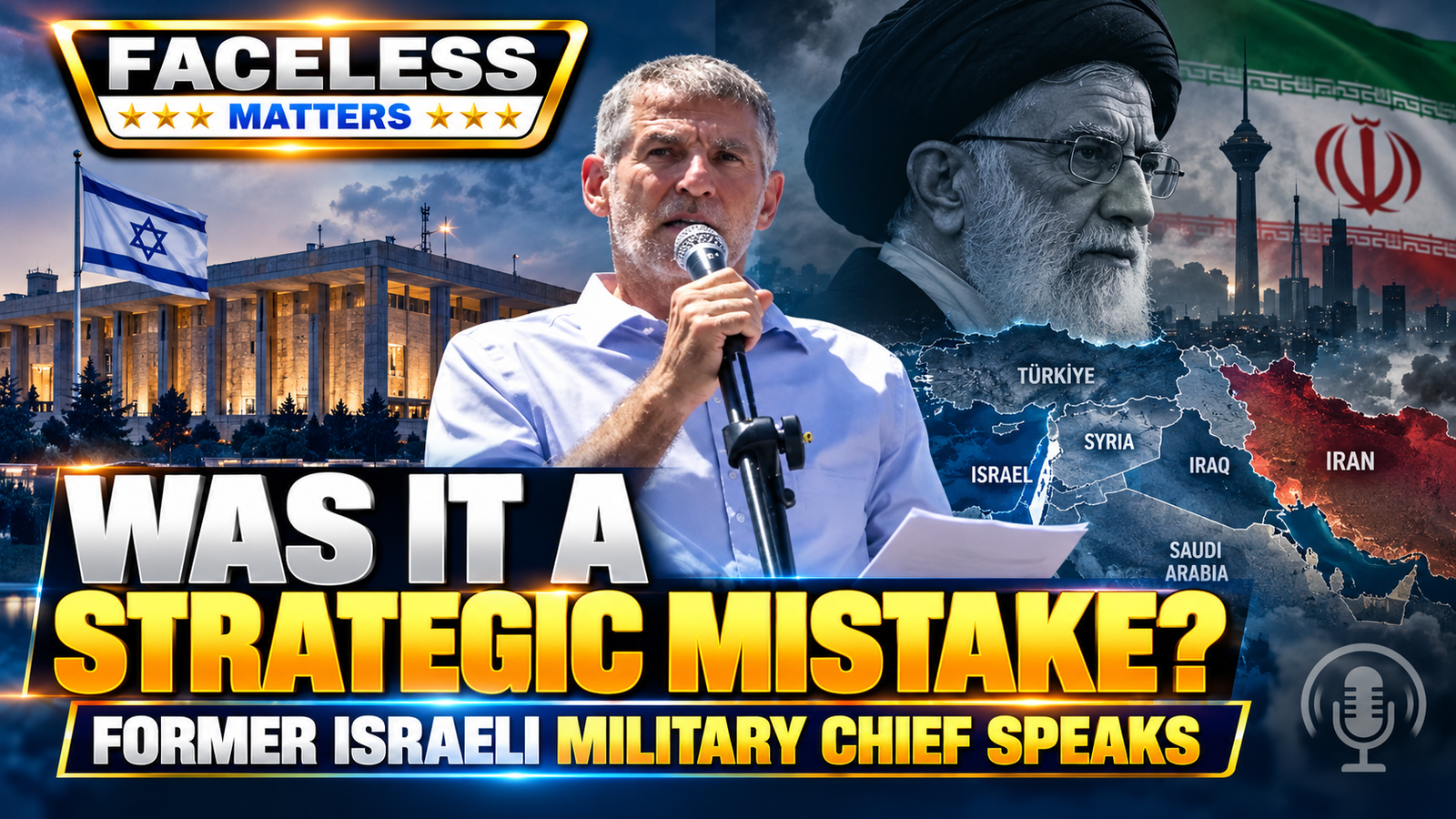
FACELESS MATTERS | International Affairs & Defence | 10 October 2026

Key Takeaways
- Yair Golan, a former deputy chief of staff of the Israel Defense Forces (IDF) and leader of Israel’s Democrats party, has criticised the killing of Iran’s former Supreme Leader Ali Khamenei.
- Golan argued that removing Khamenei did not serve Israel’s strategic interests and may have left more hardline figures influential within Iran’s leadership.
- He also criticised Prime Minister Benjamin Netanyahu’s stated objective of changing Iran’s political system, describing the goal as unrealistic and unsuccessful.
- His remarks represent the assessment of an Israeli opposition politician. They do not, on their own, establish the full military or political consequences of the operation.
- The debate raises a broader strategic question: can the removal of a senior leader produce the political outcome a government intends, or can succession and institutional continuity limit its effects?
TABLE OF CONTENTS
What Did Yair Golan Say About the Khamenei Killing?
Yair Golan has said that killing Iran’s former Supreme Leader Ali Khamenei was a mistake because, in his assessment, the Khamenei killing did not serve Israel’s national interests. His comments, reported by Daily Jang on 10 October 2026, have also been covered by Israeli news organisations, including i24NEWS and The Times of Israel.
Golan’s argument centres on the strategic consequences of removing a long-serving leader. He suggested that Khamenei’s death did not weaken the Iranian system in the way Israel’s leadership may have expected. Instead, he argued, it left a political and security environment in which more hardline figures could exercise influence.
The distinction is important. Golan was not simply commenting on the military operation that killed Khamenei. He was questioning whether the Khamenei killing advanced Israel’s broader political and security objectives.
In strategic terms, the effectiveness of a military operation cannot be measured solely by whether it achieves its immediate target. Governments must also consider the political arrangements that follow, the response of the targeted state and whether the operation improves the security environment over time.
Golan’s assessment is therefore part of a wider debate about the relationship between military success and long-term political outcomes.
Who Is Yair Golan?
Yair Golan is a former senior Israeli military officer who served as deputy chief of staff of the Israel Defense Forces. He subsequently entered politics and became leader of Israel’s Democrats party, an opposition political organisation.
His military background gives his comments a connection to Israel’s defence establishment, but his current statements should be understood in their political context. He is speaking as an opposition leader evaluating government policy, not issuing an official assessment on behalf of the Israeli military.
That distinction matters when interpreting criticism of a government’s wartime decisions. Former military officers can bring professional experience to public debate, but their opinions do not automatically represent the views of serving commanders, intelligence agencies or the wider defence establishment.
Golan’s comments are relevant because they challenge the strategic assumptions behind the Khamenei killing. They are not proof that every part of the Israeli military or political establishment shares his interpretation.
For readers, the most useful approach is to assess the argument itself: what objective was intended, what outcome was achieved, what consequences followed and what evidence supports each conclusion?
Why Did Golan Call the Operation a Strategic Mistake?
Golan’s central argument is that removing Khamenei did not necessarily advance Israel’s interests. He suggested that an established leader with decades in power could be more predictable than a successor or a leadership structure dominated by more hardline figures.
This is a strategic interpretation rather than a universally established rule. Long-serving leaders can be difficult adversaries, and their removal can create opportunities for political change. However, it can also produce continuity, internal consolidation or a succession that does not align with the attacking state’s expectations.
Three questions help explain Golan’s reasoning.
1. Did the operation produce the intended political result?
A military operation may achieve its immediate objective without achieving a broader political objective. If the intended outcome includes weakening a government, changing its behaviour or altering its political system, the death of a senior leader is only one part of the assessment.
Golan argued that Israel did not achieve the wider objective of overthrowing Iran’s political system. That is his assessment of the campaign, not an independently established measurement of every military and diplomatic outcome.
Evaluating the claim requires examining the Khamenei killing’s stated objectives, the condition of Iran’s governing institutions, the decisions made by its successor leadership and any subsequent changes in Iran’s policies.
2. Did leadership removal strengthen hardliners?
Golan argued that removing Khamenei left more extreme and violent figures in influential positions. The underlying concern is that a leadership transition may not produce moderation or political flexibility.
The effect of leadership removal depends on several factors, including succession rules, the influence of security institutions, internal political competition and the ability of the state to maintain command structures.
A successor may preserve established policies, adopt a harder position or eventually pursue a different direction. None of those outcomes should be assumed solely from the identity of the person who replaces a leader.
The claim that more hardline figures gained influence therefore requires continued examination of observable decisions and credible reporting.
3. Was there a viable political plan for the period after the operation?
Golan also criticised the gap between military action and the political objectives pursued afterward. His comments suggest that an operation designed to change a strategic environment needs a credible plan for what follows.
Such planning can involve diplomatic initiatives, regional coordination, security arrangements and a realistic assessment of the targeted state’s political institutions.
Without an achievable political objective, a military operation may produce immediate disruption without delivering the longer-term result its supporters expected.
This is the central issue raised by Golan’s criticism: whether the Khamenei killing was connected to a realistic and sustainable strategy.
Khamenei’s Death and the Wider Israel-Iran Conflict
Ali Khamenei was killed on 28 February 2026 in an Israeli airstrike on his compound in Tehran, during the opening phase of the joint United States-Israeli offensive against Iran, according to contemporary reporting by i24NEWS.
His death became a major event in the conflict because he had held Iran’s highest leadership position for decades. The removal of a leader at that level can affect political authority, national security planning and the public presentation of a war.
However, the death of a senior leader does not automatically mean that the political system surrounding that person has collapsed. Institutions, security organisations, political networks and established procedures can continue functioning after a leadership transition.
The distinction between an individual leader and the state’s institutional structure is essential. A government may lose an influential figure while retaining the capacity to make decisions, mobilise resources and maintain its strategic priorities.
That possibility helps explain why Golan’s comments focus on the political consequences of the operation rather than only on its immediate military result.
The broader Israel-Iran conflict must also be evaluated across several dimensions: military capabilities, political continuity, diplomatic relationships, domestic responses and the potential for further escalation. No single event can independently settle all of these questions.
Did Israel Achieve Its Broader War Objectives?
Golan criticised Netanyahu’s objective of overthrowing Iran’s political system, describing it as unrealistic and arguing that it was not achieved. His statement raises a basic question in the evaluation of military campaigns: how should success be defined?
There are at least three distinct levels of assessment.
Tactical outcome: Did a particular operation strike its intended target or accomplish its immediate military task?
Operational outcome: Did the operation weaken relevant military capabilities, disrupt command structures or alter the opposing side’s ability to conduct operations?
Strategic outcome: Did the campaign produce a more favourable and sustainable political or security environment for the government that initiated it?
These levels are related but not interchangeable. A successful strike does not necessarily prove that a wider campaign has achieved its strategic objectives. Likewise, the survival of a political system does not, by itself, mean that no military objectives were achieved.
Golan’s criticism focuses primarily on the strategic level. He argues that the campaign did not deliver the political transformation Netanyahu sought and that Israel’s position may have worsened.
A comprehensive assessment would require evidence about the campaign’s declared objectives, military effects, political developments and longer-term security consequences. The comments of one opposition leader are an important part of that debate, but they cannot independently resolve it.
Could Removing a Leader Strengthen the System Around Him?
Leadership removal can create uncertainty, but its effects depend on the institutions that remain.
In some circumstances, a leadership transition may weaken coordination, create competition among political factions or open space for policy change. In others, established institutions can manage succession, maintain control and present the transition as a reason for national unity.
A government’s resilience may depend on its security apparatus, constitutional or political procedures, administrative capacity and the ability of senior officials to agree on the next steps.
These considerations are relevant to the Khamenei killing because they show why an operation against an individual cannot be treated as equivalent to the removal of an entire political system.
Golan’s argument is that the Khamenei killing may have strengthened harder-line elements rather than creating the outcome Israel wanted. Whether that assessment remains accurate over time will depend on the decisions of Iran’s leadership and the subsequent course of the conflict.
Observable evidence matters more than assumptions about what a successor will do. Statements, policy decisions, military actions and diplomatic behaviour can help establish whether the new leadership is continuing previous policies or pursuing a different approach.
What Does This Debate Mean for Israeli Security Policy?
Golan’s comments put the relationship between military force and political strategy at the centre of Israel’s domestic debate.
A government facing a serious security threat may consider military action necessary to disrupt hostile capabilities or reduce immediate risks. However, the justification for an operation and the assessment of its longer-term results are separate questions.
The first asks why the government decided to act. The second asks whether the action achieved its intended objectives and what consequences followed.
Golan’s criticism addresses the second question. He argues that the Khamenei killing did not serve Israel’s interests and that the broader campaign failed to achieve its stated political objective.
Other assessments could place different weight on the operation’s immediate military effects, the disruption of Iranian capabilities or the risks posed by Iran’s leadership. A responsible analysis should examine these arguments using evidence rather than assuming that a single political statement settles the matter.
For Israel, the longer-term policy questions include how to deter future threats, how to manage the consequences of military action and whether diplomatic arrangements can reduce the risk of renewed confrontation.
Those questions remain relevant regardless of whether observers agree with Golan’s assessment.
What Should Readers Watch Next?
Several developments could help clarify the strategic consequences discussed by Golan.
Iran’s leadership decisions: Public statements and policy actions can indicate whether the successor leadership is maintaining existing priorities or adopting a different approach.
Israel’s stated objectives: Further explanations from the Israeli government may clarify whether its priorities have shifted from regime change toward more limited security goals.
Military developments: Independently verified information about military capabilities and operational activity may help assess the immediate effects of the campaign.
Diplomatic engagement: Negotiations, regional initiatives and public proposals could indicate whether the parties are pursuing a political route to reduce tensions.
Domestic political debate in Israel: Statements from government officials, opposition figures and former military leaders may reveal competing assessments of the operation’s costs and results.
These indicators should be assessed individually. A single statement or military development is not sufficient to establish the overall strategic outcome of the conflict.
FACELESS MATTERS Analysis
Yair Golan’s criticism is significant because it questions whether the killing of a senior adversary can deliver the political and security benefits expected by the government that carried out the operation.
His argument rests on two related claims: that the removal of Khamenei did not serve Israel’s interests and that the broader campaign failed to achieve the objective of overthrowing Iran’s political system. These are his assessments and should remain attributed to him.
The wider strategic lesson is that military action and political outcomes must be evaluated separately. An operation may achieve an immediate objective while leaving the underlying institutions, security relationships and political priorities largely intact. Conversely, the long-term consequences of a leadership transition may take time to become visible.
The Khamenei killing therefore raises questions about the relationship between leadership removal, institutional resilience and the political objectives of military campaigns. Answering those questions requires evidence about what changed after the operation, not simply the fact that the operation occurred.
Golan’s former military role adds context to his criticism, but it does not make his conclusions definitive. His position as an opposition leader is also relevant because his comments form part of Israel’s domestic political debate over the government’s decisions and their consequences.
For FACELESS MATTERS, the key distinction is between a political assessment and a verified strategic outcome. Golan has publicly argued that the Khamenei killing was a mistake and did not serve Israel’s interests. Whether subsequent developments support that assessment must be judged through evidence, official decisions and the longer-term course of the conflict.
Conclusion
Yair Golan, a former deputy chief of staff of the Israel Defense Forces and leader of Israel’s Democrats party, has described the killing of Ali Khamenei as a strategic mistake because he believes it did not serve Israel’s interests. He has also criticised Netanyahu’s objective of overthrowing Iran’s political system, arguing that it was unrealistic and unsuccessful.
His comments highlight a central issue in military strategy: achieving an immediate operational objective does not automatically deliver a desired political outcome. Leadership removal can produce disruption, but the effects depend on succession, institutional continuity, subsequent policy decisions and the wider security environment.
The Khamenei killing should therefore be assessed through both its immediate military context and its longer-term political consequences. Golan’s criticism contributes to that assessment, but it is not conclusive proof that every aspect of the operation failed. Further evidence about Iran’s leadership, Israel’s security position and the course of diplomacy will be necessary to judge the operation’s lasting effects.

INTERNAL READING — FACELESS MATTERS
Iran Israel War 2026: Iran Claims Over 1,000 Israeli Soldiers Killed
Minab School Strike: UN Probe Questions the “Accident” Claim
IRAN U.S. SANCTIONS 2026: DANGEROUS REGIONAL RISKS
US Ships Move at Night Through Hormuz: Is Iran’s Military Pressure Changing American Operations?
Pakistan Oil Crisis: 5 Proven Lessons From the Iran War
Iran Submarine Video Fact Check 2026: Viral Footage Actually Shows Japan’s Raigei
Iran Says It Is Not at War With Saudi Arabia
Pakistan at a Critical Hour: What Regional War, Oil Shock and Political Protests Mean for the Nation
Delia Ramirez: 5 Powerful Warnings on Civilian Harm
SOURCES & EDITORIAL NOTE
Primary Report
Daily Jang — Seyyed Ali Khamenei’s Killing Was a Serious Mistake, Says Former Israeli Deputy Chief of Staff
Independent Reporting
i24NEWS — Killing Khamenei Was a ‘Mistake,’ Yair Golan Says
The Times of Israel — Yair Golan: It Was a ‘Mistake’ for Israel to Assassinate Ali Khamenei
The Jerusalem Post — Democrats Party Head Yair Golan Calls Khamenei Assassination a Mistake
Ynet News — Yair Golan Calls Khamenei Killing a Mistake, Says Iran War Left Israel Worse Off
Editorial Note
This report distinguishes Yair Golan’s political and strategic assessment from independently established facts. His claim that the killing of Ali Khamenei harmed Israel’s interests is attributed to him and is not presented as an uncontested conclusion. The article draws on Daily Jang’s original report and cross-checks the reported remarks against independent media coverage.
Prepared by FACELESS MATTERS using the sources linked above. The analysis reflects the reporting available at the time of publication. Further verified information or official responses may warrant an update.