

TABLE OF CONTENTS
The story of Field Marshal Syed Asim Munir does not begin with the highest military rank he would eventually hold. It begins much earlier, in Rawalpindi, where his family had settled, where his early education took place and where religious learning formed part of his documented background.
Episode 5 examined the formative years.
Episode 6 now reaches the first major professional turning point.
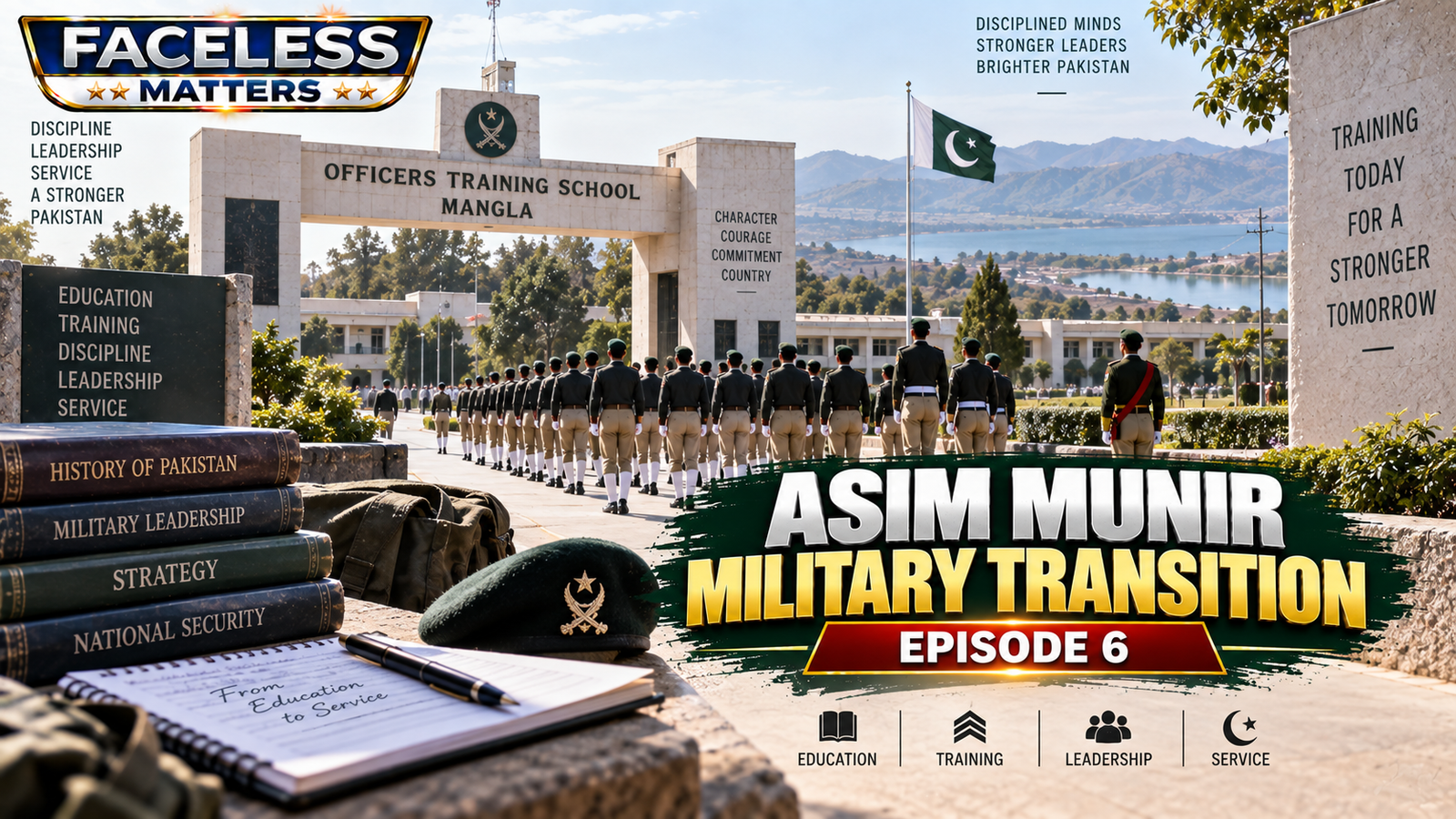
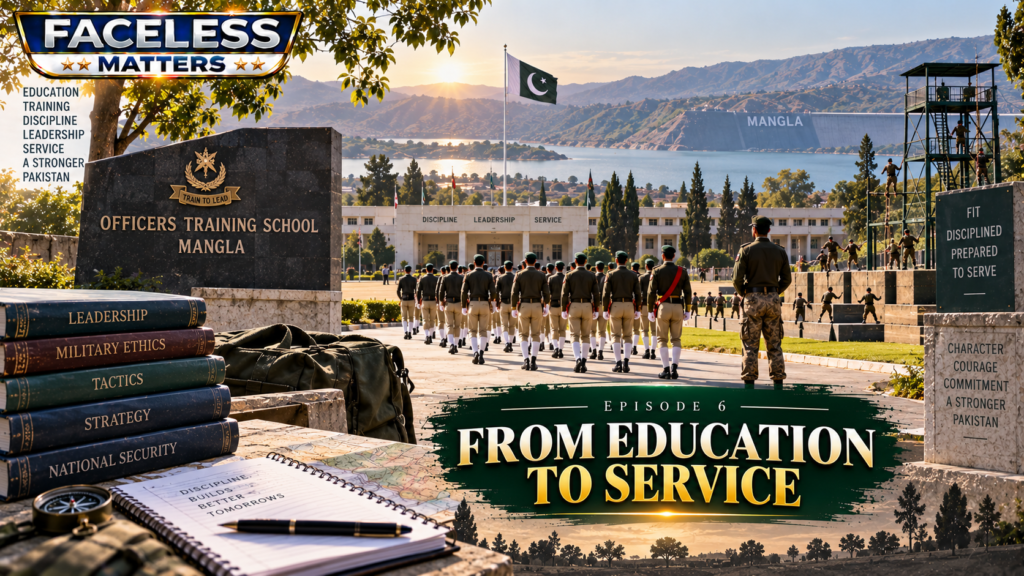
The available public record identifies 1986 as the decisive year. Asim Munir entered the Officers Training School at Mangla, completed the 17th OTS course, received the Sword of Honour and was commissioned into the 23 Frontier Force Regiment. The Government of Pakistan confirms this sequence in its official biographical record.
This episode examines that transition without inventing a private motivation that the sources do not establish.
There is no reliable public record showing a single childhood moment when the young Asim Munir formally announced a military ambition. What can be documented is more useful: a movement from education and formative development into a structured professional institution.
The Asim Munir military transition should therefore be understood as a documented institutional change rather than a dramatic story of destiny.
Before this point, the biography is primarily about family, education, religious learning, Rawalpindi and youth.
After this point, the central subjects become military training, professional performance, commissioning, regimental service and eventually command responsibility.
That change deserves its own chapter.
From Formative Years to Professional Service
The previous episode examined the environment in which the young Asim Munir developed.
The family background had already been established.
The Rawalpindi setting had been examined.
His father’s association with education and religious service had been documented.
His early religious education at Markazi Madrasa Dar-ul-Tajweed had been placed within the chronology.
The next question is what happened when this formative period gave way to professional life.
The answer is 1986.
The Government of Pakistan records that Munir was commissioned in April 1986 into the 23 Frontier Force Regiment and was a recipient of the Sword of Honour of the 17th OTS Course.
India Today independently reports that he entered service through the Officers Training School at Mangla in 1986 rather than through the Pakistan Military Academy and that he received the Sword of Honour as the best-performing cadet.
The Indian Express likewise reports that he graduated from the Officers Training School at Mangla in 1986 and was commissioned into the Frontier Force Regiment.
These sources establish the institutional milestone.
They do not establish every personal reason behind the decision.
That distinction is important.
A responsible biography should not convert an undocumented personal motivation into a historical fact.
The Asim Munir military transition is therefore examined through the evidence of training, performance and commissioning.
Why 1986 Matters
The year 1986 creates a clear boundary in the chronology.
Before 1986, the public record primarily concerns family, education and formative development.
After 1986, the record increasingly concerns professional military service.
That does not mean everything changed overnight.
A person’s earlier education, habits, values and social experiences do not disappear when a uniform is put on.
But the institution around the individual changes.
Military service introduces a formal hierarchy, professional standards, physical requirements, structured training and responsibilities that are different from those of ordinary educational life.
For a young officer, the institution also becomes a new environment for learning.
The individual is assessed not simply as a student but as someone being prepared to lead and serve within a military organization.
The Asim Munir military transition therefore represents a change in the framework through which his abilities would be developed and evaluated.
That is more historically useful than presenting 1986 as a magical moment when his entire future was already visible.
Officers Training School at Mangla
The Officers Training School at Mangla is central to Episode 6.
According to the Government of Pakistan, Munir was part of the 17th OTS Course. India Today also identifies Mangla as the institution through which he entered military service.
This detail matters because military biographies often compress commissioning into a single sentence.
A reader may see a date and a regiment without considering the training process that came before it.
But commissioning requires preparation.
An officer-training institution exists to develop individuals within a professional framework.
Training includes standards, assessment, discipline and preparation for responsibilities that extend beyond the classroom.
The OTS route therefore deserves to be treated as an important stage in its own right.
The Asim Munir military transition was not simply the moment he received a commission.
It was a process that culminated in commissioning after formal officer training.
This also explains why the Sword of Honour is relevant.
It provides an independent institutional marker of performance during that training stage.
The Sword of Honour
The Sword of Honour is one of the strongest documented details associated with Munir’s OTS period.
The Government of Pakistan confirms that he received the Sword of Honour of the 17th OTS Course. India Today describes him as the best-performing cadet and connects that achievement with the award.
The Asim Munir military transition keeps the history evidence-based.
However, the award should not be turned into a prophecy.
Receiving an honour at officer training does not prove that a cadet was destined to become Army Chief decades later.
It does not reveal every aspect of his personality.
It does not establish his private expectations about the future.
It does establish that his performance during the course received formal recognition.
That is enough.
Historical writing becomes stronger when an achievement is allowed to mean exactly what the evidence supports.
The Asim Munir military transition therefore includes a clear documented achievement, but the later career must still be examined separately.
From Cadet to Commissioned Officer
There is an important difference between being a cadet and being a commissioned officer.
A cadet is preparing for professional service.
A commissioned officer has entered that service.
The Government of Pakistan places Munir’s commissioning in April 1986 and identifies the 23 Frontier Force Regiment as his regiment.
Dawn’s 2022 profile likewise states that he entered service through the OTS programme at Mangla, completed the 17th Officers Training Course and was commissioned into the 23 Frontier Force Regiment in 1986.
This gives the biography a firm chronological marker.
The young man who had previously been described through family and education now had a professional military identity.
That identity would develop over the following decades through assignments, further education, staff responsibilities and command.
But those later stages belong to later episodes.
Episode 6 is concerned with the bridge.
The Asim Munir military transition marks the point where the biography moves decisively from formative history into professional military history.
Religious Education and Military Service
Earlier episodes established that religious education was part of Munir’s background.
That fact is well documented.
India Today reports that he studied at Markazi Madrasa Dar-ul-Tajweed in Rawalpindi. The Indian Express also reports the same early educational institution.
The existence of that background does not, however, provide a simple explanation for his later military career.
A responsible biography should distinguish between sequence and causation.
One event can precede another without directly causing it.
The available sources do not provide a verified personal statement saying that religious education led directly to military service.
Nor do they provide enough evidence to reconstruct the private decision-making process of a young man in the mid-1980s.
The Asim Munir military transition can therefore be described without claiming an unsupported psychological connection between religious learning and professional choice.
This distinction keeps the Asim Munir military transition evidence-based.
The historical record is interesting enough without embellishment.
Pakistan’s Institutional Context in 1986
Munir entered military service in 1986, during the rule of General Muhammad Zia-ul-Haq.
The Indian Express places his OTS graduation within this wider historical period and discusses the relationship between military institutions and the religious environment of the time.
That context is relevant.
But it must be handled carefully.
A country’s political environment can shape its institutions without automatically determining an individual’s personal choices.
The fact that Munir entered the military during Zia’s rule does not establish why he chose the profession.
It does help explain the institutional environment in which his early professional career began.
This is an important distinction for the biography.
The wider historical setting provides context.
The individual career provides the specific chronology.
The two should be connected without being confused.
The Asim Munir military transition occurred within a particular national and institutional period, but the evidence does not justify reducing the decision to a single political cause.
What the Public Record Establishes
By the end of the OTS period, several facts are firmly supported.
Munir was born in Rawalpindi in 1968.
He received early religious education in Rawalpindi.
He later entered the Officers Training School at Mangla.
He belonged to the 17th OTS Course.
He received the Sword of Honour.
He was commissioned in April 1986.
His commissioning was into the 23 Frontier Force Regiment.
These facts are supported by the Government of Pakistan and independent reporting.
Together, they establish the basic chronology.
What remains less certain is the private motivation behind the choice.
The public sources do not provide a complete first-person account of when he decided to pursue military service.
They do not document every conversation he may have had with his family.
They do not provide a private diary describing his expectations before OTS.
Those gaps should remain visible.
A biography becomes more trustworthy when it recognizes what cannot be established.
What We Should Not Assume
There are several conclusions that this episode deliberately avoids.
It does not claim that his father ordered him to join the Army.
It does not claim that religious education automatically produced military ambition.
It does not claim that playing cricket directly prepared him for command.
It does not claim that Rawalpindi made military service inevitable.
It does not claim that the Sword of Honour predicted his eventual rise to the highest military office.
None of those conclusions is established by the sources reviewed for this episode.
What is established is simpler and stronger.
A young man with an educational and religious background entered the Officers Training School.
He completed the 17th OTS course.
He received formal recognition for his performance.
He was commissioned into the 23 Frontier Force Regiment.
That sequence is sufficient to mark the transition.
Why the OTS Route Matters
The OTS route is more than a footnote.
India Today specifically notes that Munir entered service through the Officers Training School at Mangla rather than the Pakistan Military Academy.
Dawn also identifies him as a graduate of the 17th OTS programme and notes that he was commissioned into the 23 Frontier Force Regiment.
This distinction gives the beginning of his military career a specific institutional identity.
The biography should therefore avoid using generic language such as “he joined the military academy” when the documented route was OTS.
Precision matters.
Small institutional details can make a major difference to the credibility of a long-form biography.
The Asim Munir military transition should preserve that precision because the OTS route is one of the clearest documented features of his entry into commissioned service.
A New Professional Identity
When Munir completed his training and received his commission, the meaning of his daily responsibilities changed.
The young person previously described through family, education and community was now a professional officer.
Military service created a new set of expectations.
There were duties to perform, standards to maintain and institutional responsibilities to accept.
The regiment became the next major professional environment.
This does not erase the earlier stages of his life.
Instead, it places them in a new chronological position.
The family background remains relevant.
The Rawalpindi environment remains part of the story.
Religious education remains part of the documented biography.
But the professional framework has changed.
The Asim Munir military transition is therefore best understood as the beginning of a new institutional identity rather than the end of his earlier identity.
Commissioning Did Not Guarantee Senior Leadership
The Asim Munir military transition needs evidence, not hindsight.
Readers already know that Munir eventually reached the highest levels of Pakistan’s military establishment.
That knowledge can make early achievements appear inevitable.
They were not.
Commissioning in 1986 was an important professional milestone, but it did not guarantee senior command decades later.
The Pakistan Army was and remains a large institution with many officers.
Career progression depends on performance, assignments, institutional decisions, professional education, leadership responsibilities and historical circumstances.
Therefore, the later Field Marshal should not be projected backward onto the young officer.
At the time of commissioning, what the public record establishes is that he had completed OTS, received the Sword of Honour and joined the Frontier Force Regiment.
That is already a significant story.
The decades that followed must be examined on their own evidence.
From the 23 Frontier Force Regiment to the Next Stage
The Government of Pakistan identifies the 23 Frontier Force Regiment as Munir’s commissioning regiment and later records that he commanded his parent unit.
Dawn’s profile similarly identifies the regiment as the beginning of his commissioned service.
This creates the natural endpoint for Episode 6.
The transition has taken place.
The training institution has been completed.
The commission has been granted.
The regiment has become the professional home of the young officer.
The next episode can therefore examine what happened after commissioning: the early regimental years, responsibilities of a junior officer, professional development and the first stages of a career that would eventually expand far beyond a single regiment.
The Asim Munir military transition is complete as a historical stage.
What follows is career development.
FACELESS MATTERS Analysis: Why Transition Matters
The most useful lesson from this episode is that professional careers are built through transitions rather than single dramatic moments.
A person moves from one institution to another.
Training replaces ordinary education.
Assessment becomes professional evaluation.
Responsibilities expand.
Experience accumulates.
Opportunities appear.
The public record rarely captures every private thought behind these changes.
That does not make the history impossible to understand.
The Asim Munir military transition should follow evidence.
In Munir’s case, the evidence provides a clear sequence.
Early education was followed by officer training.
Officer training was followed by commissioning.
Commissioning was followed by regimental service.
The Sword of Honour provides a documented marker of notable performance during the training stage.
The 23 Frontier Force Regiment provides the institutional starting point for his commissioned career.
That sequence is more valuable than an invented story about destiny.
Why Episode 6 Matters to the 100-Episode Biography
The structure of the series now has a clear turning point.
Episode 1 established the family and early formation.
Episode 2 examined migration and settlement.
Episode 3 examined the childhood environment.
Episode 4 examined Syed Sarwar Munir and the family background.
Episode 5 examined the formative years.
Episode 6 establishes the move into professional military service.
This chronological structure is deliberate.
It prevents the biography from jumping directly from childhood to national leadership.
Instead, it allows readers to see the intermediate stages.
That makes the story more useful for readers interested in Pakistan’s military history, leadership development and institutional history.
The Asim Munir military transition is therefore not merely another date in a long career.
It is the structural hinge between the first family-and-education chapters and the later professional chapters.
Before this stage, the central themes are family, education, religion, community and environment.
After it, the central themes become military professionalism, service, responsibility and career development.
That is why Episode 6 deserves a separate treatment.
Conclusion: From Education Toward Service
The move into military training was the decisive early professional turning point in Asim Munir’s documented biography.
The Government of Pakistan confirms that he was commissioned in April 1986 into the 23 Frontier Force Regiment and received the Sword of Honour of the 17th OTS Course.
India Today and The Indian Express independently confirm the OTS route at Mangla and the 1986 commissioning.
These facts establish a clear transition.
They do not establish every private reason behind the decision.
They do not prove that military leadership was predetermined.
They do not transform the formative years into a prophecy.
They show a young man moving from education and personal development into a structured professional institution.
The Asim Munir military transition is therefore best understood as a documented change in environment, responsibility and professional identity.
The next chapter can now examine the early regimental years and the responsibilities of a newly commissioned officer.
That is where the professional military biography truly begins.
Source Verification & Analysis
The principal claims in this episode were cross-checked against official Government of Pakistan material and established biographical reporting.
- Government of Pakistan, Press Information Department — The official profile confirms that Syed Asim Munir was commissioned in April 1986 into the 23 Frontier Force Regiment and was a recipient of the Sword of Honour of the 17th OTS Course. It also records his later professional military education and major appointments.
- India Today — Biographical reporting provides information on Asim Munir’s birth in Rawalpindi, his family’s reported Jalandhar roots, his father Syed Sarwar Munir’s role as a schoolteacher and imam, his early education at Markazi Madrasa Dar-ul-Tajweed, and his later religious education.
- Dawn E-Paper — The November 25, 2022 profile confirms that Munir entered military service through the Officers Training School programme at Mangla, completed the 17th Officers Training Course, was commissioned into the 23 Frontier Force Regiment in 1986, and received the Sword of Honour. It also records his later professional military education and appointments.
The episode deliberately avoids presenting unsupported private motivations or uncertain personal details as established facts. Where the public record does not provide sufficient evidence, the article does not add speculative detail.for joining the military because the reviewed public sources do not establish one.
Fresh News Link
For current institutional context, Radio Pakistan reported on September 5, 2026 that Field Marshal Syed Asim Munir, serving as Chief of Army Staff and Chief of Defence Forces, visited Quetta Garrison and received briefings on the security environment, operational preparedness, institutional coordination and development-related stability in Balochistan.
This current report is contextual only; it is not evidence about Munir’s personal decision to enter military service in 1986.
INTERNAL READING — FACELESS MATTERS
The opening episode establishes the documented family roots, Rawalpindi background and early educational environment that preceded Asim Munir’s military career.
The second episode examines the reported family migration from Jalandhar through Partition-era Pakistan and the eventual settlement in Rawalpindi.
The third episode examines Dheri Hassanabad, the family environment, Rawalpindi and the early education associated with Asim Munir’s childhood.
Suggested Future Internal Articles
Episode 7 — Asim Munir Early Military Career: The First Regimental Chapter
Focus: the early commissioned years in the 23 Frontier Force Regiment and the professional responsibilities that followed.
Episode 8 — Asim Munir Command Development: Building a Professional Military Career
Focus: the documented progression from early regimental responsibilities toward later command and staff assignments.
Episode 9 — Asim Munir Military Education: From Fuji School to Strategic Studies
Focus: the professional education that later included Japan, Quetta, Malaysia and the National Defence University.
[…] Asim Munir Military Transition — Episode 6: From Education Toward Servicehttps://facelessmatters.com/asim-munir-military-transition-episode-6/ […]
[…] Asim Munir Military Transition — Episode 6: From Education Toward Servicehttps://facelessmatters.com/asim-munir-military-transition-episode-6/ […]
[…] Asim Munir Military Transition — Episode 6: From Education Toward Service […]
[…] Asim Munir Military Transition — Episode 6: Powerful Path to Service […]