

August 31, 2026 | Istanbul
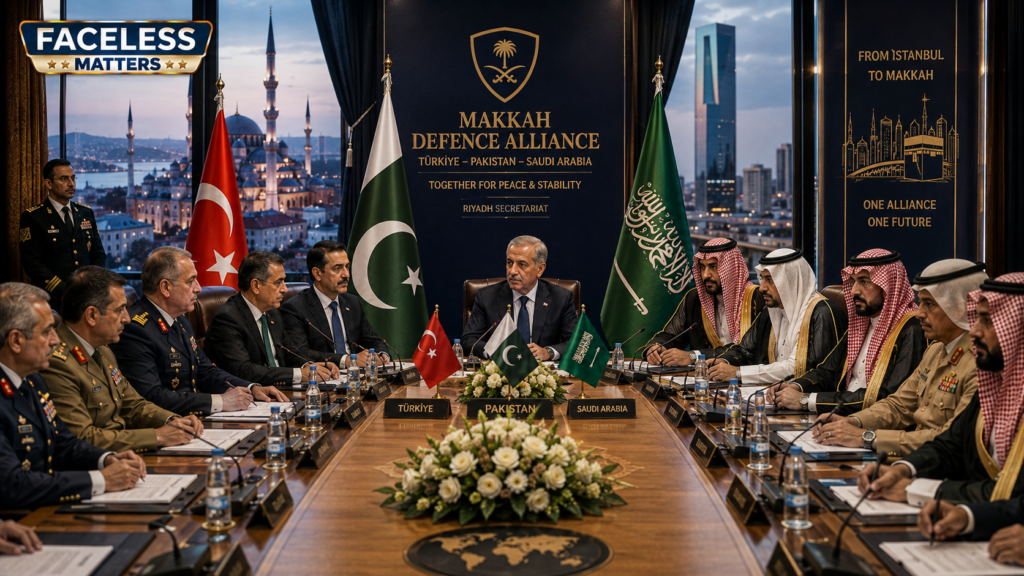
TABLE OF CONTENTS
The trilateral defence framework created by Pakistan, Türkiye and Saudi Arabia has entered a new institutional phase.
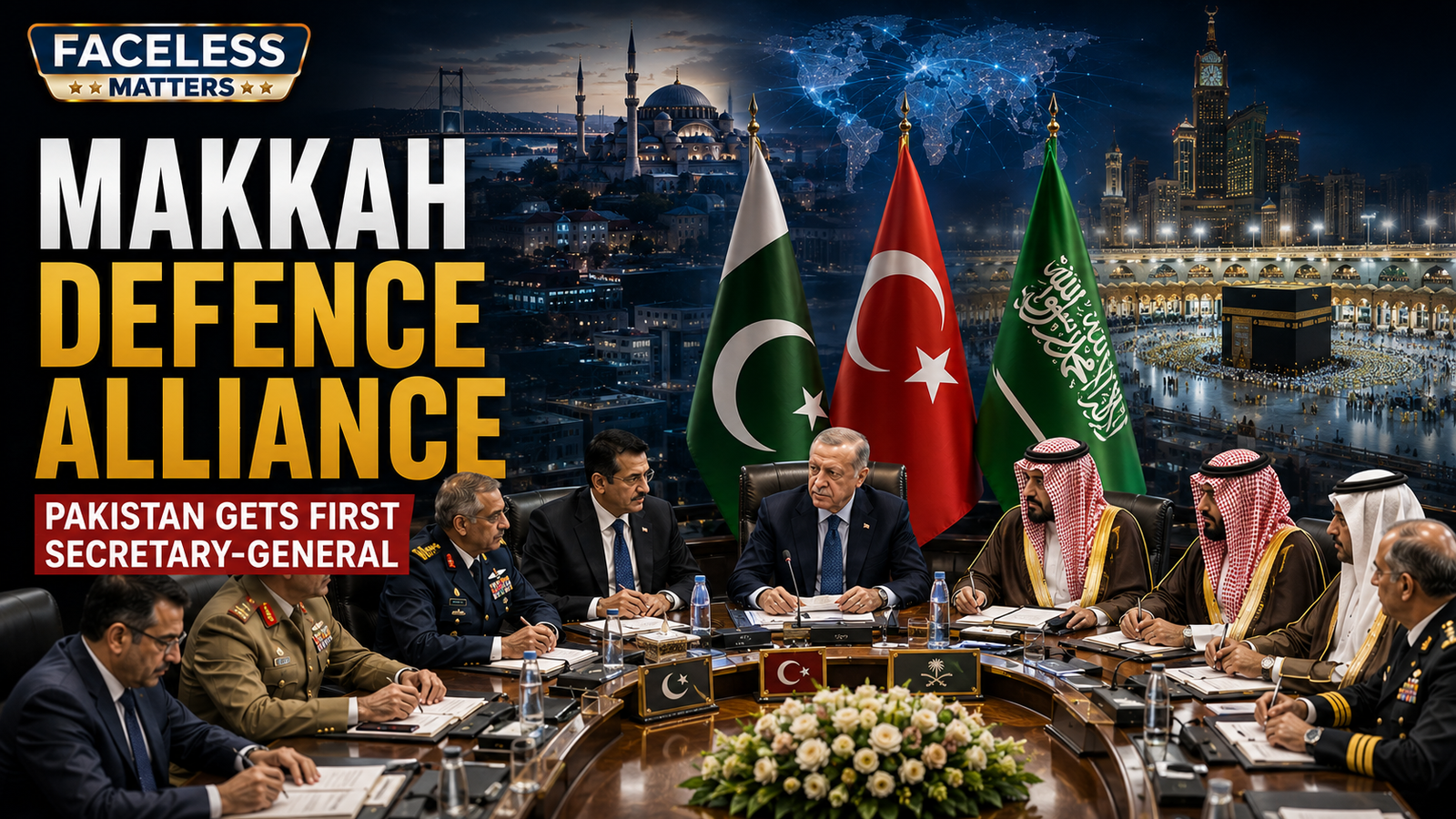
Following the first meeting of the Strategic Political and Defence Committee in Istanbul, Turkish Foreign Minister Hakan Fidan announced that the three-country arrangement will officially be known as the Makkah Defence Alliance, while its secretariat will be established in Riyadh and its first secretary-general will come from Pakistan.
The announcement is significant because it moves the relationship beyond the language of a newly signed defence agreement and toward a functioning political, military and institutional framework.
For FACELESS MATTERS, the most important question is therefore no longer simply what the three countries agreed to on paper.
The real question is how effectively Pakistan, Türkiye and Saudi Arabia can convert that agreement into a durable strategic institution.
Makkah Defence Alliance Becomes a Strategic Institution
The original Makkah Joint Defence Agreement was signed on August 7 by Pakistan, Türkiye and Saudi Arabia.
Its collective-defence principle states that an armed attack against one member would be regarded as an attack against all three. The agreement was presented as a framework for strengthening collective security, deterrence and regional stability.
The Istanbul meeting represents the next stage.
Instead of remaining a political declaration, the arrangement is now beginning to acquire the infrastructure normally required for sustained strategic cooperation: a name, a secretariat, political mechanisms, defence coordination and a roadmap for implementation.
That institutional shift is the central development.
A treaty can create an obligation.
An institution creates the machinery required to fulfil it.
Why the Makkah Defence Alliance Name Matters
The decision to formally use the name Makkah Defence Alliance carries political significance.
Makkah is not simply the location where the original agreement was signed. It provides the alliance with a distinctive regional identity while avoiding the appearance that the framework is merely an extension of an existing Western security architecture.
Fidan emphasized that the alliance is based on defence, international law, sovereignty, territorial integrity and non-interference in domestic affairs. He also stressed that it is not directed against any particular state.
That language is strategically important.
It allows the three governments to present the alliance as a defensive and regional-security mechanism, rather than as an openly confrontational bloc.
This distinction could become particularly important as the security environment across West Asia remains highly unstable.
Pakistan’s Makkah Defence Alliance Role Is the Bigger Story
The most consequential announcement for Islamabad is that the alliance’s first secretary-general will be appointed from Pakistan.
The secretariat is planned for Riyadh, but Pakistan will provide the first individual to occupy the alliance’s top administrative position.
This gives Pakistan an important institutional opportunity.
The secretary-general will potentially sit at the centre of coordination among the three member states, helping translate political decisions into administrative processes, strategic consultations and future programmes.
For Pakistan, that is more than diplomatic symbolism.
It creates an opportunity to shape the alliance’s early institutional culture.
The first leadership team of any international organization often has disproportionate influence because it establishes procedures, priorities, coordination mechanisms and expectations for future members.
If Islamabad uses that position effectively, Pakistan could gain influence that extends beyond its conventional bilateral defence relationships with Ankara and Riyadh.
FACELESS MATTERS Analysis: Why the Makkah Defence Alliance Matters
The institutional design itself is revealing.
The secretariat will be based in Riyadh, while the first secretary-general will come from Pakistan.
This creates a deliberate balance between Saudi Arabia’s financial, geographic and diplomatic weight and Pakistan’s military and strategic experience.
Türkiye brings another major component: a large military establishment, NATO experience, growing defence-industry capabilities and an increasingly sophisticated domestic defence-production ecosystem.
The three countries therefore bring different strengths to the table.
Saudi Arabia contributes financial capacity, regional influence, strategic geography and investment power.
Pakistan contributes extensive military experience, a large professional armed force and a long-standing defence relationship with Saudi Arabia.
Türkiye contributes advanced defence technology, military-industrial capabilities, NATO experience and growing expertise in unmanned systems and defence production.
The alliance’s real value will depend on whether these complementary assets can be integrated into practical cooperation.
The Defence Industry Could Become the Economic Engine
One of the most commercially important dimensions is defence-industrial cooperation.
Türkiye has increasingly developed indigenous capabilities across drones, electronic warfare, naval platforms, aerospace systems and other defence technologies. Pakistan has its own established defence-production base and military-industrial experience, while Saudi Arabia has been pursuing defence localization and domestic industrial development.
That creates a potentially valuable three-way economic relationship.
Future cooperation could involve:
- Defence technology partnerships
- Joint research and development
- Military production
- Unmanned systems
- Electronic warfare
- Training and exercises
- Maintenance and logistics
- Defence procurement
- Technology transfer
- Industrial localization
Türkiye’s defence ministry has previously outlined plans for joint exercises involving land, naval and air forces as well as deeper defence-industry cooperation under the pact.
This is where the alliance could become economically significant.
If cooperation remains limited to diplomatic meetings, its strategic impact will be modest.
If the three countries develop joint production, technology-sharing and long-term procurement programmes, the economic and security implications become considerably larger.
Collective Defence Is Powerful — But Implementation Is Everything
The collective-defence principle is politically powerful.
But the existence of a clause does not automatically create military interoperability.
The three countries would still need to determine how consultations occur, who initiates emergency meetings, how intelligence is shared, how military commands coordinate and what practical support can be provided during a crisis.
This is the point where the Makkah Defence Alliance will face its first serious institutional test.
A credible security alliance requires more than political statements.
It needs:
- Clear decision-making procedures
- Secure communication channels
- Intelligence-sharing mechanisms
- Military interoperability
- Joint exercises
- Logistics coordination
- Defence-industrial cooperation
- Crisis-response procedures
- Regular political consultations
- Sustainable funding and institutional staffing
The Istanbul meeting appears to be the beginning of that process rather than its conclusion. Türkiye’s foreign ministry confirmed that the first committee meeting involved the country’s foreign and defence ministers and chief of general staff alongside their Pakistani and Saudi counterparts.
Is This a Middle Eastern NATO?
That comparison will inevitably appear.
The collective-defence principle has already drawn comparisons with NATO’s Article 5 because an armed attack against one member is treated as an attack against all.
But the comparison should not be overstated.
The three-country framework is much younger, its institutional architecture is still being built, and the precise military obligations remain less developed than those of NATO.
Calling it a “Middle Eastern NATO” may therefore create expectations that the current structure cannot yet support.
A more accurate description is a new trilateral collective-security framework that is moving toward institutionalization.
That distinction matters.
The alliance should be judged by what it actually builds rather than by the most dramatic comparison attached to it.
Why Türkiye Is Important
Türkiye’s role gives the alliance a distinctive strategic dimension.
Ankara is already part of NATO and possesses decades of experience operating within a multinational military structure.
Its defence industry has also expanded rapidly, creating capabilities that could become valuable to both Pakistan and Saudi Arabia.
For Pakistan, closer defence-industrial cooperation with Türkiye could potentially support technology development and modernization.
For Saudi Arabia, Turkish defence products and industrial partnerships could complement its ambitions for greater domestic defence production.
For Türkiye, deeper relations with Pakistan and Saudi Arabia create additional strategic and commercial opportunities.
The arrangement therefore contains both security logic and economic logic.
That combination could help sustain the alliance over time.
Why Saudi Arabia Is Equally Important
Saudi Arabia provides something neither Pakistan nor Türkiye can easily replicate: enormous financial capacity combined with strategic geographic importance.
Riyadh’s position also makes the choice of the Saudi capital for the secretariat meaningful.
The kingdom is seeking greater strategic autonomy while simultaneously maintaining relationships with major global powers.
A trilateral framework involving Pakistan and Türkiye gives Riyadh another regional instrument for defence cooperation without necessarily replacing its other partnerships.
Fidan has emphasized that the alliance is complementary to existing alliances rather than designed to replace them.
That could be crucial to its international acceptability.
The Expansion Question
Another major development is that the framework may not necessarily remain limited to three countries.
Turkish officials have indicated that a roadmap is being considered for additional countries to join the defence pact.
Expansion, however, could become both an opportunity and a complication.
More members could increase military capabilities, financial resources and diplomatic reach.
But more members could also make decision-making harder.
Every additional country introduces different foreign-policy priorities, threat perceptions and existing alliances.
The alliance’s first challenge may therefore be to establish a strong internal model before attempting rapid expansion.
The Real Strategic Test for Pakistan
For Pakistan, the opportunity is significant — but so is the responsibility.
Providing the first secretary-general gives Islamabad an important role in shaping the organization’s administrative identity.
Pakistan will need to demonstrate that its representative can operate as an institutional coordinator rather than simply as a national delegate.
That distinction will matter.
A successful secretary-general would need to balance the priorities of Riyadh and Ankara while maintaining confidence in Islamabad’s neutrality within the alliance’s internal decision-making.
If Pakistan succeeds, the position could strengthen its diplomatic relevance across the wider Muslim world and create another platform for strategic engagement.
If the institution becomes dominated by bilateral interests, however, its effectiveness could be limited.
What the Istanbul Meeting Really Changes
The most important change is not simply the announcement of a new name.
The Istanbul meeting signals that the three governments are attempting to transform political commitment into institutional capacity.
That means the coming months will be more important than the ceremony surrounding the original agreement.
The real indicators to watch are:
- Who becomes Pakistan’s first secretary-general?
- How will the Riyadh secretariat be structured?
- What military exercises will be conducted?
- Will joint defence production actually begin?
- How will intelligence cooperation develop?
- Will additional countries be invited?
- What crisis-response mechanisms will be created?
- How will the alliance coordinate with NATO and other existing security partnerships?
These answers will determine whether the alliance becomes a lasting regional institution or remains primarily a diplomatic framework.
FACELESS MATTERS Strategic Outlook
The trilateral defence framework enters its next phase with three clear advantages.
First, its members possess substantial military, financial and technological resources.
Second, all three governments have a strong interest in increasing regional security cooperation.
Third, the alliance is being institutionalized rather than left as a one-time political agreement.
But there are also serious challenges.
Different strategic priorities could eventually emerge.
Pakistan will have to balance its relationships with China, the Gulf states, Türkiye and the wider international system.
Türkiye must manage its NATO commitments alongside its regional partnerships.
Saudi Arabia must maintain strategic flexibility while developing greater regional defence autonomy.
The alliance’s success will therefore depend on strategic coordination rather than political enthusiasm alone.
A New Security Architecture Is Taking Shape
The announcement from Istanbul is best understood as the beginning of a new phase.
The original agreement created the commitment.
The Istanbul meeting began building the institution.
Riyadh will host the secretariat.
Pakistan will provide the first secretary-general.
Türkiye brings defence technology and military-industrial capacity.
Saudi Arabia brings financial strength and regional influence.
Pakistan brings military experience and strategic depth.
If these capabilities can be organized into a coherent framework, the alliance could become an important component of the emerging regional security architecture.
But the final judgment should be based on implementation.
The name has now been announced. The institution is being built. The real test begins next.
INTERNAL LINKS
- Makkah Joint Defence Agreement: Istanbul Meeting Tests a New Trilateral Security Framework — FACELESS MATTERS’ earlier analysis examines the first Strategic Political and Defence Committee meeting and explains how the three countries are attempting to convert the original agreement into practical defence cooperation. Read the FACELESS MATTERS analysis
- US South Korea Military Drills 2026: Security Risks — This FACELESS MATTERS defence analysis provides wider context on military readiness, alliance coordination, joint exercises and the strategic importance of interoperability in modern security partnerships. Read the defence analysis
TRUSTED EXTERNAL SOURCES
The development has been independently reported by multiple established outlets and official sources:
- Reuters coverage via Dawn — confirms the new official name, Riyadh secretariat and Pakistani first secretary-general.
- — confirms the first Strategic Political and Defence Committee meeting in Istanbul.
- Associated Press coverage — provides context on the defensive character and collective-defence principle of the agreement.
SOURCE VERIFICATION & FACELESS MATTERS ANALYSIS
The immediate development in this report is based on the August 31, 2026 announcement by Turkish Foreign Minister Hakan Fidan, corroborated by Pakistan’s official broadcaster, Dawn/Reuters, Al Jazeera and Türkiye’s Foreign Ministry. The sources confirm that the trilateral framework will be known as the Makkah Defence Alliance, that its secretariat is being established in Riyadh, and that its first secretary-general will come from Pakistan.
The strategic conclusions in this article are FACELESS MATTERS analysis, not claims that future military, economic or diplomatic developments are already confirmed.
FACELESS MATTERS — Independent News, Analysis & Digital Media
For editorial questions, corrections, source concerns or legitimate inquiries:
info@facelessmatters.com
This article is provided for informational, educational and analytical purposes. FACELESS MATTERS distinguishes verified reporting from strategic interpretation and does not present future developments as established facts.
Follow FACELESS MATTERS for independent news, geopolitical analysis, defence developments and global affairs.
[…] Makkah Defence Alliance: 5 Essential Facts for Pakistanمشرقِ وسطیٰ اور پاکستان کے وسیع تر دفاعی و جغرافیائی تناظر کو سمجھنے کے لیے متعلقہ تازہ تجزیہ۔ […]
[…] Makkah Defence Alliance: 5 Essential Facts for Pakistan — Explore our analysis of Pakistan’s evolving defence cooperation with Türkiye and Saudi Arabia and understand how new regional security frameworks may reshape Pakistan’s strategic partnerships. Read the FACELESS MATTERS analysis […]
[…] Makkah Defence Alliance: 5 Essential Facts for Pakistan — Explore FACELESS MATTERS’ analysis of Pakistan’s evolving regional defence partnerships and their wider strategic implications. […]
[…] 1. Makkah Defence Alliance: 5 Essential Facts for Pakistan — A recent FACELESS MATTERS analysis examining Pakistan, Türkiye and Saudi Arabia’s emerging security framework and the changing regional security architecture.Makkah Defence Alliance: 5 Essential Facts for Pakistan […]
[…] 1. Makkah Defence Alliance: 5 Essential Facts for Pakistan — A recent FACELESS MATTERS analysis of Pakistan, Türkiye and Saudi Arabia’s emerging strategic framework, useful for understanding how geopolitical partnerships can also create wider economic and investment implications.Makkah Defence Alliance: 5 Essential Facts for Pakistan […]
[…] 1. Makkah Defence Alliance: 5 Essential Facts for Pakistan […]
[…] Makkah Defence Alliance: 5 Essential Facts for Pakistan — A recent FACELESS MATTERS analysis of Pakistan, Türkiye and Saudi Arabia’s emerging collective-defence framework, directly relevant to the changing regional security architecture. Read the Makkah Defence Alliance analysis […]
[…] Makkah Defence Alliance: 5 Essential Facts for Pakistan — Relevant to Pakistan’s expanding regional defense partnerships, collective security architecture and defense-industry cooperation. […]
[…] 1. Makkah Defence Alliance: 5 Essential Facts for Pakistan […]
[…] Makkah Defence Alliance: 5 Remarkable Gains for Pakistan […]
[…] Makkah Defence Alliance: 5 Essential Facts for Pakistanپاکستان اور خلیجی خطے کی بدلتی دفاعی و strategic alignment کو سمجھنے کے لیے اہم context۔ […]
[…] Makkah Defence Alliance: 5 Essential Facts for Pakistan […]
[…] Makkah Defence Alliance: 5 Essential Facts for Pakistan — Relevant to the changing Middle Eastern security environment and regional strategic calculations. […]